

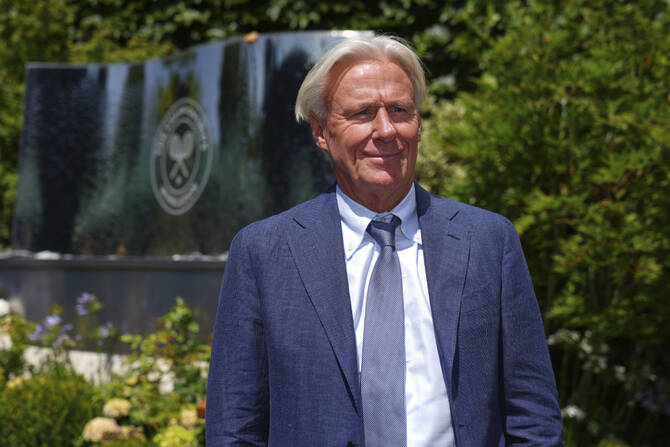

NEW YORK: Bjorn Borg starts his new memoir, “Heartbeats,” with a story about being rushed to a Dutch hospital in the 1990s after overdosing on “alcohol, drugs, pills — my preferred ways of self-medication,” and the Swedish tennis great closes it by revealing that he was diagnosed with prostate cancer.
“It’s good,” Borg, 69, said in a recent video interview with The Associated Press from his home in Stockholm, “to have a good beginning and a good ending.”
In between, the 292-page book, which will be released in the US by Diversion Books on Sept. 23, contains revelations about his love life, various adventures and regrets, and the 11-time Grand Slam champion’s detailed recollections of particular matches.
Bjorn Borg quit tennis at age 25 because he stopped caring when he lost
Famously private, Borg kept a lot to himself during his days on tour — as well as since he surprisingly retired in his 20s.
He brings readers back to when, having lost the 1981 Wimbledon and US Open finals to rival John McEnroe, Borg realized he was done.
“All I could think was how miserable my life had become,” he writes.

Swedish Bjorn Borg returns a forehand to his opponent French Francois Jauffret during their match at the French Tennis Open in Paris June 7, 1976. (AFP file photo)
He was 25 and, while he would briefly return to tennis, he never competed at another Grand Slam event.
After the 1981 final at the US Open, a tournament he never won, Borg grabbed some beers and sat in the pool at a house on Long Island, where friends planned a party to celebrate a victory.
“I was not upset or sad when I lost the final. And that’s not me as a person. I hate to lose,” he told the AP.
“My head was spinning,” he said, “and I knew I’m going to step away from tennis.”
Bjorn Borg wasn’t always calm on a tennis court
Borg writes about his childhood and his relationships with his parents (and, later, his children).
He writes about earning the nickname “Ice-Borg” for calmness on court — often contrasted by fans to the more fiery McEnroe and Jimmy Connors. And Borg writes that did not come about “organically,” but rather via “the bitter experiences” of a 12-year-old kid.
“I behaved so badly on the tennis court. I was swearing, cheating, behaving the worst you can imagine,” he recalled in the video interview.
He said his hometown tennis club banned him for six months and, when he returned, “I did not open my mouth on the tennis court, because I was scared to get suspended again.”
“Boiling inside? Yes,” Borg told the AP. “I had to control my feelings. ... You cannot do that in one week. It took years to figure out how I should behave on the court.”

Former top seeded Swedish tennis player Bjorn Borg returns the ball during a training session on the central court on April 10, 1992. (AFP file photo)
Borg discusses cocaine and 2 overdoses that landed him in the hospital
Borg writes about panic attacks and his drug use, which he says started in 1982.
“The first time I tried cocaine,” he says in the book, “I got the same kind of rush I used to get from tennis.”
He also writes about “the worst shame of all,” which he says came when he looked up from a hospital bed in Holland to see his father. Borg also clarifies that an earlier overdose, in 1989 in Italy, was accidental, not a suicide attempt.
“Stupid decision to be involved with this kind of thing. It really destroys you,” he told the AP about drugs. “I was happy to get away from tennis, to get away from that life. But I had no plan what to do. ... I had no people behind me to guide me in the right direction.”
Borg name-drops Trump, Arafat, Warhol, Hefner, Tina Turner in his memoir
In all, Borg paints the picture of quite a life.
There was a water-skiing shoulder injury before 1977 US Open. Death threats during the 1981 US Open. Getting paid in cash ... and getting robbed at gunpoint. A woman claiming he was the father of her son. Coin-throwing by spectators in Rome that led him to never return.
This is not the typical sports autobiography: There is a reference to getting a message to Yasser Arafat and, five pages later, the phrase ”Andy Warhol was someone easy to like” appears. There are name-drops of Donald Trump, Nelson Mandela, Tina Turner and “my old friend Hugh Hefner,” among many, many others.
“People will be very surprised what really happened,” Borg told the AP. “For me to come out (after) all these years, all I went through — I went through some difficult times — (it’s) a relief for me to do this book. I feel so much better. ... No secrets anymore.”


