

Pakistan president eyes strengthening trade, investment, tourism cooperation during Iraq visit

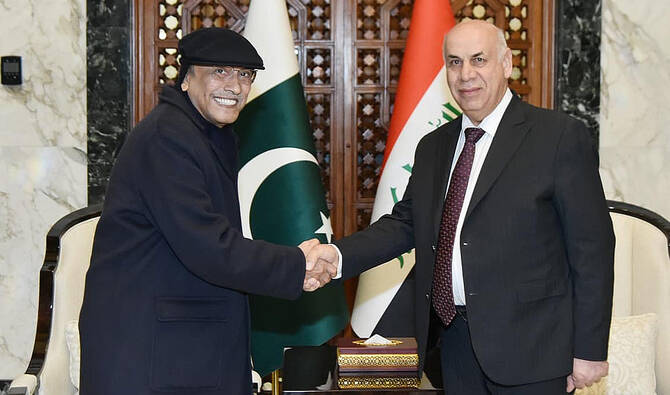
President of Pakistan, Asif Ali Zardari (left) shaking hands with Iraq's Culture Minister Dr. Ahmed Fakkak Al-Badrani in Baghdad, Iraq on December 20, 2025. (Government of Pakistan)
Short Url
Updated 21 December 2025
Follow

Pakistan president eyes strengthening trade, investment, tourism cooperation during Iraq visit

  • President Asif Ali Zardari arrived in Baghdad on Saturday for four-day visit aimed to bolster bilateral ties
  • Zardari, Iraqi leaders to discuss ways to strengthen cooperation in energy, manpower, technology and education

ISLAMABAD: President Asif Ali Zardari is in Iraq for a four-day visit where he will review bilateral ties and hold meetings with the country’s leadership to strengthen cooperation in trade, investment, religious tourism and energy as well as other sectors, state-run media said this week. 

Zardari arrived in Baghdad on a four-day trip on Saturday where he was received by the country’s Culture Minister Dr. Ahmed Fakkak Al-Badrani.

Pakistan and Iraq established diplomatic relations in 1947 and have traditionally maintained cordial ties, though commercial links remain modest, with officials and business groups identifying scope for cooperation in construction services, pharmaceuticals, manpower and agricultural exports.

“During the visit, President Asif Ali Zardari will hold high-level meetings with the Iraqi leadership, during which all aspects of bilateral relations will be reviewed,” state broadcaster Pakistan Television reported on Saturday. 

“The meetings will consider ways to further strengthen cooperation in key areas of mutual interest, including trade, investment, energy, reconstruction, manpower, technology, education, and people-to-people contacts.”

It said both sides are also expected to discuss regional and international issues, including cooperation at multilateral forums. 

“The president’s visit is expected to further strengthen friendly relations between Pakistan and Iraq, explore new avenues of partnership, and promote people-to-people ties, particularly religious tourism and economic cooperation,” PTV said. 

Earlier this month, Pakistan’s Interior Minister Mohsin Naqvi met his Iraqi counterpart, Abdul Ameer Al-Shammari, on the sidelines of meetings in Brussels, where both sides agreed to enhance cooperation on security and facilitate travel for Pakistani Shia pilgrims to Najaf and Karbala.

The two officials discussed measures to ensure the smoother movement of these pilgrims and their compliance with visa regulations.


Pakistan to promote mineral sector at Saudi forum this month with 13 companies

Updated 5 sec ago
Follow

Pakistan to promote mineral sector at Saudi forum this month with 13 companies

  • Delegation will take part in the Future Minerals Forum in Riyadh from Jan. 13-15
  • Petroleum minister will lead Pakistan, participate in a 90-minute country session

ISLAMABAD: Around 13 Pakistani state-owned and private companies will attend the Future Minerals Forum (FMF) in Saudi Arabia from Jan. 13 to 15, an official statement said on Friday, as the country seeks to ramp up global engagement to develop its mineral resources.

The FMF is an international conference and investment platform for the mining sector, hosted by mineral-rich countries to attract global investors, companies and governments.

Petroleum Minister Ali Pervaiz Malik confirmed Pakistan’s participation in a meeting with the Saudi envoy, Nawaf bin Said Al-Malki.

Pakistan hosts one of the world’s largest copper-gold zones. The Reko Diq mine in southwestern Balochistan, with an estimated 5.9 billion tons of ore, is partly owned by Barrick Gold, which calls it one of the world’s largest underdeveloped copper-gold deposits. Its development is expected to boost Pakistan’s struggling economy.

“Upon an invitation of the Government of the Kingdom of Saudi Arabia, the Federal Minister informed the Ambassador that Pakistan will fully participate in the upcoming Future Minerals Forum (FMF), scheduled to be held in Riyadh later this month,” Pakistan’s Press Information Department (PID) said in an official statement.

The Pakistani minister will lead his country’s delegation at the FMF and take part in a 90-minute country showcase session titled “Unleashing Potential: Accelerating Pakistan’s Mineral Revolution” along with local and foreign investors.

Pakistan will also establish a dedicated pavilion to highlight the vast potential of its rich geological landscape to the global mineral community.

The Saudi envoy welcomed Pakistan’s decision to participate in the forum and discussed enhancing bilateral cooperation in the minerals and energy sectors during the meeting.

According to the statement, he highlighted the potential for cooperation between Saudi Arabia and Pakistan in the minerals and energy sectors, expressing confidence that the FMF would provide a platform to expand collaboration.
Pakistan’s mineral sector, despite its rich reserves of salt, copper, gold and coal, contributes only 3.2 percent to the country’s GDP and just 0.1 percent to global mineral exports.

However, many countries, including the United States, have shown interest in Pakistan’s underdeveloped mineral sector, particularly in copper, gold and other critical resources.

In October, Pakistan dispatched its first-ever shipment of rare earth and critical minerals to the United States, according to a Chicago-based US public relations firm’s report.