

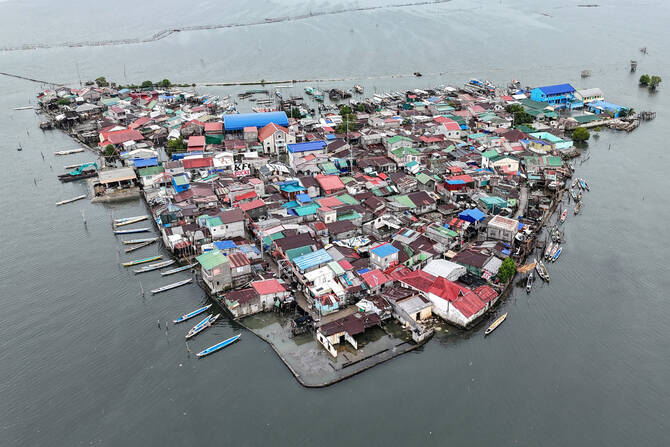

BULACAN, Philippines: On the Philippine island of Pugad, street food vendor Maria Tamayo wakes before her grandchildren to begin the backbreaking work of removing seawater from her home scoop by scoop with a plastic dustpan.
The routine has been the same ever since the rising tides of Manila Bay began swallowing the island — a seven-hectare speck of land in danger of sinking completely underwater.
“Scooping water takes a long time. That’s why my feet have started aching,” the 65-year-old said, adding that she can spend up to three hours a day at the task.
“I have to scoop out the water before my grandchildren wake up, or else they’ll slip on the floor. But it’s no use ... there’s still water.”
Tamayo is one of 2,500 people living in Pugad’s only village.
The island is not the only one at risk in coastal Bulacan. Parts of the province are sinking at a rate of almost 11 centimeters (4.3 inches) a year, the fastest in the Philippines, according to a study led by geologist Mahar Lagmay.
The gradual sinking, known as land subsidence, is an “alarming” phenomenon caused by the overextraction of groundwater, and exacerbated by rising sea levels due to global warming, Lagmay said.
“The rates of subsidence (on Pugad Island) are quite high,” he said, adding that while studies specific to the tiny island were lacking, existing data on surrounding areas told the story clearly.

This photo taken on August 21, 2025, shows workers unloading sandbags at a construction site outside a church on a flooded street on Isla Pugad in Hagonoy town, Bulacan province, north of Manila. (AFP)
With high tides flooding the streets at least three times a week, the sea already dictates the rhythm of daily life on Pugad.
Class schedules are adjusted daily based on tide charts to prevent children from contracting flood-borne diseases.
Homes have been raised on stilts to keep floors dry, while small business owners use high tables to keep their wares above murky water that can rise to 1.5 meters (five feet) on heavy flooding days.
‘Back to normal’ impossible
Sea levels across the Philippines are already rising three times faster than the global average of 3.6 millimeters per year, and the Department of Environment and Natural Resources (DENR) has said this could accelerate to 13 millimeters annually.
“Sea level rise is being experienced in many parts of the country,” DENR geosciences chief Karlo Queano told AFP, warning coastal areas could disappear without large-scale intervention.
While piecemeal efforts are in place in some areas — groundwater extraction has been banned in parts of Bulacan since 2004 — a broad national strategy has yet to take shape.
A government study on the path forward was not expected until 2028, Queano said.
“I think it’s already impossible for our lives in the village to go back to normal because of climate change,” said Pugad village captain Jaime Gregorio.
Gregorio said roads were being raised every three years to keep the community viable, but leadership changes meant the implementation of long-term flood mitigation projects was rarely consistent.
For Tamayo, who has lived on the island her whole life, the constant adjustment to the tide has drained what little money her family has scraped together.
Since 2022, they have been elevating their house each year, adding more gravel and concrete to stay above water, so far spending 200,000 pesos ($3,500).
“I love this island so much, this was where my mom and dad raised me... but sometimes, I think about leaving because of the high tide,” Tamayo told AFP.

This photo taken on August 21, 2025, shows resident Raymart Tamayo (R) and his son Rodolfo (C) walking in the kitchen of their flooded house on Isla Pugad in Hagonoy town, Bulacan province, north of Manila. (AFP)
Her boatman husband, Rodolfo Tamayo, insists their livelihood depends on staying.
“We can’t go to [other places], we won’t have jobs there. We will go hungry.”
Lagmay, the geologist, said land subsidence could be reversible with effective government policies governing the over-digging of wells.
But addressing the rise of sea levels was impossible without a concerted effort by the world’s highly industrialized countries to reduce greenhouse gas emissions, he said.
A UN climate fund established in 2023 to help countries like the Philippines address damage caused by climate change, meanwhile, remains unimplemented.
“We are talking of climate justice here. We have very little contribution to climate change, but we are very affected by its adverse effects,” said Elenida Basug, the DENR’s climate change service director.
Crouching in the doorway of her flooded home, Tamayo urged the world’s polluters to take responsibility for what she and her neighbors were experiencing.
“We are the ones who are suffering... They are rich, so we cannot do anything. Even if we speak against them, who would listen?” Tamayo said.


