Pakistan floods leave three million people affected, 300,000 still in tents

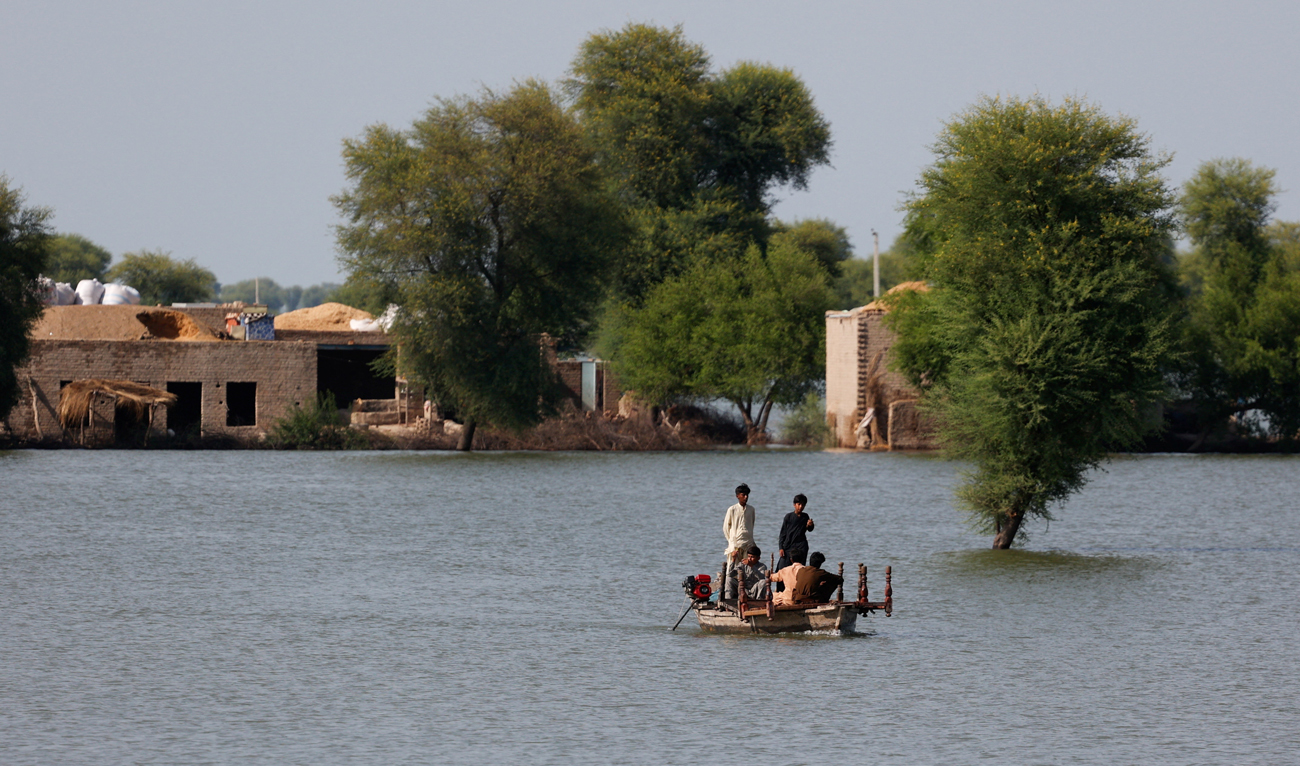
Residents travel in boat, with the partially submerged homes in the background, following monsoon rains and rising water levels of Indus River on the outskirts of Dadu, Sindh province, Pakistan on September 15, 2025. (REUTERS)
Short Url
Updated 17 September 2025
Follow

Pakistan floods leave three million people affected, 300,000 still in tents

  • Nearly 1,000 killed nationwide since monsoon season began in late June
  • Relief camps, rescue operations continue as new rains forecast this week

ISLAMABAD: At least three million people have been affected by floods across Pakistan and 300,000 remain in tents, according to figures shared at a Senate briefing on Wednesday, underscoring the scale of devastation caused by this year’s monsoon season.

Heavy rains and excess water released from Indian dams caused rivers in Punjab province to swell late last month, inundating more than 4,700 villages in the country’s agricultural heartland, destroying crops and homes and forcing millions to flee.

Since the onset of the monsoon season on June 26, Punjab has reported 296 deaths out of a nationwide toll of 998, according to the National Disaster Management Authority (NDMA). Other casualties include 504 deaths in northwestern Khyber Pakhtunkhwa province, 80 in Sindh, 41 in Gilgit-Baltistan, 38 in Azad Kashmir, 30 in Balochistan and nine in Islamabad.

At a meeting of the Senate Standing Committee on Climate Change, chaired by Senator Sherry Rehman, a former climate minister, participants were told that three million people have been affected by the floods and 300,000 remain in tents.

Rehman urged the government to speed up cash assistance for flood victims through the Benazir Income Support Programme (BISP), Pakistan’s main social safety net.

“The government should immediately transfer BISP assistance to flood-affected areas, any delay in this regard is unacceptable,” she said.

“Pakistan should appeal to the United Nations for assistance instead of a mini-budget.”

Rehman also called for transparency in aid distribution and improvements in camp conditions.

“The government should ensure transparency in distribution of relief among flood victims,” she said. “Relief camps should be improved to meet humanitarian standards.”

According to the statement, which cited figures from the National Disaster Management Authority (NDMA), more than 2,000 relief camps were reported operational nationwide, with rescue operations continuing in Punjab and Sindh in coordination with the Pakistan Army and Navy.

Punjab alone had around 2.9 million people affected by floods, the Senate briefing was told.

Rehman linked the current disaster to climate change, noting that Pakistan has joined the top five countries most affected by global warming.

Meanwhile, in its daily situation report, the Provincial Disaster Management Authority (PDMA) in Punjab said the flow of water in most of the province’s rivers had returned to normal.

“The Indus, Jhelum and Ravi rivers are at normal levels,” the PDMA said, adding the Chenab had normalized at Marala, Khanki, Qadirabad and Trimmu, with only medium flooding in the Sutlej at Ganda Singh Wala and low flooding at Sulemanki and Islam headworks.

The PDMA said Panjnad currently carried 194,000 cusecs of water with a low-level flood, while torrents in Dera Ghazi Khan had also normalized.

The authority warned, however, that the monsoon’s 11th spell would persist until Sept. 19, with rain expected in Rawalpindi, Murree, Galiyat and other northern districts.

Flash floods could occur in streams around Rawalpindi, Murree and Galiyat on Sept. 18 and 19.

Pakistan stocks close at record high over current account surplus, falling bond yields

Updated 9 sec ago
Follow

Pakistan stocks close at record high over current account surplus, falling bond yields

  • KSE-100 index gains 1,646.79 points or 0.97% to close at new high of 171,960.64 points
  • Pakistan’s central bank posted a current account surplus of $100 million in November

KARACHI: Pakistani stocks closed at an all-time high of 171,960.4 points on Thursday, with financial analysts attributing the surge to increasing investor confidence stemming from a current account surplus reported in November and a drop in government bond yields.

The benchmark KSE-100 index gained 1,646.79 points or 0.97% to close at an all-time high of 171,960.64 points on Thursday. The previous day, Pakistani stocks surged to 170,313.85 points at close of business. 

Ahsan Mehanti, chief executive officer at Arif Habib Commodities, said the optimistic mood at the stock exchange was fueled by the $100 million current account surplus reported by the central bank in November.

“Speculations ahead of year-end close and fall in government bond yields up to 70 basis points after the SBP (State Bank of Pakistan) policy easing played the catalyst role in bullish activity at PSX,” Mehanti told Arab News. 

The surplus was a welcome development for Islamabad as Pakistan’s central bank reported a $291 million deficit in October.

Topline Securities, a Pakistani brokerage firm, said in its daily market review that strong buying by local funds followed a drop in Pakistan Investment Bond (PIB) yields, which boosted investor confidence.

PIB yields are the returns on bonds or government-backed securities that pay fixed semi-annual interest, with rates influenced by market demand and SBP auctions.

“Strength in ENGRO (Engro Corporation), FFC (Fauji Fertilizer Company), UBL (United Bank Limited), LUCK (Lucky Cement) and BAHL (Bank AL Habib) underpinned positive momentum, collectively contributing 1,504 points to the index,” the brokerage firm wrote on X. 

“This upside was partly offset by declines in PIOC (Pakistan International Oil Company), DHPL (D.H. Corporation Limited) and MLCF (Millat Tractor Limited), which together subtracted 176 points.”

The sustained rise in equities comes amid improving liquidity conditions and continued investor participation, with market participants focusing on corporate earnings, sector-specific developments and broader macroeconomic signals.

Earlier on Monday, Pakistan’s central bank cut its key policy interest rate by 50 basis points to 10.5%, a move that surprised analysts and followed four consecutive policy meetings where rates were held unchanged.

The cut came despite an International Monetary Fund staff report earlier this month cautioning against premature monetary easing.

Inflation eased to 6.1% in November, remaining within the SBP’s target band, though analysts have warned that price pressures could resurface later in the fiscal year as base effects fade and food and transport costs remain volatile.