

Pakistan seeks Saudi, Emirati investment to revamp aging railway track

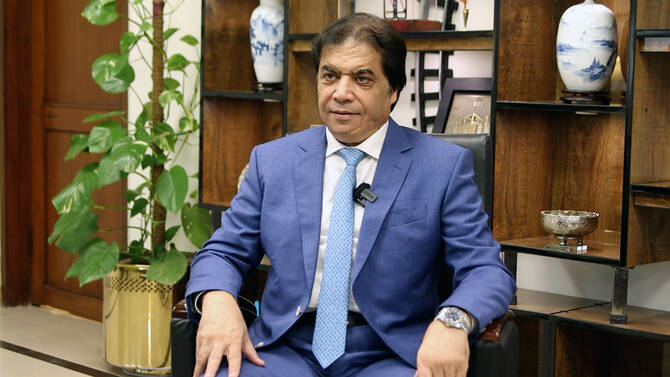
Pakistan Railways Minister Hanif Abbasi speaks during an interview with Arab News in Islamabad on September 16, 2025. (AN Photo)
Short Url
Updated 17 September 2025
Follow

Pakistan seeks Saudi, Emirati investment to revamp aging railway track

  • Railways minister says $2.5 billion needed to modernize Multan–Lahore section
  • Pakistan offers 25-year build–operate–transfer model to attract Gulf investors

ISLAMABAD: Pakistan is seeking investment from Saudi Arabia and the United Arab Emirates (UAE) to modernize its aging railway network, with officials estimating that $2.5 billion is needed for an upgrade of the key Multan–Lahore section, Railways Minister Hanif Abbasi told Arab News this week.

The South Asian nation’s railway system, much of it dating back to the 19th-century British colonial era, has long awaited large-scale modernization. Successive governments have looked to foreign partners to finance improvements, with projects promised under the China–Pakistan Economic Corridor (CPEC) still largely stalled.

An overhaul of more than 1,800 kilometers of track has been billed as the centerpiece of a $60 billion CPEC package first announced in 2015, but no financing deal has materialized. Meanwhile, the Asian Development Bank has separately signaled interest in funding rail upgrades, including a $2 billion Karachi–Rohri project, according to recent reports.

“I am going to Saudi Arabia for two days on October 19-20. I am going to the UAE from September 30 to October 2, and I am going to France on October 24. All these things are related to railways,” Abbasi said. “So, we will meet the Saudis there and try to have Saudi investment, because this is the right time for every country, for every investor to invest in Pakistan Railways.”

Asked what proposals Pakistan would extend to Saudi Arabia, Abbasi said:

 “I think that if they come to Multan–Lahore [route], or Lahore–Rawalpindi, it is an offer from us.”

He said Pakistan would present a build–operate–transfer model to potential Gulf investors.

“We have a model: built–operate transfer. We will give them that place for 25 years. We will give them that section. They will come and talk to us.”

Abbasi said similar proposals had been offered to the UAE.

“We have offered them to invest in Multan and Lahore. We need around $2.5 billion for Multan and Lahore,” he said.

The minister also confirmed meetings with officials of Mashreq Bank, a Dubai-based institution that recently launched Shariah-compliant digital services in Pakistan. While Mashreq’s immediate focus has been on digital banking, Abbasi said discussions had included possible rail sector opportunities.


Pakistan has ruled out military operation in northwestern Tirah Valley

Updated 4 sec ago
Follow

Pakistan has ruled out military operation in northwestern Tirah Valley

  • Residents in northwestern Tirah Valley fled their homes this month fearing a military operation against militants
  • Defense minister says army conducting intelligence-based operations in area, residents’ migration “routine” practice

Islamabad: Defense Minister Khawaja Asif on Tuesday clarified that the military was not conducting a military operation in the northwestern Tirah Valley, saying that the ongoing residents’ migration from the area was a routine practice that has been going on for several years. 

The defense minister’s clarification came as residents of Tirah Valley in Pakistan’s northwestern Khyber Pakhtunkhwa (KP) province bordering Afghanistan fled their homes this month, fearing a planned military operation by the army against militants, particularly the Tehreek-e-Taliban Pakistan (TTP) group. 

Pakistan’s information ministry on Sunday issued a clarification that the armed forces were not involved in the “depopulation” of the valley. It pointed to a notification from the provincial Khyber Pakhtunkhwa Relief, Rehabilitation and Resettlement Department in December which demanded the release of funds, reportedly Rs4 billion [$14.24 million], for the voluntary movement of people from Tirah Valley. 

Speaking to reporters at a news conference alongside Information Minister Attaullah Tarar and Special Assistant to the PM for Information and KP Affairs Ikhtiar Wali Khan, Asif said the last military operation in the area was conducted several years ago. He said the military had decided that intelligence-based operations (IBOs) were more effective than military operations as they resulted in lower civilian casualties. 

“So over a long period of time, the army gave up [military] operation in favor of IBOs,” Asif said. “For many years this practice has been continuing. Hence, there is no question of an operation there.”

The defense minister described the migration of residents from Tirah Valley as a “routine” practice due to the harsh cold. 

He criticized the provincial government, led by the Pakistan Tehreek-e-Insaf (PTI) party for not serving the people of the area, accusing it of not building any schools, hospitals, or police stations in Tirah Valley.

Asif said around 400-500 TTP members lived in the valley with their families, alleging that hemp was being harvested there on over 12,000 acres of land. He said that while hemp is also used for medicinal and construction purposes, its dividends were going to militants and politicians. 

“All of this hemp is harvested there and the dividends from it either go to the people associated with politics or the TTP,” the minister said.

“We have initiated the process to stop this so that the people benefit from this harvest and so that schools and hospitals are constructed there.”

The minister said that a district-level jirga or tribal council met representatives of the KP government on Dec. 11, 24 and 31 to decide matters related to the residents’ migration in the area. 

Holding up the KP Relief, Rehabilitation and Resettlement Department notification, Asif said:

“In the presence of this notification, in the presence of this tribal council and in the presence of all of these things, where do you see the army?“

The minister accused the provincial government of deflecting its “failures” in the province to the armed forces or to a military operation that did not exist. 

The migration has exposed tensions between the provincial government and the military establishment over the use of force in the region.

KP Law Minister Aftab Alam Afridi said earlier this month that the provincial government will not allow a military operation to take place in the area, arguing that past military campaigns had failed to deliver lasting stability.