

Militants kill policeman, injure two Levies troops in overnight attack on Balochistan post

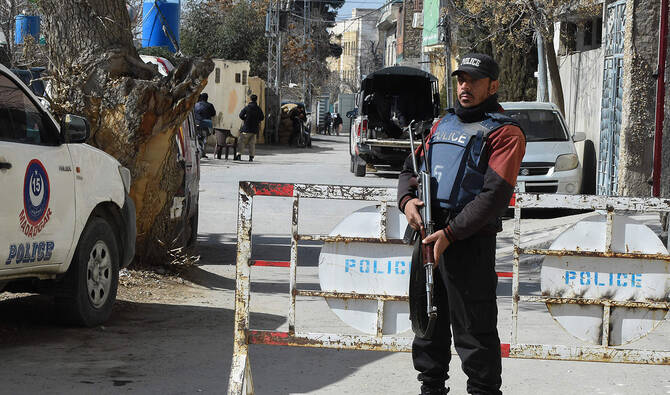
Policeman stands guard in Quetta, Pakistan, on February 5, 2024. (AFP/File)
Short Url
Updated 17 September 2025
Follow

Militants kill policeman, injure two Levies troops in overnight attack on Balochistan post

  • Officials suspect Pakistani Taliban in the Sherani assault that left one Levies officer missing
  • Gunmen also looted two armored vehicles carrying about $770,000 from Turbat to Gwadar

QUETTA: Militants killed a police officer and injured two Levies personnel in a coordinated overnight assault on a security post in Pakistan’s restive Balochistan province, officials said on Wednesday, in one of two violent incidents reported in the resource-rich region

The attack took place on Tuesday night when gunmen described by authorities as militants of “Fitna Al Khawarij” stormed the Levies Thana Headquarters and Police Thana in Sherani town, Deputy Commissioner Hazrat Wali Kakar told Arab News.

The term “khawarij,” rooted in early Islamic history, is used by officials for Tehreek-e-Taliban Pakistan (TTP) fighters who mainly operate in northwestern Khyber Pakhtunkhwa province but have also staged attacks in Balochistan.

“Levies and police personnel retaliated, engaging the militants in a fierce gunbattle,” Kakar said. “One police official, Aftab Ur Rehman, was killed in the attack and two Levies personnel, Kalu Khan and Abdul Wahid, were injured.”

“One Levies official, Azam, is still missing, and a search operation is underway in the area,” he continued.

Kakar said the attackers set a Levies vehicle ablaze and destroyed Provincial Disaster Management Authority (PDMA) stocks stored at the compound before escaping under the cover of darkness.

No group immediately claimed responsibility, but the TTP has carried out attacks in Sherani, which borders Khyber Pakhtunkhwa’s Dera Ismail Khan district where the militant group frequently targets security forces.

In a separate incident on Tuesday afternoon, unidentified gunmen intercepted and robbed two armored vehicles carrying over Rs220 million ($770,000) for two private banks from Turbat to Gwadar, about 65 km from Turbat city, said Ilahi Bukhsh, a senior Levies officer in Dasht Khadan

“Six security guards with weapons were deployed with the money-carrying vehicles but the armed men intercepted and neutralized them,” Bukhsh said.

No group has claimed responsibility for the robbery.

Balochistan, Pakistan’s largest province by landmass and rich in mineral resources, has long faced an insurgency led by separatist groups who accuse Islamabad of exploiting its wealth while neglecting locals.

Pakistan denies the charge, saying it has invested in the province’s development.


Pakistan to launch AI screening in January to target fake visas, agent networks

Updated 5 sec ago
Follow

Pakistan to launch AI screening in January to target fake visas, agent networks

  • New system to flag forged-document travelers before boarding and pre-verify eligibility
  • Move comes amid increasing concern over fake visas, fraudulent agents, forged papers

ISLAMABAD: Pakistan will roll out an AI-based immigration screening system in Islamabad from January to detect forged documents and prevent illegal overseas travel, the government said on Thursday. 

The move comes amid increasing concern over fake visas, fraudulent agents and forged papers, with officials warning that such activity has contributed to deportations, human smuggling and reputational damage abroad. Pakistan has also faced scrutiny over irregular migration flows and labor-market vulnerability, particularly in the Gulf region, prompting calls for more reliable pre-departure checks and digital verification.

The reforms include plans to make the protector-stamp system — the clearance required for Pakistani citizens seeking overseas employment — “foolproof”, tighten labor-visa documentation, and cancel the passports of deportees to prevent them from securing visas again. The government has sought final recommendations within seven days, signalling a rapid enforcement timeline.

“To stop illegal immigration, an AI-based app pilot project is being launched in Islamabad from January,” Interior Minister Mohsin Naqvi said following a high-level meeting chaired by him and Minister for Overseas Pakistanis Chaudhry Salik Hussain.

Naqvi said the new screening technology is intended to determine travelers’ eligibility in advance, reducing airport off-loads and closing loopholes exploited by traffickers and unregistered agents.

The interior minister added that Pakistan remains in contact with foreign governments to improve the global perception and ranking of the green passport, while a uniform international driving license will be issued through the National Police Bureau.

The meeting also approved zero-tolerance measures against fraudulent visa brokers, while the Overseas Pakistanis Ministry pledged full cooperation to streamline the emigration workflow. Minister Hussain said transparency in the protector process has become a “basic requirement,” particularly for labor-migration cases.

Pakistan’s current immigration system has long struggled with document fraud, with repeated cases of passengers grounded at airports due to forged papers or agent-facilitated travel. The launch of an AI screening layer, if implemented effectively, could shift the burden from manual counters to pre-flight verification, allowing authorities to identify risk profiles before departure rather than after arrival abroad.

The reforms also come at a moment when labor mobility is tightening globally. Gulf states have begun demanding greater documentation assurance for imported labor, while European and Asian destinations have increased scrutiny following trafficking arrests and irregular-entry routes from South Asia. For Pakistan, preventing fraudulent departures is increasingly linked to protecting genuine workers, reducing deportation cycles and stabilizing the country’s overseas employment footprint.