Pakistan raises diesel prices, keeps petrol unchanged

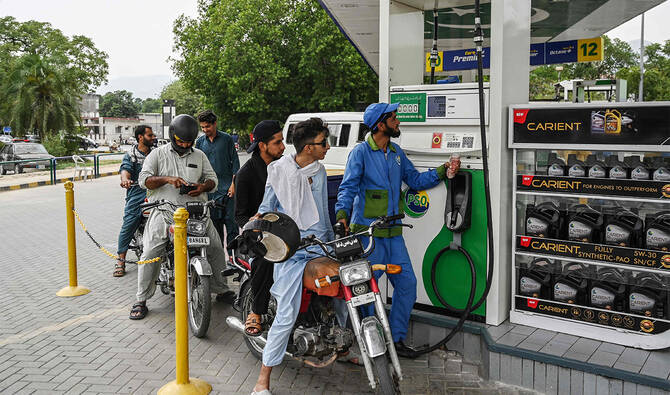
An employee fills the tank of a motorbike at a fuel station in Islamabad, Pakistan, on June 16, 2025. (AFP/File)
Short Url
Updated 16 September 2025
Follow

Pakistan raises diesel prices, keeps petrol unchanged

  • Diesel price increased by Rs2.78 per liter to Rs272.77, petrol steady at Rs264.61
  • Changes follow regulator’s recommendations, diesel hike likely to hit transport, farm costs

ISLAMABAD: Pakistan on Tuesday increased the price of high-speed diesel by Rs2.78 per liter while keeping petrol unchanged, the Finance Division said, revising petroleum rates for the second half of September.

The new rate for diesel stands at Rs272.77 per liter, up from Rs269.99, while petrol remains steady at Rs264.61.

“The Government has revised the prices of petroleum products for the fortnight commencing September 15, 2025, based on the recommendations of Oil and Gas Regulatory Authority (OGRA) and the relevant Ministries,” the Finance Division said in a statement.

Diesel is widely used in agriculture and transport, meaning changes in its price can directly impact inflation and the cost of goods across the country.

The government adjusts local fuel prices every two weeks in line with fluctuations in global oil markets and exchange rate movements.

Officials say the system is designed to pass on international price changes to domestic consumers in a transparent manner.



Pakistan’s finance chief heads to Riyadh to highlight climate funding priorities at global summit

Updated 4 sec ago
Follow

Pakistan’s finance chief heads to Riyadh to highlight climate funding priorities at global summit

  • Muhammad Aurangzeb will join high-level talks on securing capital for climate adaptation and resilience
  • The visit includes bilateral meetings with senior Saudi officials to deepen bilateral economic cooperation

ISLAMABAD: Federal Minister for Finance and Revenue Muhammad Aurangzeb left for Saudi Arabia on Wednesday to attend the Global Development Finance Conference in Riyadh, said an official statement, where he will present Islamabad’s perspective on climate adaptation and financing.

Pakistan is among the world’s most climate-vulnerable countries, grappling with recurrent floods, heatwaves and rising adaptation costs that far exceed its domestic resources.

Last month, while addressing COP30 in Brazil via video link, Aurangzeb urged reforms to global climate-finance mechanisms, arguing the Green Climate Fund was mired in “bureaucracy” and the Loss and Damage Fund had made little progress four years after its launch.

The finance division said the minister had departed for Riyadh to take part in the conference, a three-day gathering focused on new development-finance models.

“During the conference, Finance Minister Senator Muhammad Aurangzeb will participate in a high-level session on climate adaptation and resilience, where he will join global leaders in discussing how developing countries can secure the capital needed to address climate vulnerabilities,” the statement said.

“His participation will highlight Pakistan’s priorities in climate finance and the government’s efforts to strengthen economic resilience in the face of global environmental challenges,” it added.

Aurangzeb is also scheduled to hold bilateral meetings with senior Saudi officials, including leadership of the National Development Fund and the Ministry of Finance, to discuss development financing, investment opportunities and broader economic cooperation.

The statement said he will give interviews to international media outlets such as CNN and CGTN to outline Pakistan’s reform trajectory and development-finance needs.

The finance chief will additionally meet Pakistan’s diplomatic mission in Riyadh to review ongoing economic diplomacy initiatives.

The Global Development Finance Conference, organized under the patronage of Saudi Crown Prince Mohammed bin Salman, aims to bring together more than 100 speakers from over 120 international and regional organizations.

The conference is positioned as a key platform within Vision 2030 to accelerate innovative financing models and support countries seeking sustainable growth amid rising global climate and development pressures.