

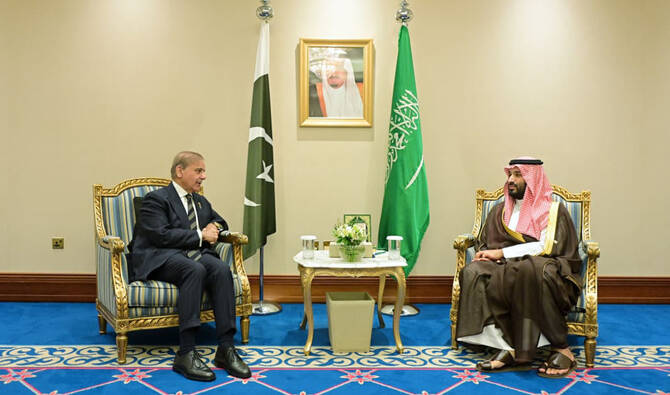
Pakistan PM meets Saudi Crown Prince in Doha, pledges all-out diplomatic support after Israeli attack

Prime Minister Shehbaz Sharif meeting Saudi Crown Prince Mohammed bin Salman on the sidelines of an emergency Arab–Islamic Summit in Doha, Qatar, on September 15, 2025. (PMO)
Short Url
Updated 15 September 2025
Follow

Pakistan PM meets Saudi Crown Prince in Doha, pledges all-out diplomatic support after Israeli attack

  • PM assures Crown Prince of Pakistan’s backing at UNSC, OIC against Israel’s “unlawful and reckless aggression”
  • Pakistan had earlier condemned Israeli strikes and expressed solidarity with Qatar during Sept. 11 visit to Doha by Sharif

ISLAMABAD: Prime Minister Shehbaz Sharif on Monday met Saudi Crown Prince Mohammed bin Salman on the sidelines of an emergency Arab–Islamic Summit in Doha, vowing Pakistan’s full diplomatic support after Israel’s strike on Qatar.

The emergency summit was convened in the Qatari capital following Israel’s Sept. 9 air strikes on Doha that killed at least six people, including Hamas members, sparking condemnation across the Muslim world. Leaders have gathered in Doha to discuss a collective response, with Pakistan seeking to leverage its current non-permanent seat on the UN Security Council to push for action.

“The Prime Minister assured the Saudi Crown Prince of Pakistan’s all out diplomatic support, particularly at the United Nations Security Council ... as well as at all other diplomatic multilateral foras, including the OIC,” the Sharif’s office said.

During the meeting, the PM conveyed his “deep appreciation for HRH Crown Prince Mohammed bin Salman’s bold and sagacious leadership in unifying the Ummah at this critical time.” 

He said the convening of the Emergency Arab-Islamic Summit in Doha had sent out an “important message that Muslims around the world spoke with one voice against Israel’s unlawful and reckless aggression, that threatened regional peace and security.”

The press release said the Saudi Crown Prince expressed his “appreciation for Pakistan’s active diplomatic efforts, including at the UNSC and OIC, to express solidarity with Qatar at this critical time.”

Leaders of Arab and Islamic states will warn that Israel’s attack on Qatar and other “hostile acts” threaten coexistence and efforts to normalize ties in the region, Reuters reported on Monday, based on a draft resolution to be put before the Arab-Islamic summit.

An excerpt of the pre-summit draft resolution seen by Reuters said “the brutal Israeli attack on Qatar and the continuation of Israel’s hostile acts including genocide, ethnic cleansing, starvation, siege, and colonizing activities and expansion policies threatens prospects of peace and coexistence in the region.”

These actions threaten “everything that has been achieved on the path of normalizing ties with Israel including current agreements and future ones,” according to the draft, which was drawn up by foreign ministers meeting ahead of the summit.


Pakistan accuses India of manipulating Chenab flows, seeks clarification under Indus Waters Treaty

Updated 8 sec ago
Follow

Pakistan accuses India of manipulating Chenab flows, seeks clarification under Indus Waters Treaty

  • Foreign office spokesperson says sudden variations in river flows threaten agriculture, food security and livelihoods downstream
  • He also condemns a hijab-removal incident in India, calling it part of a broader pattern of religious intolerance and Islamophobia

ISLAMABAD: Pakistan said on Thursday it had observed abrupt variations in the flow of the River Chenab during the ongoing month, accusing India of manipulating river flows at a critical point in the agricultural cycle and saying it had written to New Delhi seeking clarification.

Local media reported quoted Pakistani officials as saying India released about 58,000 cusecs of water at Head Marala on Dec. 7–8 before sharply reducing flows to roughly 870–1,000 cusecs through Dec. 17, far below the 10-year historical average of 4,000–10,000 cusecs for this period.

Pakistan’s Foreign Office spokesman Tahir Andrabi told a weekly media briefing in Islamabad India had failed to share prior information or operational data on the Chenab flows, a practice he said New Delhi had previously followed under the 1960 Indus Waters Treaty. New Delhi said earlier this year it had put the treaty “in abeyance” following a gun attack in Indian-administered Kashmir that it blamed on Pakistan, a charge Islamabad denied, calling instead for an impartial and transparent international investigation.

Pakistan also described India’s unilateral suspension of the treaty as a violation of international law and an “act of war.”

“Pakistan would like to reiterate that the Indus Waters Treaty is a binding international agreement, which has been an instrument of peace and security and stability in the region,” Andrabi said. “Its breach or violation, on one hand, threatens the inviolability of international treaties in compliance with international law, and on the other hand, it poses serious threats to regional peace, principles of good neighborliness, and norms governing interstate relations.”

Andrabi said Pakistan viewed the sudden variations in the Chenab’s flow with “extreme concern and seriousness,” saying the country’s Indus Waters Commissioner had written to his Indian counterpart seeking clarification in line with procedures outlined in the treaty.

“Any manipulation of river flow by India, especially at a critical time of our agricultural cycle, directly threatens the lives and livelihoods, as well as food and economic security of our citizens,” he continued. “We call upon India to respond to the queries raised by Pakistan.”

He said Pakistan had fulfilled its obligations under the Indus Waters Treaty and urged the international community to take note of India’s “continued disregard” of a bilateral treaty and to counsel New Delhi to act responsibly under international law.

Andrabi maintained Pakistan remained committed to peaceful resolution of disputes with India but would not compromise on its water rights.

In the same briefing, he also condemned an incident in which the chief minister of the Indian state of Bihar was seen in a video forcibly removing the hijab of a Muslim woman during a public interaction, followed by remarks by a minister in Uttar Pradesh who mocked the episode, saying it reflected a broader pattern of religious intolerance and Islamophobia and warranted strong condemnation.