

Rescued from the streets, homeless girls build new futures at Dhaka charity home

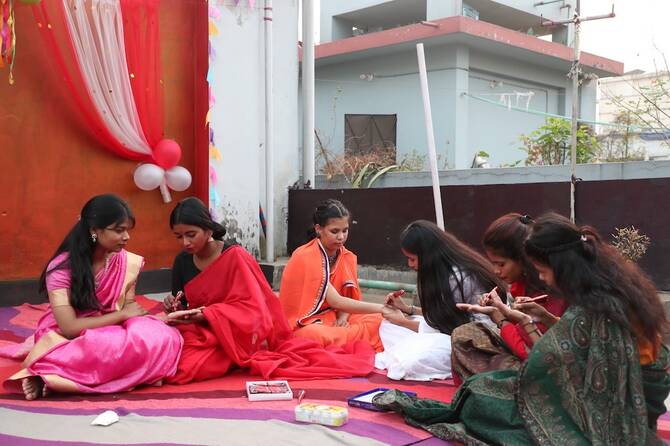
Bangladeshi girls take part in vocational training at their shelter, Happy Home, in Dhaka, July 2025. (ActionAid Bangladesh)
Short Url
Updated 15 September 2025
Follow

Rescued from the streets, homeless girls build new futures at Dhaka charity home

  • 1.5 million Bangladeshi children lack access to safe shelter and basic care
  • Happy Home program has taken care of 17,480 vulnerable girls since 2006

DHAKA: When Shikha Akter was abandoned by both parents, her grandparents brought her to Dhaka, about 90 km from their native Shariatpur district, and placed her in a new care facility for children.

Now 16, she has spent most of her life at Happy Home, a shelter run by ActionAid Bangladesh.

“I landed here at Happy Home at the age of 6. Since then, it has become my only address on this earth. It really is a home,” she told Arab News.

“Growing up with so many sisters has been a joyful experience ... We were given the opportunity to study, just like other boys and girls. I don’t feel abandoned.”

The Happy Home program was launched in 2006 to support homeless and marginalized girls aged 6 to 18.

The initiative has since helped more than 17,480 of them, providing shelter, food and clothing. Some of them have been living at the program’s boarding home in Mohammadpur area in Dhaka, while others stay for day care and return to their families.

The main goal of the project is to integrate street children into mainstream education and prepare them for independent living once they reach adulthood.

Shikha was among Happy Home’s highest-scoring secondary school exam takers in May this year, reaching 4.57 out of 5.

“The day my Secondary School Certificate exam results were published was the most memorable moment of my life,” she said. “It felt like I had overcome one of the biggest hurdles on the path to success.”

She already has plans for the future — to become independent and reunite with her sibling.

“I have a younger sister who lives with our maternal aunt. I dream of bringing her to live with me once I’m able to live on my own,” she said.

“I want to be a businesswoman. I will make different types of colorful bangles and sell them to fashion-conscious women. I have already received training in making bangles.

“My seniors also promised to help me open a Facebook page with my bangles. It will help me in marketing.”

More than 1.5 million Bangladeshi children lack access to safe shelter and basic care, according to ActionAid Bangladesh data.

“Girls are particularly vulnerable to abuse and exploitation, which is why our program prioritizes their safety and education. Happy Home provides healthcare, life skills, and educational opportunities to help girls build a secure and independent future,” said Farah Kabir, the aid group’s country director.

“The program has enabled thousands of girls to complete education, acquire vocational skills, access psychosocial support, and secure employment. Many alumni have pursued higher education and built successful careers, proving that investing in girls’ safety, education, and skills can break cycles of poverty and create lasting positive change in communities,” 

Another Happy Home resident, Rozi Akter, recently gained admission to Lalmatia Women’s College in Dhaka after scoring 4.50 in this year’s secondary school exam.

Rozi spent the early years of her childhood on the streets of Dhaka with her five sisters. Their mother worked in other people’s homes, and their stepfather did not treat them well.

“During the daytime, we had to roam here and there outside home. We used to return home during night only to sleep,” she said. “I landed here at Happy Home at the age of 7.”

While she is still learning, focusing on science and computers, she has a plan to become a fashion designer.

“By watching YouTube videos, I’m learning fashion design to prepare myself for a future in the business,” she said.

“We have sewing machines at Happy Home, and some of our older sisters used to make clothes with them. Watching them helped me gain some hands-on experience. I’ve already made a few pieces myself.”

She is aware that in two years she will face adult life but is not afraid because her seniors have done well and will provide support.

“I feel very happy to be raised in a shelter like Happy Home, surrounded by many other girls like me,” she said.

“We all have different stories of struggle, but as girls, we share the same spirit. We always stand by each other through every challenge.”


New ‘superfood’ transforms livelihoods in India’s rural east

A farmer harvests makhana, or lotus seeds, in Kapchhahi village in India’s eastern state of Bihar. (Mahesh Mukhia)
Updated 08 December 2025
Follow

New ‘superfood’ transforms livelihoods in India’s rural east

  • Known as fox nut or lotus seed, makhana is rich in protein, dietary fiber, minerals
  • Most of the world’s makhana production is in Bihar, one of India’s poorest states

BIHAR: Wading through knee-deep, stagnant water, Mahesh Mukhia plunges his hands into the mud, pulling up handfuls of sludge that he and others toss into a large, partially submerged basket.

After a while, they shake the basket to drain away the water and debris. What remains is makhana — round black seeds that have lately gained popularity as India’s new superfood.

A regional Indian snack, also known as fox nut or lotus seed, makhana is the edible seed of the prickly waterlily. The plant grows in freshwater ponds and wetlands in southern and eastern Asia.

After makhana seeds are handpicked from pond beds, cleaned, and sun-dried, they are roasted at high heat so their hard black shells crack open and release the white, popcorn-like puffed kernels, which are eaten as snacks or used in dishes.

It has long been known for its nutritional value — high in plant-based protein and dietary fiber, the seeds are also rich in minerals and gluten-free — which over the past few years have helped it gain global attention and are transforming farmlands in Bihar, one of India’s poorest states.

“Earlier, people were not researching it but now, after research, makhana’s nutritional values have been highlighted. Now this is a superfood. That’s why demand is growing everywhere,” said Mahesh Mukhia, a farmer in Kapchhahi village in Bihar’s Darbhanga district, whose family has been harvesting the seeds for generations.

“The difference is that my forefathers did farming in a traditional way, but we’ve learnt to do it in a scientific way,” Mukhia told Arab News.

“There is Bhola Paswan Shastri Agricultural College in the neighboring Purnea district. I went there for training. After I started practicing farming the way I learnt, the yield increased by more than 30 percent.”

Makhana farming is highly labor-intensive, starting with the cultivation of water lilies in shallow ponds. The plants require constant monitoring as they are sensitive to water levels and pests.

Harvesting takes place between August and October. Workers pluck the seeds by hand and then dry them under the sun for several days before they can be processed.

The processing and roasting of makhana also require significant effort. The dried seeds are first de-shelled by manually cracking them, followed by multiple rounds of roasting to make them crisp.

Whole families are involved in the production, which has been expanding since 2020, when the state government introduced the Makhana Development Scheme.

Besides training in farming and processing, growers who cultivate fox nut receive $820 per hectare.

“The rate has also gone up. The makhana that we used to sell at 200-300 ($2-$3) rupees per kg is now selling at 1,000 ($12) or 1,500 rupees per kg,” Mukhia said.

“Makhana farmers are now making a profit. Those who are growing makhana are earning well, those who are popping it are also doing well, and those involved in trading are making profits too. We are getting good demand from everywhere. I just received an order for 25 tonnes recently.”

Bihar currently produces over 85 percent of India’s makhana and accounts for most of the world’s production, according to Ministry of Commerce and Industry estimates.

According to reports by the Indian Brand Equity Foundation and the Agricultural and Processed Food Products Export Development Authority, India accounts for roughly 85 to 90 percent of the world’s production.

Farmland where the crop is grown has increased many times over the past decade and can now be compared to the area covering half of New York City.

More than 600,000 people are involved in the makhana industry in Bihar, according to Niraj Kumar Jha, Darbhanga district’s horticulture officer.

“Earlier, we were cultivating 5,000 hectares in the Kosi and Mithlanchal regions. But now it has expanded to 35,000 hectares, and with many supportive schemes, farmers are increasingly encouraged to grow makhana,” he said.

“We are strengthening our marketing channels. We’ll reach the metro cities as well as world markets ... We can see that makhana is growing very popular, not only in India.”