Pakistan lodge protest as India tensions spill into cricket

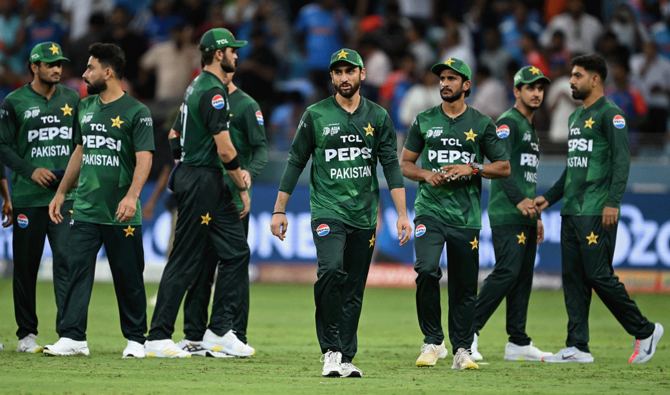
Pakistan's players walk back to the pavilion at the end of the Asia Cup 2025 Twenty20 international cricket match against India at the Dubai International Stadium in Dubai on September 14, 2025. (AFP)
Short Url
Updated 15 September 2025
Follow

Pakistan lodge protest as India tensions spill into cricket

  • Tensions simmered after match as India’s players left the field without shaking hands of Pakistani players
  • Pakistan alleges match referee Andy Pycroft told captain Salman Agha not to shake Indian skipper’s hands

DUBAI, UAE: Pakistan lodged a complaint on Monday with cricket’s governing body about the match referee in their Asia Cup clash with India after simmering tensions between the countries spilled over into sport.

India beat their arch-rivals by seven wickets on Sunday in Dubai as the neighbors met for the first time in cricket since their military conflict in May.

Tensions simmered after the match as India’s players left the field without shaking hands.

Pakistan blamed the India side and also allege match referee Andy Pycroft of Zimbabwe told captain Salman Agha not to shake the hand of India skipper Suryakumar Yadav before the game. There was no handshake between the captains.

“The PCB has lodged a complaint with the ICC regarding violations by the match referee of the ICC code of conduct and the MCC laws pertaining to the spirit of cricket,” Pakistan Cricket Board (PCB) chairman Mohsin Naqvi wrote on social media.

The PCB demanded the immediate removal of Pycroft from the remainder of the regional T20 tournament.

The International Cricket Council has been contacted for comment.

In his post-match press conference, Suryakumar said his team acted on the advice of the Indian government and the Board of Control for Cricket in India (BCCI).

“We are aligned with the Indian government and the BCCI,” said Suryakumar when asked why his team did not shake hands with the Pakistan players.

As a protest, Pakistan did not send their captain Agha to post-match duties.

The two teams are likely to meet again in a Super Four match in Dubai on Sunday, provided Pakistan win their last group game against the United Arab Emirates on Wednesday.

They can also meet for a third time in the September 28 final in Dubai if results go their way.

India and Pakistan were playing for the first time since cross-border hostilities in May left more than 70 people dead in missile, drone and artillery exchanges, before a ceasefire.

The conflict was triggered by an April 22 attack on civilians in Pahalgam in Indian-administered Kashmir that New Delhi accused Pakistan of backing, a charge Islamabad denies.


Pakistan says mosque bomber identified, accuses India and Afghanistan of backing attack

Updated 6 sec ago
Follow

Pakistan says mosque bomber identified, accuses India and Afghanistan of backing attack

  • Suicide bombing at mosque on Islamabad’s outskirts kills at least 31, injures 169
  • Minister says attacker not an Afghan national but had travel history to Afghanistan

ISLAMABAD: Pakistan said on Friday it had identified the suicide bomber responsible for an attack on a mosque on the outskirts of the capital that killed at least 31 people, with the government saying the incident was carried out by militants sponsored by India and supported by Afghanistan.

The explosion took place during Friday prayers in the Tarlai area, a densely populated suburb of the capital, with hundreds of worshippers inside the mosque. Islamabad’s district administration said 169 people were also injured, several of them critically. 

The attack comes amid a renewed surge in militant violence in Pakistan and follows a suicide bombing outside a district court complex in Islamabad in November last year that killed at least 12 people and wounded dozens, underscoring growing security concerns even in heavily guarded urban centers.

Talal Chaudhry, Pakistan’s minister of state for interior, told reporters at the blast site, an imambargah, or a place of worship for the Shi’ite Muslim community, that the attacker had been identified as a suicide bomber following forensic analysis.

“We have now received information about the terrorist who carried out the suicide bombing here,” Chaudhry said. “He is not an Afghan national, but details of how many times he traveled to Afghanistan have been obtained.”

He said investigators were trying to piece together more evidence, though he added he could not share some of the information at this time.

Chaudhry accused neighboring countries of backing militant violence in Pakistan, saying the attack followed a familiar pattern. 

“Those who carried out the attack are the same [groups that are] sponsored and supported by our neighbors, sponsored by India and supported by Afghanistan,” he added.

Islamabad has long accused Kabul of allowing its soil to be used by militant groups and New Delhi of backing their cross-border attacks against Pakistani civilians and security forces. However, the Afghan and Indian governments have consistently denied the allegations.

India also issued a statement during the day, condemning the attack and condoling the loss of life while calling Islamabad’s accusation against it “as baseless as it is pointless.”

However, Chaudhry said the authorities had also detained militants and their facilitators in the past who were linked to earlier attacks in the capital, as he pledged to do the same again.

“Be assured that the previous terrorists and their handlers involved in Islamabad attacks were arrested and are being dealt with according to the law,” he continued, adding those responsible for targeting the mosque would also be arrested.

No militant group has so far claimed responsibility for the attack.

Rescue teams reached the scene within minutes, Chaudhry said, and an emergency was imposed at major hospitals, including the Pakistan Institute of Medical Sciences, Polyclinic Hospital and the Capital Development Authority Hospital. 

Chaudhry said the attackers had deliberately targeted civilians.

Islamabad has generally been less affected by militant attacks than Pakistan’s northwestern and southwestern regions, but the scale of the casualties has heightened concerns about security in the capital amid a broader resurgence of violence nationwide.