

Pakistan coach disappointed India did not shake hands at Asia Cup

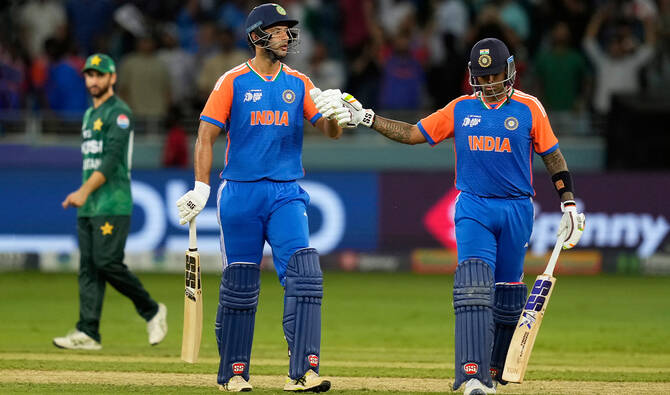
India’s captain Suryakumar Yadav (right) celebrates with batting partner Shivam Dube after their win in the Asia Cup cricket match against Pakistan at Dubai International Cricket Stadium in Dubai, United Arab Emirates, on September 14, 2025. (AP)
Short Url
Updated 15 September 2025
Follow

Pakistan coach disappointed India did not shake hands at Asia Cup

  • India won by seven wickets in first match between two sides after Pakistan, India’s military clash in May
  • Captains of both teams did not shake hands at the toss while players also refrained from doing so at end 

DUBAI: Pakistan head coach Mike Hesson said they were disappointed by India’s decision not to shake hands after Sunday’s politically-charged Asia Cup match between the bitter neighbors.

India won the Group A encounter by seven wickets in the first cricket match between the sides since a four-day military conflict between the nuclear-armed neighbors in May.

While the match itself passed without incident, there was no shaking of hands between the captains at the toss or among the players at the end.

“We were ready to shake hands at the end of the game, we obviously are disappointed that our opposition didn’t do that,” Hesson told reporters.

“We sort of went over there to shake hands and they’d already gone into the changing room.

“That was a disappointing way for the match to finish, and a match we were disappointed for the way we played, but we were certainly willing to shake hands.”

Pakistan captain Salman Agha did not attend the presentation ceremony, which New Zealander Hesson said was a “follow-on effect” of India’s refusal to shake hands.

India captain Suryakumar Yadav dedicated their victory to their armed forces at the ceremony, and expressed solidarity with the victims of the April 22 attack in Indian Kashmir which triggered the conflict.

In the post-match press conference, Suryakumar said the players were aligned with the Indian cricket board and government.

“We took a call (on not shaking hands). We came here to just play the game. We have given a proper reply,” said the batter.

Bilateral cricket between India and Pakistan remains suspended since 2013 and the arch-rivals play each other only in multi-team tournaments.

Sunday’s match went ahead despite calls in India for the team to boycott it.

India could face Pakistan twice more at the tournament, including in the September 28 final should the teams advance that far.


Pakistan warns social media firms of Brazil-style action over failure to curb terror content

Updated 4 sec ago
Follow

Pakistan warns social media firms of Brazil-style action over failure to curb terror content

  • Government says TikTok, Telegram showed highest cooperation while X remained least responsive
  • Pakistan authorities demand platforms share IP data, deploy AI filters and comply with local laws

ISLAMABAD: Pakistan on Thursday issued a final warning to major social media platforms, urging them to comply with local laws and proactively curb militant content or face action similar to measures taken by Brazil against X, where the platform was briefly banned last year.

Briefing foreign media in Islamabad, Minister of State for Interior Talal Chaudhry and Minister of State for Law and Justice Aqeel Malik said the government had formally raised concerns with platforms including X, Meta, Facebook, WhatsApp, YouTube, TikTok and Telegram. The officials said Pakistan expected these companies to strengthen moderation systems, improve cooperation with law enforcement and adopt tools capable of detecting extremist activity before it spreads.

 “This is our last warning. These companies must comply with Pakistani laws, establish offices in Pakistan, and use AI and algorithmic tools to identify terror-linked accounts,” Chaudhry told reporters.

He said authorities had detected dozens of accounts linked to regional militant networks operating across multiple platforms. 

“These accounts are linked to organizations already proscribed by the United States and the United Nations,” he noted, underscoring what officials described as cross-border online activity contributing to radicalization and security threats.

The warning comes as Pakistan cites Brazil’s precedent. In June last year, Brazil’s Supreme Court blocked access to X after the platform refused to ban accounts accused of spreading misinformation during the 2022 presidential election. Access was restored in October after X paid a $5.1 million fine and appointed a local representative, as required under Brazilian law.

Chaudhry said Pakistan had raised its concerns repeatedly, including a detailed briefing to platforms on July 24 this year, but responses “remained insufficient,” describing X as the least cooperative platform, while TikTok and Telegram showed the highest compliance.

Officials said Islamabad has also asked platforms to share IP addresses of accounts linked with militancy and to block the creation of mirror accounts through advanced filters. 

Malik said the issue had been taken up not only with companies but also with governments where these platforms are headquartered.

“Pakistan is a frontline state against terrorism and continues to pay the price for global terrorism. The world must cooperate with Pakistan in this war,” he added, warning that failure to comply could force the government to take action against non-cooperative platforms.