

Pakistan coach disappointed India did not shake hands at Asia Cup

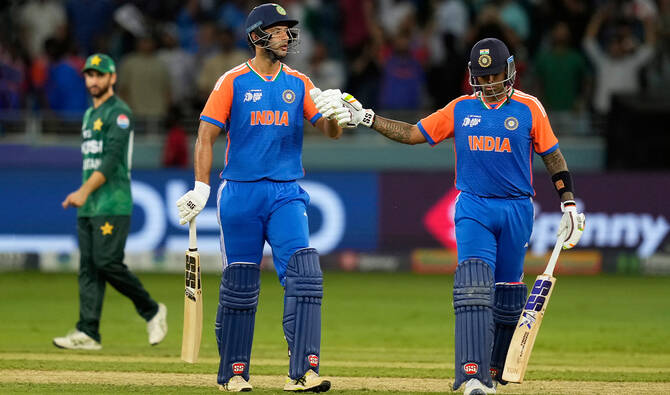
India’s captain Suryakumar Yadav (right) celebrates with batting partner Shivam Dube after their win in the Asia Cup cricket match against Pakistan at Dubai International Cricket Stadium in Dubai, United Arab Emirates, on September 14, 2025. (AP)
Short Url
Updated 15 September 2025
Follow

Pakistan coach disappointed India did not shake hands at Asia Cup

  • India won by seven wickets in first match between two sides after Pakistan, India’s military clash in May
  • Captains of both teams did not shake hands at the toss while players also refrained from doing so at end 

DUBAI: Pakistan head coach Mike Hesson said they were disappointed by India’s decision not to shake hands after Sunday’s politically-charged Asia Cup match between the bitter neighbors.

India won the Group A encounter by seven wickets in the first cricket match between the sides since a four-day military conflict between the nuclear-armed neighbors in May.

While the match itself passed without incident, there was no shaking of hands between the captains at the toss or among the players at the end.

“We were ready to shake hands at the end of the game, we obviously are disappointed that our opposition didn’t do that,” Hesson told reporters.

“We sort of went over there to shake hands and they’d already gone into the changing room.

“That was a disappointing way for the match to finish, and a match we were disappointed for the way we played, but we were certainly willing to shake hands.”

Pakistan captain Salman Agha did not attend the presentation ceremony, which New Zealander Hesson said was a “follow-on effect” of India’s refusal to shake hands.

India captain Suryakumar Yadav dedicated their victory to their armed forces at the ceremony, and expressed solidarity with the victims of the April 22 attack in Indian Kashmir which triggered the conflict.

In the post-match press conference, Suryakumar said the players were aligned with the Indian cricket board and government.

“We took a call (on not shaking hands). We came here to just play the game. We have given a proper reply,” said the batter.

Bilateral cricket between India and Pakistan remains suspended since 2013 and the arch-rivals play each other only in multi-team tournaments.

Sunday’s match went ahead despite calls in India for the team to boycott it.

India could face Pakistan twice more at the tournament, including in the September 28 final should the teams advance that far.


Pakistan Air Force conducts ‘Exercise Golden Eagle’ to test combat readiness, agility

Updated 10 February 2026
Follow

Pakistan Air Force conducts ‘Exercise Golden Eagle’ to test combat readiness, agility

  • The exercise follows an intense, four-day Pakistan-India military conflict in May 2025
  • It focused on AI-enabled operations integrating disruptive technologies, military says

ISLAMABAD: The Pakistan Air Force (PAF) has conducted “Exercise Golden Eagle” that successfully validated its combat readiness and operational agility through synchronized employment of the PAF’s complete combat potential, the Pakistani military said on Tuesday.

It comes months after Pakistan’s four-day military conflict with India in May, with Islamabad claiming victory in the standoff after the PAF claimed to have shot down at least six Indian fighter aircraft, including the French-made Rafale. New Delhi acknowledged some losses but did not specify a number.

The exercise was conducted on a Two-Force construct, focusing on AI-enabled, net-centric operations while integrating indigenous niche, disruptive and smart technologies in line with evolving regional security dynamics, according to the Inter-Services Public Relations (ISPR), the Pakistani military’s media wing.

Operating within a robust Integrated Air Defense System, friendly forces shaped the battlespace through seamless fusion of kinetic operations with cyber, space and electro-magnetic spectrum operations.

“The kinetic phase featured First-Shoot, First-Kill swing-role combat aircraft equipped with long-range BVR air-to-air missiles, extended-range stand-off weapons and precision strike capabilities, supported by Airborne Early Warning & Control platforms and Air-to-Air Refuelers,” the ISPR said in a statement.

“A key highlight of the exercise was Manned–Unmanned Teaming, with deep-reach killer drones and loitering munitions operating in a highly contested, congested and degraded environment, validating PAF’s capability to conduct high-tempo operations in modern warfare.”

In recent months, many countries have stepped up defense engagement with Pakistan, while delegations from multiple nations have proposed learning from the PAF’s multi-domain air warfare capabilities that officials say were successfully employed during the May conflict.

“The successful conduct of Exercise Golden Eagle reaffirms Pakistan Air Force’s unwavering commitment to maintaining a high state of operational preparedness, leveraging indigenous innovation and effectively countering emerging and future security challenges,” the ISPR added.