Pakistan invites global crypto firms to seek virtual asset service licenses

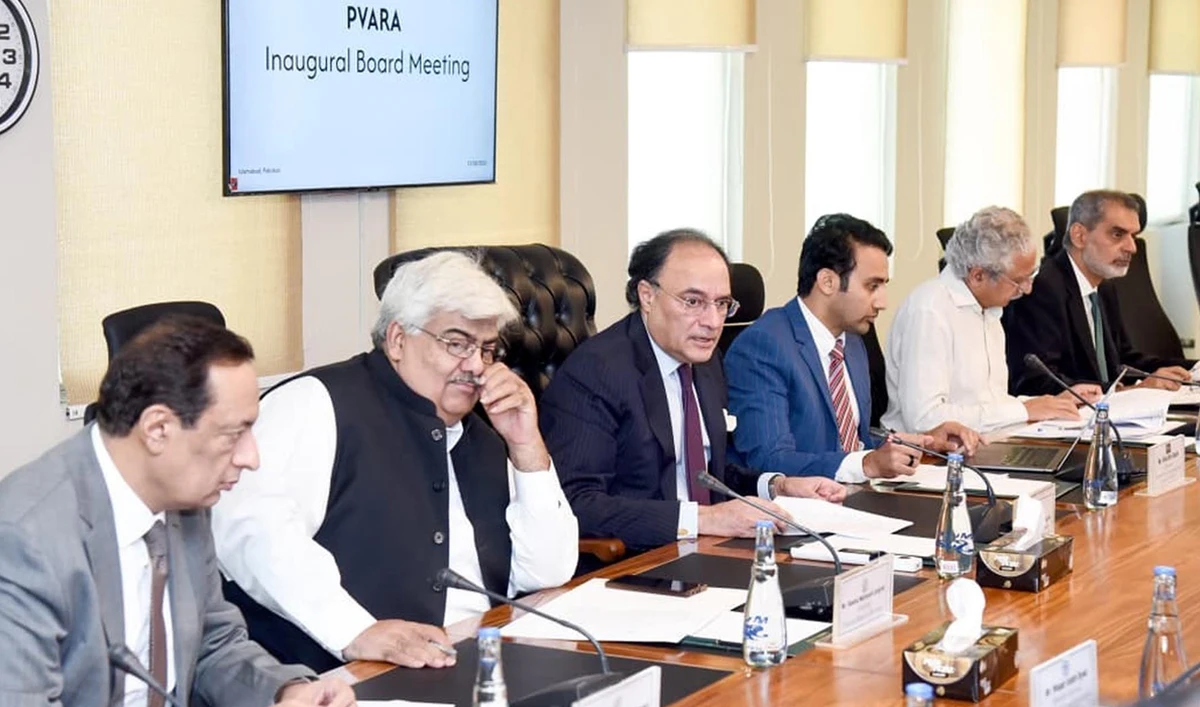
Finance Minister Muhammad Aurangzeb (third left) chairs the inaugural board meeting of the Pakistan Virtual Assets Regulatory Authority (PVARA) in Islamabad, Pakistan, on August 26, 2025. (PID/File)
Short Url
Updated 14 September 2025
Follow

Pakistan invites global crypto firms to seek virtual asset service licenses

  • Country says its digital market serves over 40 million users with $300 billion in annual trading
  • Government calls licensing a key move to align Pakistan’s crypto sector with global financial rules

KARACHI: Pakistan on Saturday invited international crypto exchanges and other virtual asset service providers (VASPs) to apply for licenses to operate in the country, in a move aimed at formalizing and regulating a fast-growing digital market that authorities say serves over 40 million users with about $300 billion in annual trading volume.

The call for expressions of interest (EoI) comes from the newly created Pakistan Virtual Asset Regulatory Authority (PVARA), set up under the Virtual Assets Ordinance 2025. The agency said the initiative will bring Pakistan’s virtual asset sector in line with global standards on anti-money laundering and counter-terrorism financing and provide a secure framework for fintech innovation.

“This EoI is our invitation to the world’s leading VASPs to partner in building a transparent and inclusive digital financial future for Pakistan,” said Bilal bin Saqib, PVARA chairman and minister of state for crypto and blockchain.

According to a statement issued by his office, applicants must already be licensed in at least one major jurisdiction and show strong compliance with anti-money laundering, counter-terrorism financing and know-your-customer rules.

Required submissions include company profiles, licensing details, operational overviews, compliance histories and proposed business models for Pakistan.

The authority, governed by a board that includes the heads of the State Bank of Pakistan, the Securities and Exchange Commission and the Federal Board of Revenue, will oversee licensing and supervision, and offer regulatory sandboxes to encourage Shariah-compliant innovation.

PVARA said applications will be accepted on a rolling basis via email.

Pakistan views the measure as a “pivotal step” toward integrating its digital-asset economy with global financial norms while protecting consumers and combating illicit finance, the statement added.
Pakistan Air Force conducts ‘Exercise Golden Eagle’ to test combat readiness, agility

Updated 10 February 2026
Follow

Pakistan Air Force conducts ‘Exercise Golden Eagle’ to test combat readiness, agility

  • The exercise follows an intense, four-day Pakistan-India military conflict in May 2025
  • It focused on AI-enabled operations integrating disruptive technologies, military says

ISLAMABAD: The Pakistan Air Force (PAF) has conducted “Exercise Golden Eagle” that successfully validated its combat readiness and operational agility through synchronized employment of the PAF’s complete combat potential, the Pakistani military said on Tuesday.

It comes months after Pakistan’s four-day military conflict with India in May, with Islamabad claiming victory in the standoff after the PAF claimed to have shot down at least six Indian fighter aircraft, including the French-made Rafale. New Delhi acknowledged some losses but did not specify a number.

The exercise was conducted on a Two-Force construct, focusing on AI-enabled, net-centric operations while integrating indigenous niche, disruptive and smart technologies in line with evolving regional security dynamics, according to the Inter-Services Public Relations (ISPR), the Pakistani military’s media wing.

Operating within a robust Integrated Air Defense System, friendly forces shaped the battlespace through seamless fusion of kinetic operations with cyber, space and electro-magnetic spectrum operations.

“The kinetic phase featured First-Shoot, First-Kill swing-role combat aircraft equipped with long-range BVR air-to-air missiles, extended-range stand-off weapons and precision strike capabilities, supported by Airborne Early Warning & Control platforms and Air-to-Air Refuelers,” the ISPR said in a statement.

“A key highlight of the exercise was Manned–Unmanned Teaming, with deep-reach killer drones and loitering munitions operating in a highly contested, congested and degraded environment, validating PAF’s capability to conduct high-tempo operations in modern warfare.”

In recent months, many countries have stepped up defense engagement with Pakistan, while delegations from multiple nations have proposed learning from the PAF’s multi-domain air warfare capabilities that officials say were successfully employed during the May conflict.

“The successful conduct of Exercise Golden Eagle reaffirms Pakistan Air Force’s unwavering commitment to maintaining a high state of operational preparedness, leveraging indigenous innovation and effectively countering emerging and future security challenges,” the ISPR added.