

Libya government reaches agreement with armed group to end Tripoli tensions

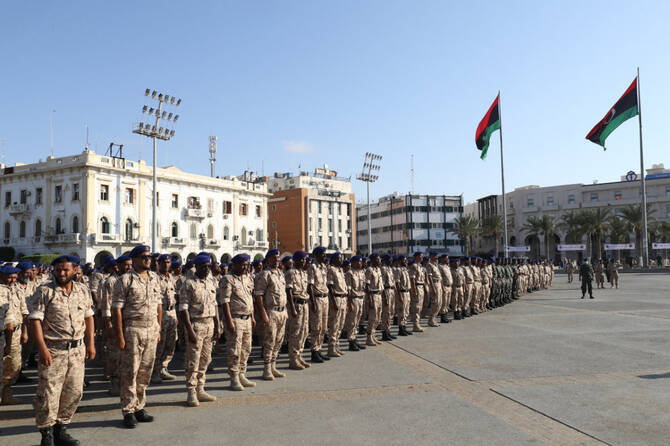
Libyan soldiers take part in a military parade in the capital Tripoli. (AFP file photo)
Short Url
Updated 13 September 2025
Follow

Libya government reaches agreement with armed group to end Tripoli tensions

  • Negotiations between the government and the Radaa Force were reportedly facilitated by Turkiye
  • The Radaa Force controls the east of the capital and Mitiga airport, as well as prisons and detention centers

TRIPOLI: Libya’s UN-recognized government based in Tripoli has reached a preliminary accord with a powerful armed group to end months of tensions that have flared into occasional violence, a government adviser and local media said Saturday.

Negotiations between the government and the Radaa Force were facilitated by Turkiye, according to the same sources.
Ziyad Deghem, an adviser to the head of the Presidential Council transitional body, said the details of the accord “will be announced to the public at a later date.”
Neither Radaa nor the government have so far made any official comments.
However, Libyan broadcaster Al-Ahrar on Saturday posted on X a video that it said showed defense ministry forces entering an airport controlled by Radaa.
The North African country is still plagued by division and instability after years of unrest following the NATO-backed uprising that toppled longtime leader Muammar Qaddafi in 2011.
It remains divided between the UN-recognized government in the west and its eastern rival, backed by military commander Khalifa Haftar.
In mid-May, there were clashes in Tripoli between forces loyal to the government and armed groups that the authorities are trying to dismantle.
Among them is the Radaa Force, which controls the east of the capital and Mitiga airport, as well as prisons and detention centers.
According to a source within the group, cited by Al-Ahrah, the two parties agreed to a “neutral and unified force... managing and securing four airports” in the west, including Mitiga.
The airport, controlled by Radaa since 2011, is the only one to serve the Libyan capital with commercial flights.
Prisons and detention centers managed by the Radaa Force are set to come under the authority of the Attorney General’s office, according to Al-Ahrar.
Speaking on the channel, Deghem thanked Turkiye “for its exceptional efforts” and the UN mission in Libya (UNSMIL) for its “essential and decisive” mediation.


Oman and Lebanon call for full Israeli withdrawal, urge end to attacks

Updated 58 min 46 sec ago
Follow

Oman and Lebanon call for full Israeli withdrawal, urge end to attacks

  • Joseph Aoun and Sultan Haitham bin Tariq make a joint call for an immediate halt to Israeli attacks on Lebanese territory
  • Reaffirmation of the unified Arab position on ending the Israeli occupation and establishing an independent Palestinian state based on the 1967 borders

BEIRUT: Lebanese President Joseph Aoun and his Omani counterpart Sultan Haitham bin Tariq on Wednesday made a joint call for an immediate halt to Israeli attacks on Lebanese territory and a full withdrawal from all occupied Arab lands, warning that continued violations pose a direct threat to regional stability.

The statement came during a high-level summit in Muscat, where both leaders voiced “serious concern over the ongoing Israeli aggression” and described the occupation as a “clear violation” of UN Security Council Resolution 1701 and other international resolutions.

The two sides also expressed support for international efforts to de-escalate tensions, stabilize the situation on the ground, facilitate the return of displaced persons, and advance post-conflict reconstruction.

Aoun led a Lebanese ministerial delegation to Oman that included Lebanon’s ministers of foreign affairs, interior, defense, health, and agriculture for talks with Omani officials.

The joint statement emphasized the strengthening of bilateral ties and expanding cooperation in key sectors including politics, the economy, investment, banking, tourism, transport, and logistics.

Both sides called for early preparations to hold the first session of the Omani-Lebanese Joint Committee, chaired by the two foreign ministers in Muscat, and to pursue new agreements and memorandums of understanding intended to enhance collaboration in trade, culture, and science. The statement also highlighted the need to boost private sector engagement in shared development opportunities.

The Omani side reaffirmed its full support for Lebanon’s sovereignty, independence, and territorial integrity, as well as for strengthening Lebanese state institutions, particularly the army and legitimate security forces, and backing the country’s ongoing economic, financial, and administrative reforms.

The two sides reaffirmed the unified Arab position on ending the Israeli occupation and establishing an independent Palestinian state based on the 1967 borders, with East Jerusalem as its capital. They also underscored the importance of strengthening Arab solidarity, respecting the sovereignty of states, and upholding the principles of good neighborliness and international law.

Aoun’s official visit to Oman took place within the context of Muscat’s established role as a regional and international mediator. During his meetings, Aoun praised Oman’s diplomatic standing and approach, describing it as “wise and responsible.”

He commended Oman’s foreign policy, grounded in dialogue, mediation, balance, and good neighborliness, saying it had earned the sultanate a “distinguished status and a pivotal role in promoting stability and resolving conflicts through peaceful means.”

Aoun said that, in Lebanon, “we hold this wise approach in high regard and deeply value the sultanate’s steadfast support for Lebanon in various international forums, as well as its support as we confront the challenges before us.”

For his part, Sultan Haitham bin Tariq reaffirmed Oman’s continued commitment to Lebanon’s stability and its close monitoring of the latest developments in the country.

He emphasized the deep-rooted relations between the two countries and the importance of strengthening bilateral cooperation and coordination. The sultan also praised the positive contributions of the Lebanese community in Oman.

On the sidelines of the visit, Lebanese Interior Minister Ahmed Al-Hajjar held a meeting with his Omani counterpart Hamoud bin Faisal Al-Busaidi at Al-Alam Palace in Muscat. They underlined the enhancement of joint cooperation, particularly in security and policing.

According to a joint statement, the discussions also covered Lebanon’s efforts to consolidate internal security and maintain stability.

Participating on the Omani side in the expanded talks were Al-Busaidi; Shihab bin Tarik Al-Said, deputy prime minister for defense affairs; Badr bin Hamad Al-Busaidi, foreign minister of Oman; Hamad bin Said Al-Aufi, head of the private office; Mahad bin Said Ba’owain, minister of labor and head of the honorary mission; Saud bin Hamoud Al-Habsi, minister of agricultural, fisheries and water resources; and Hilal bin Ali Al-Sabti, minister of health.