

Police surgeon confirms sexual violence against three minors in Karachi child-abuse case

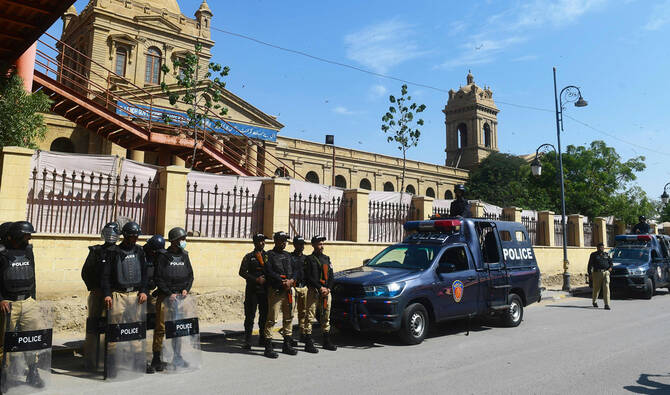
In this file photo, taken on February 8, 2024, policemen stand guard on a street in Karachi. (AFP/File)
Short Url
Updated 13 September 2025
Follow

Police surgeon confirms sexual violence against three minors in Karachi child-abuse case

  • Arrested suspect accused of abusing 100 children, charged under law carrying death penalty
  • Police officials say abuse went undetected for nine years until a shopkeeper raised the alarm

KARACHI: Authorities in Karachi said on Saturday they had confirmed sexual violence against at least three of four minor girls examined after the arrest of a man accused of abusing nearly 100 children over nine years.

The case surfaced earlier this week when one of the alleged victims stole a USB drive from the suspect and took it to a shop to copy a movie. The shopkeeper found hundreds of videos of child abuse on the device and alerted police.

Shabbir Ahmed, a juice vendor originally from Abbottabad, was arrested on Thursday, and investigators said they had recovered more than 400 clips showing assaults on over 100 girls aged between five and 12, some targeted repeatedly over several years.

“Today, four victim girls, one aged seven, two aged ten and one aged 12, were brought in for examination,” Karachi police surgeon Dr. Summaiya Syed told Arab News. “Findings in three of them are suggestive of sexual violence, and medicolegal documentation has been completed.”

Police said on Friday Ahmed began abusing children in 2016, luring them with small amounts of money and assaulting them inside his shuttered shop in the city’s Qayyumabad neighborhood.

A diary recovered from the suspect contained names and records of more than 85 victims, noting their ethnicity. The most recent assault is believed to have taken place on Sept. 4.

The suspect has now been charged under Section 376(3) of the Pakistan Penal Code, which carries the death penalty or life imprisonment for raping a minor. A judicial magistrate has granted police five-day remand for interrogation.

At least five families have lodged formal complaints so far, and more are expected as medical examinations continue, police said.

Child sexual abuse remains widespread in Pakistan. Sahil, a local NGO, recorded 3,364 incidents in 2024, while the Sustainable Social Development Organization (SSDO) documented 5,398 cases between 2019 and 2023.

One of the country’s most notorious cases emerged in Kasur, Punjab province, where between 2006 and 2015 hundreds of videos of mostly male children being abused were circulated illegally, sparking nationwide outrage.


Pakistan PM orders accelerated privatization of power sector to tackle losses

Updated 15 December 2025
Follow

Pakistan PM orders accelerated privatization of power sector to tackle losses

  • Tenders to be issued for privatization of three major electricity distribution firms, PMO says
  • Sharif says Pakistan to develop battery energy storage through public-private partnerships

ISLAMABAD: Pakistan’s prime minister on Monday directed the government to speed up privatization of state-owned power companies and improve electricity infrastructure nationwide, as authorities try to address deep-rooted losses and inefficiencies in the energy sector that have weighed on the economy and public finances.

Pakistan’s electricity system has long struggled with financial distress caused by a combination of factors including theft of power, inefficient collection of bills, high costs of generating electricity and a large burden of unpaid obligations known as “circular debt.” In the first quarter of the current financial year, government-owned distribution companies recorded losses of about Rs171 billion ($611 million) due to poor bill recovery and operational inefficiencies, official documents show. Circular debt in the broader power sector stood at around Rs1.66 trillion ($5.9 billion) in mid-2025, a sharp decline from past peaks but still a major fiscal drain. 

Efforts to contain these losses have been a focus of Pakistan’s economic reform program with the International Monetary Fund, which has urged structural changes in the energy sector as part of financing conditions. Previous government initiatives have included signing a $4.5 billion financing facility with local banks to ease power sector debt and reducing retail electricity tariffs to support economic recovery. 

“Electricity sector privatization and market-based competition is the sustainable solution to the country’s energy problems,” Prime Minister Shehbaz Sharif said at a meeting reviewing the roadmap for power sector reforms, according to a statement from the prime minister’s office.

The meeting reviewed progress on privatization and infrastructure projects. Officials said tenders for modernizing one of Pakistan’s oldest operational hubs, Rohri Railway Station, will be issued soon and that the Ghazi Barotha to Faisalabad transmission line, designed to improve long-distance transmission of electricity, is in the initial approval stages. While not all power-sector decisions were detailed publicly, the government emphasized expanding private sector participation and completing priority projects to strengthen the electricity grid.

In another key development, the prime minister endorsed plans to begin work on a battery energy storage system with participation from private investors to help manage fluctuations in supply and demand, particularly as renewable energy sources such as solar and wind take a growing role in generation. Officials said the concept clearance for the storage system has been approved and feasibility studies are underway.

Government briefing documents also outlined steps toward shifting some electricity plants from imported coal to locally mined Thar coal, where a railway line expansion is underway to support transport of fuel, potentially lowering costs and import dependence in the long term.

State authorities also pledged to address safety by converting unmanned railway crossings to staffed ones and to strengthen food safety inspections at stations, underscoring broader infrastructure and service improvements connected to energy and transport priorities.