

Nepal returns to calm as first woman PM takes charge

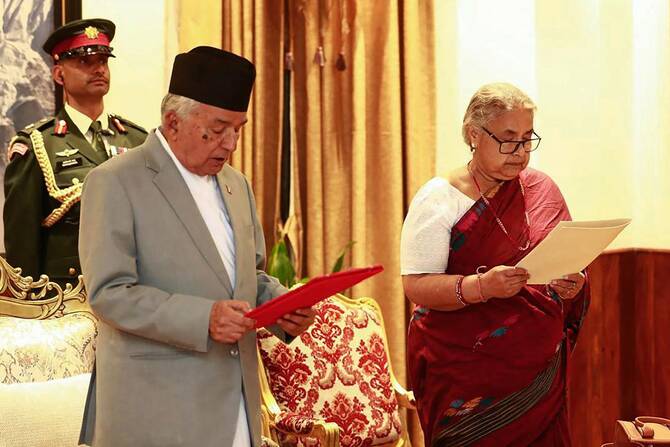
Nepal's President Ram Chandra Paudel (L) administers the oath to the country's newly appointed Prime Minister Sushila Karki during her swearing-in-ceremony at the President House in Kathmandu on September 12, 2025. (AFP)
Short Url
Updated 13 September 2025
Follow

Nepal returns to calm as first woman PM takes charge

KATMANDU: Nepal’s capital on Saturday took a step back toward normality after deadly anti-corruption protests, as daily life returned with a curfew eased and an interim prime minister sworn into office.
Soldiers scaled back their presence on the streets, where they had been deployed in large numbers since Wednesday after violent demonstrations toppled the government and left parliament in flames.
At least 51 people were killed in the worst unrest since the end of a decade-long civil war and the abolition of the monarchy in 2008.
On Friday evening, 73-year-old former chief justice Sushila Karki was sworn in as interim leader, tasked with restoring order and addressing protesters’ demands for a corruption-free future.
Parliament was later dissolved, elections set for March 5, 2026, and work to restore the government began.
By Saturday morning, the mood on the streets was calmer, with markets opening, traffic returning and families visiting temples.

’Satisfied today’

For many Nepalis, Karki’s appointment carried both symbolic weight and the promise of change.
“Nepal has got its first woman prime minister,” said Suraj Bhattarai, 51, a social worker.
“We think that the prime minister — our former chief justice — will address Nepal’s fight against corruption and take good governance forward.”
The appointment of Karki, known for her independence, came after intense negotiations by army chief General Ashok Raj Sigdel and President Ram Chandra Paudel, including with “Gen Z” representatives, the loose umbrella title of the youth protest movement.
Thousands of young activists had used the app Discord to debate the next steps — and name Karki as their choice of next leader.
The new prime minster appeared to be widely welcomed as people sought to put the unrest behind them.
“The interim government decision is good for now,” said Durga Magar, 23, who works in a Katmandu shop.
“The main issue for the people, especially young people, at this time is corruption,” she said.
“It doesn’t matter whether it is Gen Z, or anyone older in politics who tackles it — it just needs to stop,” she added.
Protests, which began Monday and escalated on Tuesday, fed into long-standing economic woes in Nepal.
A fifth of people aged 15-24 are unemployed, according to the World Bank, with GDP per capita standing at just $1,447.
“We don’t know what will happen in the future now but we are satisfied today and hope it will not remain as tense ahead,” Magar added.

’Musical chairs’

Indian Prime Minister Narendra Modi on Saturday offered his “best wishes” to Karki, adding that New Delhi was “firmly committed to the peace, progress and prosperity of the people of Nepal.”
Huge challenges remain.
The protesters’ hope of rooting out endemic corruption is no easy task, while in terms of security, more than 12,500 prisoners who escaped from jails during the chaos are on the run.
But for many, Karki’s swearing-in marks a break from the revolving door of aging prime ministers who fueled public anger with endless political horse-trading.
KP Sharma Oli, the 73-year-old leader of the Communist Party, quit as prime minister on Tuesday, ending his fourth term in the post. His whereabouts are not known.
“They were playing a game of musical chairs,” said Katmandu businessman Shikhar Bajracharya, 32.
“There was no possibility for younger people to come into power.”


Italian police fire tear gas as protesters clash near Winter Olympics hockey venue

Updated 08 February 2026
Follow

Italian police fire tear gas as protesters clash near Winter Olympics hockey venue

  • Police vans behind a temporary metal fence secured the road to the athletes’ village, but the protest veered away, continuing on a trajectory toward the Santagiulia venue

MILAN: Italian police fired tear gas and a water cannon at dozens of protesters who threw firecrackers and tried to access a highway near a Winter Olympics venue on Saturday.
The brief confrontation came at the end of a peaceful march by thousands against the environmental impact of the Games and the presence of US agents in Italy.
Police held off the violent demonstrators, who appeared to be trying to reach the Santagiulia Olympic ice hockey rink, after the skirmish. By then, the larger peaceful protest, including families with small children and students, had dispersed.
Earlier, a group of masked protesters had set off smoke bombs and firecrackers on a bridge overlooking a construction site about 800 meters (a half-mile) from the Olympic Village that’s housing around 1,500 athletes.
Police vans behind a temporary metal fence secured the road to the athletes’ village, but the protest veered away, continuing on a trajectory toward the Santagiulia venue. A heavy police presence guarded the entire route.
There was no indication that the protest and resulting road closure interfered with athletes’ transfers to their events, all on the outskirts of Milan.
The demonstration coincided with US Vice President JD Vance’s visit to Milan as head of the American delegation that attended the opening ceremony on Friday.
He and his family visited Leonardo da Vinci’s “The Last Supper” closer to the city center, far from the protest, which also was against the deployment of US Immigration and Customs Enforcement agents to provide security to the US delegation.
US Homeland Security Investigations, an ICE unit that focuses on cross-border crimes, frequently sends its officers to overseas events like the Olympics to assist with security. The ICE arm at the forefront of the immigration crackdown in the US is known as Enforcement and Removal Operations, and there is no indication its officers are being sent to Italy.
At the larger, peaceful demonstration, which police said numbered 10,000, people carried cardboard cutouts to represent trees felled to build the new bobsled run in Cortina. A group of dancers performed to beating drums. Music blasted from a truck leading the march, one a profanity-laced anti-ICE anthem.
“Let’s take back the cities and free the mountains,” read a banner by a group calling itself the Unsustainable Olympic Committee. Another group called the Association of Proletariat Excursionists organized the cutout trees.
“They bypassed the laws that usually are needed for major infrastructure project, citing urgency for the Games,” said protester Guido Maffioli, who expressed concern that the private entity organizing the Games would eventually pass on debt to Italian taxpayers.
Homemade signs read “Get out of the Games: Genocide States, Fascist Police and Polluting Sponsors,” the final one a reference to fossil fuel companies that are sponsors of the Games. One woman carried an artificial tree on her back decorated with the sign: “Infernal Olympics.”
The demonstration followed another last week when hundreds protested the deployment of ICE agents.
Like last week, demonstrators Saturday said they were opposed to ICE agents’ presence, despite official statements that a small number of agents from an investigative arm would be present in US diplomatic territory, and not operational on the streets.