

South Sudan’s opposition says government trying to enforce ‘one-tribe rule’

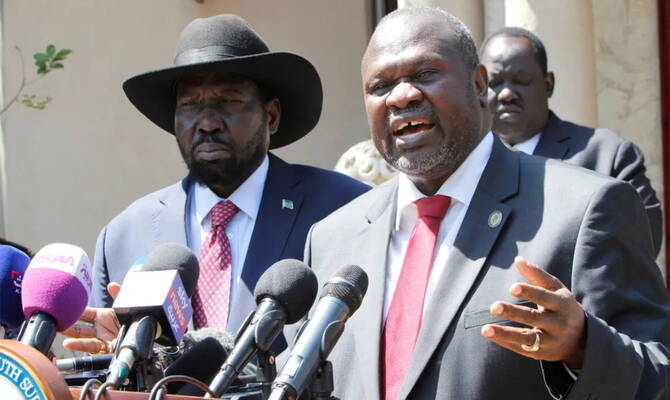
South Sudan's opposition has accused the government of trying to enforce "authoritarian control and one-tribe rule" after First Vice President Riek Machar was charged with orchestrating militia attacks and suspended from his role. (Reuters/File)
Short Url
Updated 12 September 2025
Follow

South Sudan’s opposition says government trying to enforce ‘one-tribe rule’

  • “The charges are fabricated to abrogate the (peace agreement), sideline Dr. Machar and the SPLM-IO, and entrench total government control,” SPLM-IO party said
  • Political analysts say Kiir has long been seeking to replace Machar with his close ally, Second Vice President Benjamin Bol Mel

JUBA: South Sudan’s opposition has accused the government of trying to enforce “authoritarian control and one-tribe rule” after First Vice President Riek Machar was charged with orchestrating militia attacks and suspended from his role.

Machar’s SPLM-IO party rejected the charges against him and 20 others which included murder, treason and crimes against humanity for their alleged involvement in raids by the White Army militia in the northeast in March.

Machar’s detention under house arrest since March has ignited international fears of a renewal of a devastating 2013-2018 civil war between his ethnic Nuer forces and Dinka fighters loyal to his longtime rival President Salva Kiir.

Kiir and Machar served in a unity government as part of a peace deal that ended that war, but their partnership remained strained and sporadic violence has continued between the two sides.

“The charges are fabricated to abrogate the (peace agreement), sideline Dr. Machar and the SPLM-IO, and entrench total government control,” Machar’s SPLM-IO party said in a statement late on Thursday shortly after the justice ministry announced the charges.

Political analysts say Kiir has long been seeking to replace Machar with his close ally, Second Vice President Benjamin Bol Mel, who was sanctioned by the US over suspicions that he received preferential treatment in securing government contracts.

South Sudanese officials have asked the US to lift those sanctions during recent bilateral discussions, Joseph Szlavik, a lobbyist working for Juba in Washington, told Reuters last month.

Those conversations have also touched on sending more US deportees to South Sudan following the arrival in July of eight men, including seven from third countries, Szlavik said.


Venezuela swears in 5,600 troops after US military build-up

Updated 2 sec ago
Follow

Venezuela swears in 5,600 troops after US military build-up

CARACAS: The Venezuelan army swore in 5,600 soldiers on Saturday, as the United States cranks up military pressure on the oil-producing country.
President Nicolas Maduro has called for stepped-up military recruitment after the United States deployed a fleet of warships and the world’s largest aircraft carrier to the Caribbean under the pretext of combating drug trafficking.
American forces have carried out deadly strikes on more than 20 vessels, killing at least 87.
Washington has accused Maduro of leading the alleged “Cartel of the Suns,” which it declared a terrorist organization last month.
Maduro asserts the American deployment aims to overthrow him and seize the country’s oil reserves.
“Under no circumstances will we allow an invasion by an imperialist force,” Col. Gabriel Rendon said Saturday during a ceremony at Fuerte Tiuna, Venezuela’s largest military complex, in Caracas.
According to official figures, Venezuela has around 200,000 troops and an additional 200,000 police officers.
A former opposition governor died in prison on Saturday where he had been detained on charges of terrorism and incitement, a rights group said.
Alfredo Diaz was at least the sixth opposition member to die in prison since November 2024.
They had been arrested following protests sparked by last July’s disputed election, when Maduro claimed a third term despite accusations of fraud.
The protests resulted in 28 deaths and around 2,400 arrests, with nearly 2,000 people released since then.
Diaz, governor of Nueva Esparta from 2017 to 2021, “had been imprisoned and held in isolation for a year; only one visit from his daughter was allowed,” said Alfredo Romero, director of the NGO Foro Penal, which defends political prisoners.
The group says there are at least 887 political prisoners in Venezuela.
Opposition leader and Nobel Peace Prize laureate Maria Corina Machado condemned the deaths of political prisoners in Venezuela during “post-electoral repression.”
“The circumstances of these deaths — which include denial of medical care, inhumane conditions, isolation, torture, cruel, inhuman and degrading treatment — reveal a sustained pattern of state repression,” Machado said in a joint statement with Edmundo Gonzalez Urrutia, the opposition candidate she believes won the election.