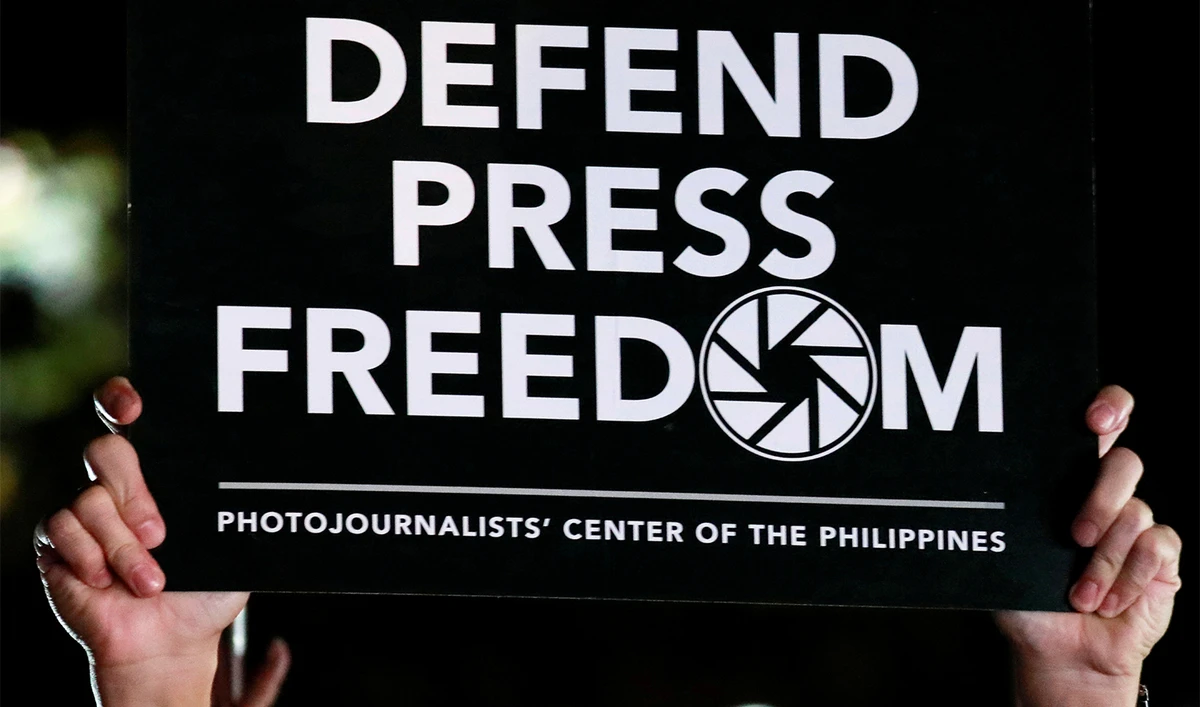
Freedom of the press at its lowest in 50 years – study

A photojournalist raises a placard in a rally for press freedom in Quezon City, Philippines, on February 15, 2019. (REUTERS/File)
Short Url
Updated 11 September 2025
Follow

Freedom of the press at its lowest in 50 years – study

  • IDEA report says Afghanistan, Burkina Faso and Myanmar saw steepest press-freedom declines worldwide
  • Defamation cases against journalists surge in South Korea, highlighting risks to media freedom in democracies

STOCKHOLM: Press freedoms worldwide have declined significantly over the past five years to hit their lowest level in 50 years, a report by a democracy think tank showed Thursday.

Afghanistan, Burkina Faso and Myanmar — already among the poorest performers in press freedoms — posted the biggest falls, the report by the Stockholm-based International Institute for Democracy and Electoral Assistance (IDEA) said.

The fourth-biggest drop was in South Korea, it added, citing “a spike in defamation cases initiated by the government and its political allies against journalists, and raids on journalists’ residences.”

“The current state of democracy in the world is concerning,” IDEA secretary general Kevin Casas-Zamora, secretary general told AFP.

More than half of countries in the world (54 percent), registered a drop in one of the five key democracy indicators between 2019 and 2024, the report said.

“The most important finding in our report is the very acute deterioration in press freedom around the world,” Casas-Zamora said.

Between 2019 and 2024, it saw “the biggest drop over the past 50 years.”

“We’ve never seen such an acute deterioration in a key indicator of democratic health,” he said.

Press freedoms declined in 43 countries across all continents, including 15 in Africa and 15 in Europe.

“There’s a toxic brew that is coming together, which involves, on the one hand, heavy-handed interventions on the part of governments,” some of them “legacies of what happened during the pandemic.”

On the other hand, “you have the very negative impact of disinformation, some of which is real disinformation and some of which is used as a pretext by governments to clamp down on press freedoms.”

The think tank is concerned about the consolidation of traditional media worldwide, as well as the “disappearance in many countries of local media which plays a very important role in supporting a democratic debate,” Casas-Zamora said.

The report only covers the period 2019 to 2024 and does not include the first effects of US President Donald Trump’s return to the White House in January.

But “some of the things that we saw during the election at the end of last year and in the first few months of 2025 are fairly disturbing,” Casas-Zamora said.

“Since what happens in the US has this ability to go global, this does not bode well for democracy globally,” he added.
‘Stay out of our politics,’ Australia’s former PM tells Netenyahu

Former Australian Prime Minister Malcolm Turnbull talks to the UK’s Channel 4 News. (Screenshot)
Updated 7 sec ago
Follow

‘Stay out of our politics,’ Australia’s former PM tells Netenyahu

  • Turnbull slams Israeli prime minister in Channel 4 interview
  • Netanyahu’s attempts to link Bondi massacre to Palestine policy ‘unhelpful’

LONDON: Australia’s former prime minister Malcolm Turnbull has told Benjamin Netanyahu to “stay out of our politics” after the Israeli leader linked the recognition of Palestine to the Bondi Beach mass shooting.
Fifteen people were killed when a father and son opened fire on people celebrating the Jewish festival of Hanukkah on Sunday evening.
Netanyahu said Australia's decision to recognize Palestinian statehood earlier this year had poured “oil on the fire of antisemitism” in the weeks leading up to the attack.
When asked about the comments on Channel 4 News in the UK, Turnbull said: “I would respectfully say to Bibi Netanyahu, please stay out of our politics.
“If you've got that kind of commentary to make, you are not helping … and it’s not right.”
Turnbull backed the current Australian Prime Minister Anthony Albanese’s government for recogizing Palestinian statehood in August along with many other Western nations as international pressure grew over the war in Gaza.
In a speech after the Bondi attack, Netanyahu said: “A few months ago I wrote to the Australian prime minister that your policy is pouring oil on the fire of antisemitism.”
He added: “Antisemitism is a cancer that spreads when leaders are silent.”
Turnbull said the vast majority of countries in the world recognize Palestine as a state and support a two-state solution to the conflict.
He said Australia is a very successful multicultural society that can not allow foreign conflicts to be imported.
“We need to ensure that that wars in the Middle East or wars in any other part of the world are not fought out here,” he said. “Trying to link them, which is what Netanyahu has done, is not helpful and that's exactly the reverse of what we want to achieve.”
Albanese also rejected Netanyahu’s comments when asked about whether there was a link between his approach to Palestine and the Bondi attack.
“Overwhelmingly, most of the world recognizes a two-state solution as being the way forward in the Middle East,” he told broadcasters. “This is a moment of national unity where we need to come together … We need to wrap our arms around members of the Jewish community who are going through an extraordinarily difficult period.”
Albanese visited in hospital the man hailed a s hero for disarming one of the attackers.
Ahmed Al-Ahmed, a shopkeeper who moved to Australia from Syria in 2007, is recovering after tackling the gunman.