

Pakistan voices sorrow over deadly Nepal protests, urges harmony

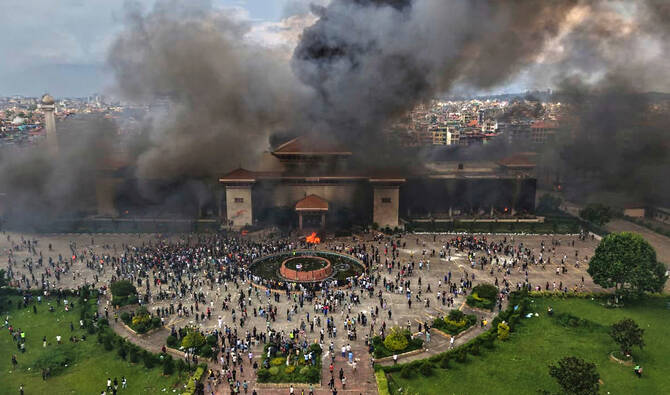
Protesters celebrate at the parliament building after it was set on fire during a protest against social media ban and corruption in Kathmandu, Nepal, on Sept. 9, 2025. (AP)
Short Url
Updated 11 September 2025
Follow

Pakistan voices sorrow over deadly Nepal protests, urges harmony

  • The deadly ‘Gen Z protests’ in Nepal toppled the country’s prime minister this week
  • The unrest was triggered by social media ban, leaving at least 25 dead and 600 injured

ISLAMABAD: Pakistan on Wednesday expressed grief over the loss of life in Nepal’s recent political unrest and voiced hope that the Himalayan nation will move toward harmony and “renewed hope” in the days ahead.

The statement came as soldiers guarded Nepal’s parliament and patrolled deserted streets of the capital Katmandu under curfew after two days of deadly anti-corruption protests forced Prime Minister K.P. Sharma Oli to resign.

The turmoil, ignited by a social-media ban announced last week, has left at least 25 people dead and more than 600 injured, with demonstrators torching the homes of senior ministers.

The army has warned that any “vandalism, looting, arson and attacks on individuals and property in the name of protest will be considered punishable crimes.”

“Pakistan is deeply grieved at the loss of precious lives in Nepal,” the foreign office said in a statement circulated in Islamabad late Wednesday. “We convey condolences to the bereaved families and offer prayers for the swift recovery of the injured.”

“We trust that the resilience of the Nepalese people will shape a future marked by harmony and renewed hope,” the statement added.

Pakistan and Nepal have maintained friendly ties since establishing diplomatic relations in 1960. Both are members of the South Asian Association for Regional Cooperation (SAARC) and often coordinate on regional trade and climate issues.

Bilateral trade remains small, focused on Pakistani textiles, pharmaceuticals and carpets and Nepali tea, cardamom and herbs, while the two countries have encouraged chambers of commerce to expand links in pharmaceuticals, surgical goods and tourism.

The political upheaval in Nepal, driven largely by young demonstrators and dubbed the “Gen Z protests,” is the second youth-led uprising in South Asia after student demonstrations in Bangladesh toppled Sheikh Hasina’s government last year and altered that country’s regional priorities.


Return of millions of Afghans from Pakistan and Iran pushes Afghanistan to the brink, UN warns

Updated 14 February 2026
Follow

Return of millions of Afghans from Pakistan and Iran pushes Afghanistan to the brink, UN warns

  • Afghan authorities provide care packages for those returning that include food aid, cash, a telephone SIM card and transportation
  • But the returns have strained resources in a country struggling with a weak economy, severe drought and two devastating earthquakes

GENEVA: The return of millions of Afghans from neighboring Pakistan and Iran is pushing Afghanistan to the brink, the U.N. refugee agency said on Friday, describing an unprecedented scale of returns.

A total of 5.4 million people have returned to Afghanistan since October 2023, mostly from the two neighboring countries, UNHCR’s Afghanistan representative Arafat Jamal said, speaking to a U.N. briefing in Geneva via video link from Kabul, the Afghan capital.

“This is massive, and the speed and scale of these returns has pushed Afghanistan nearly to the brink,” Jamal said.

Pakistan launched a sweeping crackdown in Oct. 2023 to expel migrants without documents, urging those in the country to leave of their own accord to avoid arrest and forcible deportation and forcibly expelling others. Iran also began a crackdown on migrants at around the same time.

Since then, millions have streamed across the border into Afghanistan, including people who were born in Pakistan decades ago and had built lives and created businesses there.

Last year alone, 2.9 million people returned to Afghanistan, Jamal said, noting it was “the largest number of returns that we have witnessed to any single country.”

Afghanistan’s Taliban rulers have criticized the mass expulsions.

Afghanistan was already struggling with a dire humanitarian situation and a poor human rights record, particularly relating to women and girls, and the massive influx of people amounting to 12% of the population has put the country under severe strain, Jamal said.

Already in just the month and a half since the start of this year, about 150,000 people had returned to Afghanistan, he added.

Afghan authorities provide care packages for those returning that include some food aid, cash, a telephone SIM card and transportation to parts of the country where they might have family. But the returns have strained resources in a country that was already struggling to cope with a weak economy and the effects of a severe drought and two devastating earthquakes.

In November, the U.N. development program said nine out of 10 families in areas of Afghanistan with high rates of return were resorting to what are known as negative coping mechanisms — either skipping meals, falling into debt or selling their belongings to survive.

“We are deeply concerned about the sustainability of these returns,” Jamal said, noting that while 5% of those who return say they will leave Afghanistan again, more than 10% say they know of someone who has already left.

“These decisions, I would underscore, to undertake dangerous journeys, are not driven by a lack of a desire to remain in the country, on the contrary, but the reality that many are unable to rebuild their viable and dignified lives,” he said.