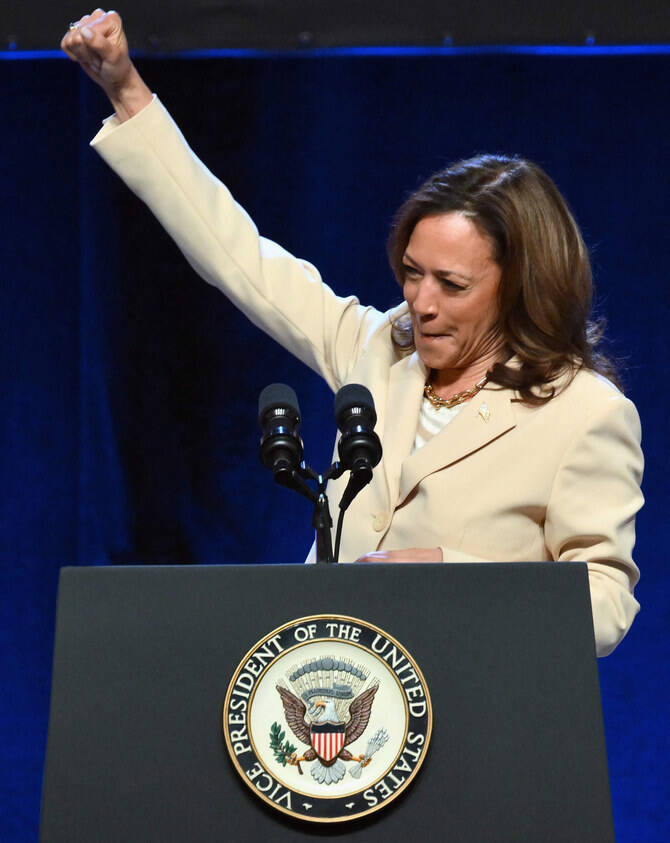
Harris says leaving reelection decision to Biden was ‘recklessness,’ but she defends his abilities

Former Vice President Kamala Harris says it was “recklessness” for Democrats to leave it to President Joe Biden to decide whether to continue seeking another term last year, but she defends his ability to do the job, according an excerpt of her new book. (AFP/File)
Short Url
Updated 10 September 2025
Follow

Harris says leaving reelection decision to Biden was ‘recklessness,’ but she defends his abilities

  • “Was it grace, or was it recklessness? In retrospect, I think it was recklessness,” Harris said
  • The remarks are the first time Harris has been publicly critical of Biden’s decision to run again

WASHINGTON: Former Vice President Kamala Harris says it was “recklessness” for Democrats to leave it to President Joe Biden to decide whether to continue seeking another term last year, but she defends his ability to do the job, according an excerpt of her new book.
Harris, in an excerpt of “107 Days” published Wednesday in The Atlantic, writes that as questions swirled about whether the then-81-year-old Biden should seek re-election, she and others left the decision to him and first lady Jill Biden.
“Was it grace, or was it recklessness? In retrospect, I think it was recklessness,” Harris said.
The remarks are the first time Harris has been publicly critical of Biden’s decision to run again — an ill-fated decision that saw him drop out in July 2024 after a disastrous debate performance, leaving her to head up the Democratic ticket and ultimately lose to Republican Donald Trump.
“The stakes were simply too high,” Harris writes in the book. “This wasn’t a choice that should have been left to an individual’s ego, an individual’s ambition. It should have been more than a personal decision.”
Biden’s office did not immediately have a comment Wednesday.
Throughout the campaign and in its wake, Harris had avoided much criticism of the president she served beside and defended him amid questions about his mental acuity.
In the book excerpt, Harris continues to defend Biden’s ability to do the job but describes him in 2024 and especially at the time of his “debate debacle” as “tired.”
“On his worst day, he was more deeply knowledgeable, more capable of exercising judgment, and far more compassionate than Donald Trump on his best. But at 81, Joe got tired. That’s when his age showed in physical and verbal stumbles,” Harris writes. “I don’t think it’s any surprise that the debate debacle happened right after two back-to-back trips to Europe and a flight to the West Coast for a Hollywood fundraiser. I don’t believe it was incapacity.”
She adds that if she believed Biden were incapacitated, she would have said so out of loyalty to the country.
Harris also blames those close to Biden for unflattering media coverage throughout the time she served as vice president and throwing her under the bus to boost Biden’s public standing.
She writes about receiving a high level of scrutiny as the first female vice president but says “when the stories were unfair or inaccurate, the president’s inner circle seemed fine with it. Indeed, it seemed as if they decided I should be knocked down a little bit more.”
Harris writes that she often learned that Biden’s staff was “adding fuel to negative narratives” that surrounded her, such as stories about her vice presidential office being in disarray and having high turnover.
The former vice president also accuses Biden’s staff of being afraid of her upstaging him, describing a speech she gave in Selma, Alabama, in March of last year in which she called for an immediate ceasefire in Gaza and more humanitarian aid to be delivered to people there.
“It went viral, and the West Wing was displeased,” Harris says, “I was castigated for, apparently, delivering it too well.”
She suggests that diminishing her also diminished Biden, especially “given the concerns about his age.”
Harris’ success, she writes, would be a marker of Biden’s good judgment and a reassurance to the public that if something happened to the president, she could step in.
“My success was important for him,” she writes. “His team didn’t get it.”
Harris’ book, whose title is a nod to the length of her abbreviated presidential campaign, is set to be published by Simon & Schuster on Sept. 23.


Trump’s failed bid to elevate an Arab American ally shows cracks in his political coalition

Osama Siblani, Donald Trump, Bill Bazzi and Amer Ghalib. (Agencies)
Updated 5 sec ago
Follow

Trump’s failed bid to elevate an Arab American ally shows cracks in his political coalition

  • “President Trump has an incredible relationships with Arab leaders around the world,” White House spokesperson Anna Kelly said in a statement

WASHINGTON: When Donald Trump won his comeback campaign, he credited the mayor of a small Detroit suburb with helping him make inroads with Michigan’s Arab American community. As a reward, Trump nominated Amer Ghalib to serve as US ambassador to Kuwait.
But Ghalib is not on his way to the oil-rich nation in the Arabian Gulf. Instead, he is still in Hamtramck, population 30,000, after his nomination stalled because of opposition from Trump’s fellow Republicans.
It’s not clear whether the White House will submit Ghalib’s name again, and he said it does not matter either way: “I’m not interested in it anymore.”
The nomination’s unraveling has exacerbated tensions between Republicans and an Arab American community that, dissatisfied with Democratic President Joe Biden’s handling of the war in Gaza, helped send Trump back to the White House. Although Trump was successful in 2024, a key constituency may not be there for his party in the November midterm elections, when control of Congress is up for grabs.
“It’s hard for me to try and convince the community to vote again Republican in 2026 and 2028 with this kind of an atmosphere,” said Bishara Bahbah, who chaired Arab Americans for Trump.
Opposition on Capitol Hill
At the last rally of his campaign, in the predawn hours before polls opened, Trump embraced Ghalib on a Michigan stage. He called the mayor “one of the greatest men in your state.” It was a long way from eight years earlier, when Trump campaigned on a promise to ban Muslims from entering the United States.
Not only did Trump win Michigan, he earned strong support from Arab Americans. He even won Dearborn, where nearly half the city’s roughly 110,000 residents are of Arab descent.
But after Trump selected Ghalib for the diplomatic post, the reception on Capitol Hill was markedly colder.
“Your long-standing views are directly contrary to the views and positions of President Trump and to the position of the United States,” Sen. Ted Cruz, R-Texas, said at a hearing last year. “I for one, I’m not going to be able to support your confirmation.”
Cruz was joined by senators from both parties in questioning Ghalib about past comments and social media activity, including some that were labeled as antisemitic. Asked about “liking” a Facebook comment comparing Jewish people to monkeys, Ghalib said he had a “bad habit” of acknowledging nearly every response on his posts but stressed that he disagreed with the statement.
Sen. Jeanne Shaheen, D-N.H., asked Ghalib about a previous comment that allegations of sexual violence during the Oct. 7, 2023, attack by Hamas against Israel were untrue. Ghalib said he condemned all abuses but claimed that he had not seen the evidence himself.
He drew further scrutiny for describing former Iraqi leader Saddam Hussein as a martyr.
While no vote was taken after the hearing, the Republican opposition put Ghalib’s nomination on a near-certain path to failure.
“President Trump has an incredible relationships with Arab leaders around the world,” White House spokesperson Anna Kelly said in a statement. She added that he “continues to deliver on the promises he made to Arab Americans and all communities by cooling inflation, securing the border, and restoring peace through strength.”
’Widespread disappointment’
Another former mayor who helped Trump with the Arab American community, Bill Bazzi of Dearborn Heights, had more luck than Ghalib. He was sworn in as US ambassador to Tunisia in October.
To some critics, the administration is sidelining Arab American voices after highlighting them during the campaign.
Bahbah said he recently spent more than a week in Michigan absorbing a sense of “widespread disappointment.”
“First of all, many of the promises that were made to the community have not been fulfilled. That’s what I’m told,” he said. “Secondly, the whole issue of immigration and visas is really rattling the community. ICE (Immigration and Customs Enforcement) is rattling the community, even those with citizenships.”
To top it off, Bahbah said, people feel that “grocery bills are much higher than they used to be.”
Many leaders in Michigan’s Arab American community emphasized that Trump’s success had less to do with support for the Republican candidate than anger at Biden.
But the reality of Trump’s second term has been more complicated than some expected. An agreement intended to stop the war in Gaza has brought mixed reactions because it “seems to be a one-sided ceasefire,” said Bahbah. He also said immigration enforcement has taken a toll in Arab American communities.
“People are terrorized,” Bahbah said. “They’re afraid.”
“This is not what the community voted for,” he added.
A splintering coalition
Ghalib emphasized that he is not upset with the president, saying “he was loyal and supportive.”
But he said “those who opposed me for nonsense reasons have made the community upset, and they will have to work hard to restore their relationship with the community.”
Ghalib’s criticism of Republicans reflects the fragility of the coalition Trump assembled in 2024. Not only did he improve his standing with Arab Americans, he also increased his share of Black and Latino voters.
But with dissatisfaction on the rise, sustaining that support is proving difficult.
Osama Siblani, editor of The Arab American News in Dearborn, said he does not believe that Trump’s success in 2024 will be repeated.
“He has no support in this community with or without Ghalib,” Siblani said.