

Egypt’s CPI rises 0.2% in August as food, housing costs climb

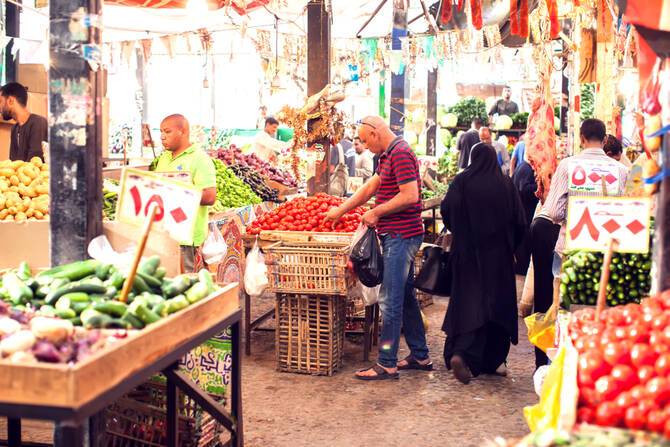
The headline consumer price index reached 257.1 points, up from 256.6 in July, according to the latest data from the Central Agency for Public Mobilization and Statistics, or CAPMAS. Shutterstock
Short Url
Updated 10 September 2025
Follow

Egypt’s CPI rises 0.2% in August as food, housing costs climb

JEDDAH: Egypt’s consumer prices rose 0.2 percent in August, reversing July’s drop, as higher food, tobacco, housing and healthcare costs outweighed declines in meat, fruits and sugar. 

The headline consumer price index reached 257.1 points, up from 256.6 in July, according to the latest data from the Central Agency for Public Mobilization and Statistics, or CAPMAS. 

Annual inflation slowed to 11.2 percent from 13.1 percent a month earlier. 

The rise in Egypt’s CPI comes amid ongoing efforts to stabilize the economy following a series of external shocks, including regional conflicts and Red Sea trade disruptions, according to a July report by the International Monetary Fund.  

It noted that while inflation has eased since September 2023, it remains a key policy challenge due to its heavy impact on purchasing power. 

Food and beverages rose 0.1 percent on the month, led by dairy, cheese and eggs up 0.8 percent, mineral water and juices up 0.8 percent, and oils, fats, coffee and grains each up 0.1 percent.  

Prices declined for meat and poultry by 1.3 percent, fish and seafood by 0.5 percent, fruits by 0.5 percent and sugar by 0.4 percent. 

Outside food, tobacco climbed 1 percent on higher cigarette prices, while clothing and footwear gained 0.9 percent. Housing, water, electricity, gas and fuel advanced 0.5 percent, driven by a 0.9 percent increase in actual rents.  

Household equipment and maintenance rose 1 percent, supported by appliances up 1.4 percent and maintenance goods up 1.1 percent. 

Healthcare increased 0.8 percent on the back of hospital services rising 2.8 percent, while transport slipped 0.3 percent as services declined 0.8 percent. Restaurants and hotels gained 0.4 percent, and miscellaneous goods and services added 0.4 percent. 

On an annual basis, healthcare costs surged 34.2 percent, housing rose 20.1 percent, tobacco 24.6 percent and transport 21.4 percent. Food and beverages increased 1.3 percent, underscoring divergent price pressures across Egypt’s consumption basket.  

With external financing stabilized through IMF support and ongoing reforms, Egyptian authorities are aiming to balance fiscal consolidation with measures to shield vulnerable groups from inflation shocks. 


Saudi Arabia’s economy expands by 4.8% in Q3: GASTAT 

Updated 7 sec ago
Follow

Saudi Arabia’s economy expands by 4.8% in Q3: GASTAT 

RIYADH: Saudi Arabia’s gross domestic product expanded by 4.8 percent in the third quarter of this year compared to the same period in 2024, driven by growth in both oil and non-hydrocarbon sectors, official data showed. 

According to estimates by the General Authority for Statistics, oil activities in the Kingdom advanced by 8.3 percent year on year in the third quarter, while the non-oil sector recorded a growth rate of 4.3 percent during the same period. 

Government activities also expanded by 1.4 percent compared to the same quarter of the previous year. 

The strong performance underscores progress under the Kingdom’s Vision 2030 strategy, which aims to diversify the economy and reduce reliance on crude revenues. 

“The main driver of growth in real GDP was non-oil activities, which contributed 2.4 percentage points. Oil activities contributed 2 percentage points. Net taxes on products and government activities contributed 0.2 percentage points each,” said GASTAT. 

All economic activities recorded positive annual growth. Petroleum refining achieved the highest rate in the third quarter, rising 11.9 percent year on year, followed by crude petroleum and natural gas activities at 7.3 percent, and electricity, gas and water activities at 6.4 percent. 

On a seasonally adjusted basis, Saudi Arabia’s GDP expanded by 1.4 percent in the third quarter compared to the previous three months. 

Oil activities grew by 3.3 percent quarter on quarter, while government activities and non-oil activities advanced by 1 percent and 0.6 percent, respectively. 

Regarding the trade balance, exports increased 18.4 percent year on year in the third quarter and 7.5 percent quarter on quarter. 

Imports rose by 4.3 percent compared to the same period last year, although inbound shipments were down 1.2 percent from the previous quarter. 

Earlier this month, the World Bank upgraded its 2025 economic growth forecast for Saudi Arabia to 3.8 percent, up from its earlier estimate of 3.2 percent, citing renewed momentum in both oil and non-oil sectors. 

In October, the International Monetary Fund also raised its economic growth forecast for the Kingdom to 4 percent for both 2025 and 2026.