DUBAI: Less than a year after Syria’s new president, Ahmad Al-Sharaa, declared an end to the country’s reign as the world’s biggest Captagon exporter, a new hub for the drug production and trafficking is emerging in northeast Africa: war-torn Sudan, raising fears that Arab Gulf states could once again become the primary target of traffickers.
Over the past decade, the region has struggled to curb the flow of the amphetamine-style pills flooding Gulf markets in an illicit trade fueled by Bashar Assad’s regime, which turned Captagon production into a lifeline against international sanctions with the support of its now-weakened ally Hezbollah in Lebanon.

A customs agent checks boxes of oranges in Lebanon. (AFP/File)
By June, six months after the fall of Assad’s government, Syria’s new authorities announced the dismantling of all Captagon production facilities and the seizure of about 200 million pills, declaring an end to a narco-economy which was worth an estimated $5.7 billion in 2021.
However, a new hub was already emerging in Sudan, a country torn apart since April 2023 by fighting between the Sudanese Armed Forces (SAF) and the paramilitary group, Rapid Support Forces (RSF), with conditions similar to that which existed in Syria at the height of its Captagon boom.
Dubbed “poor man’s cocaine,” Captagon is a cheaply produced, highly addictive amphetamine that has spread among militias and terrorist groups, including Daesh in Syria, and partygoers in the Middle East for its ability to heighten concentration, boost physical endurance, induce euphoria and suppress hunger.
In February, Sudan’s authorities seized a factory near Al-Jaili oil refinery in once RSF-controlled north Khartoum Bahri, housing a machine that produced 100,000 Captagon pills per hour and raw material to manufacture 700 million pills.
“A large portion of the drugs produced had been consumed by RSF fighters to boost their power and stamina in battle, while others were smuggled to neighboring regions inside Sudan and abroad by foreign mercenaries to their home countries,” a Sudanese officer told reporters at the abandoned factory site in February.
“The site also contained modern machines that had not yet been put into production.”
Dubbed the largest lab bust in the country’s history, the operation showed how Captagon manufacturing had surged from a 7,200-pill-per-hour facility uncovered in 2023 among the three major production sites exposed during the war, according to a report published by the Washington-based think tank New Lines Institute last month.

The wreckage of cars lie on the remains of the Shambat Bridge, which connects Omdurman and Bahri in Sudan. (AFP/File)
The report noted a sharp rise in both the scale and sophistication of Captagon production since Sudan’s war began, drawing parallels with the conditions that once fueled Syria’s drug industry and warning that Sudan is emerging as a new manufacturing hub.
With weak governance, fragile security institutions, widespread corruption, porous borders and strategic access to Red Sea shipping routes and Arab Gulf consumer markets, Sudan offers traffickers the ideal environment for illicit production.
Experts warn that Captagon revenues could empower militias and warlords — particularly the RSF — to fund their battles and prolong Sudan’s war in ways reminiscent of Syria, with accelerated production posing fresh dangers for the wider region.
Caroline Rose, a Captagon expert at New Lines Institute, said the scale of recent seizures in Sudan shows how quickly criminal networks are adapting in the post-Assad era by establishing alternative manufacturing hubs even without firm evidence of direct links to Syria’s once-vast narco-economy.
“Some of the packaging material for Captagon found in the Sudanese laboratory seizure in February was routed back to a Syrian veterinary company in Damascus though the company’s legitimacy has been debated,” Rose told Arab News.
She reported that several Syrian Interior Ministry officials confirmed at the annual New Lines Institute Captagon Trade Conference last month that Assad regime-aligned criminal actors like Amr Al-Sheikh expanded operations into Africa with aims to exploit Sudan’s civil war for manufacturing and trafficking.
FASTFACTS
• Sudan’s strategic proximity to traditional Captagon-producing countries in the Levant proves its value in the drug trade.
• The UAE and Saudi Arabia foiled a bid to smuggle 89,760 Captagon pills inside clothing buttons in a joint operation on Aug. 31.
The institute was unable to identify from where the precursor chemicals used to make the drug came. “It is possible that precursor materials are either being routed from Syria into Libya, or potentially by the Red Sea from major pharmaceutical hubs like India,” Rose told Arab News.
Fenethylline — the core component of Captagon, a codrug of amphetamine and theophylline — is said to be easy to manufacture with household chemicals and commercially available solvents, making the drug both cheap to produce and difficult to control.
While most Sudanese seizures have revealed little about a shipment’s origin or destination, one case logged in the New Lines Comprehensive Captagon Seizure Database on April 4, 2024, identified Kuwait as a transit country.
“This could mean that the consignment was either sent to Sudan from Kuwait to satisfy local demand (meaning it is a destination market), or that criminal actors sought to re-transit the consignment through Sudan and back to Gulf destination markets,” Rose told Arab News.
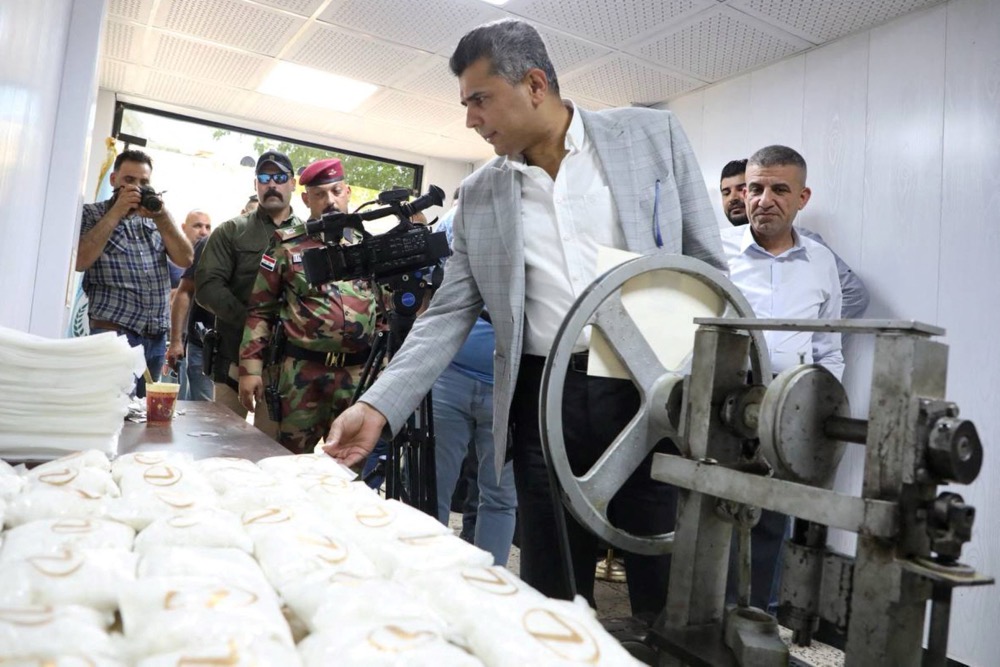
An Iraqi official inspects bags of captagon pills in Baghdad. (AFP/File)
Rose pointed to a high possibility that the large majority of Captagon produced in and transited through Sudan is destined for proven consumer markets in the Gulf Cooperation Council region. Saudi Arabia has long been targeted by Captagon traffickers because of its young demographic and extensive borders with Jordan and Iraq.
During Assad days, Captagon pills were usually smuggled from Syria and Lebanon to Jordan, and trafficked from there to the Gulf countries. Some shipments were transported by air and sea routes with the pills hidden in or among products.
Saudi Arabia alone recorded the confiscation of 700 million pills from 2014-2022.
However, recent seizures in the Gulf show the Captagon threat is far from over after Assad’s fall — only shifting to new sites and more complex smuggling routes.

The region has struggled to curb the flow of the amphetamine-style pills flooding Gulf markets in an illicit trade fueled by Bashar Assad’s regime. (AFP)
On Aug. 31, the UAE and Saudi Arabia foiled a bid to smuggle 89,760 Captagon pills worth $1.1 million hidden inside clothing buttons in a joint operation. Earlier that month, Saudi authorities seized a truck loaded with 406,395 pills concealed in sheep wool at Haditha port.
In July, Saudi security authorities arrested eight people for attempting to smuggle 300,000 pills through Jeddah Islamic Port, hidden inside vehicle parts.
In a report in “Foreign Policy” in January, Rose and Matthew Zweig, senior policy director at FDD Action, warned that the fall of Assad only complicates the Captagon trade as criminal actors will deploy their work elsewhere.
“Without production hubs in Syria, Captagon criminal agents are no longer tied down and can now stretch their operations beyond Syria to destinations unknown,” they wrote.
They reported that criminal actors have already established Captagon production and trafficking sites in Lebanon, Iraq, Turkiye and Kuwait to be close to consumption markets in the Gulf region and beyond.
The problem was compounded by the survival of technical know-how, since many smugglers and distributors evaded arrest after Syria’s crackdown, according to a June report by the New Lines Institute.
Sudan’s strategic proximity to traditional Captagon-producing countries in the Levant helps explain the country’s value in the drug trade, according to analysts.
Rose said that while Sudan is unlikely to become a full-fledged narco-state, its rise as a hub could destabilize the region by filling regional supply gaps left after the closure of Syria’s major Captagon labs and stockpiles.
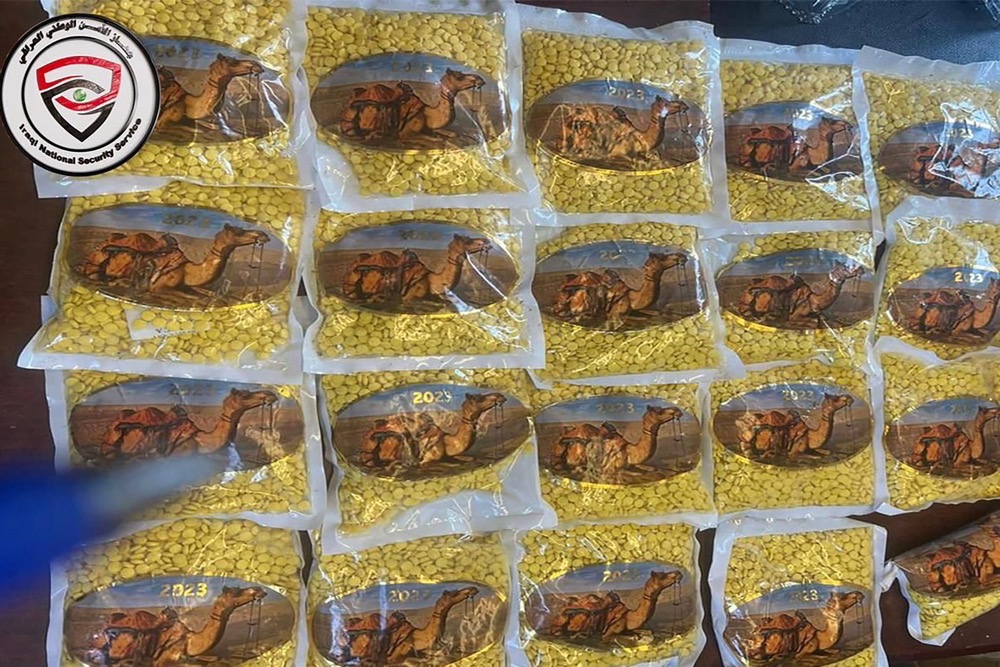
Iraqi officials confiscated 44,000 captagon tablets in the northern province of Nineve. (AFP/File)
“By helping fill some of this gap, Sudanese criminal actors will be able to keep Captagon prices low, while exploiting and potentially exacerbating the civil war’s effects,” Rose told Arab News.
She added: “Even with small-scale production and proximity to Gulf destination markets across the Red Sea, Captagon revenues could very well enrich warring factions to raise funds for recruitment, equipment and operations.”
Last month, Sudanese authorities seized 4.5 million Captagon pills in two separate operations in Shendi, in River Nile state, in what the official news agency (SUNA) called “the largest shipment of Captagon in the country’s history.” The drugs were reportedly hidden inside a truck concealed on a farm, intended for internal smuggling across the River Nile state.
Authorities said a “foreign criminal network” behind the shipment was arrested, reporting that local forces had rejected bribes offered in exchange for letting the shipments pass.
The seizure confirmed various reports of widespread corruption and bribery among police officers inside Sudan that might have facilitated Captagon smuggling in collaboration with militia and foreign mercenaries. Militia members were also reported to use the drug to stay alert, gain physical stamina and beat hunger in the famine-ravaged country.

Smoke plumes billow from a fire at a lumber warehouse in southern Khartoum during fighting between the army and the RSF. (AFP/File)
To date, neither the SAF nor the RSF has issued a public denial in response to allegations of involvement in Captagon production or smuggling.
Rose said to curb the threat of Captagon in the Middle East, regional players must exchange as much information and intelligence to identify the spillover of the drug’s trafficking and production outside Syria, particularly into Africa.
“It’s key that the new Syrian Interior Ministry conducts investigations into how regime-aligned actors began to establish operations and partnerships in Sudan, Iraq, Libya, and other countries, which could support the trade’s growth in the post-Assad era,” she said.