

Flood-hit India, Pakistan face rising basmati prices amid crop losses

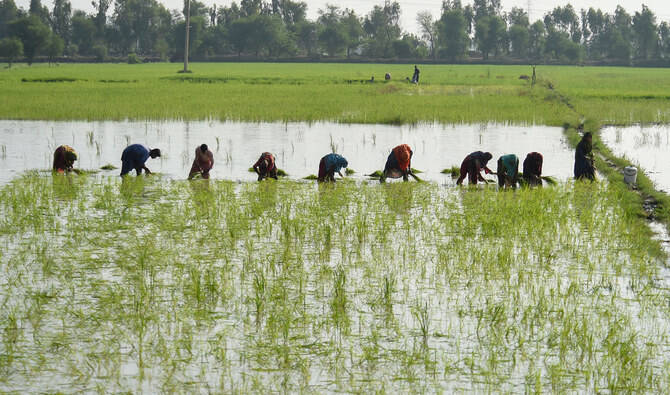
In this picture, taken on September 2, 2022, farmers plant paddy saplings in a field in flood-hit Sukkur, Sindh province. (Photo courtesy: AFP)
Short Url
Updated 08 September 2025
Follow

Flood-hit India, Pakistan face rising basmati prices amid crop losses

  • India’s northern states of Punjab and Haryana contribute over 80 percent, while Pakistan’s Punjab province accounts for over 90 percent of the total basmati rice production
  • Heavy rainfall in late August and earlier this month caused the Ravi, Chenab, Sutlej, and Beas rivers to overflow, flooding these regions in the two countries

MUMBAI/KARACHI: Heavy rains and widespread flooding in basmati rice-growing regions of India and Pakistan have raised concerns over output of the premium staple, driving prices higher as supplies are expected to fall.

India and Pakistan exclusively grow aromatic basmati rice, which sells for nearly twice the price of regular varieties and is primarily imported by Britain, the Middle East, and the United States.

Floods have severely affected the basmati rice crop, but with waters now receding, losses are expected to remain limited provided there is no additional rainfall, said Nitin Gupta, senior vice president at Olam Agri India.

India’s northern states of Punjab and Haryana contribute over 80 percent of the country’s total basmati rice production, while Pakistan’s Punjab province accounts for more than 90 percent of its output.

Heavy rainfall in late August and earlier this month caused the Ravi, Chenab, Sutlej, and Beas rivers to overflow, flooding these regions.

Initial assessments indicate that crops such as paddy, cotton, and pulses on nearly one million hectares were affected in Punjab and Haryana, said an Indian government official.

In Pakistan’s Punjab province rice, sugarcane, corn, vegetables, and cotton on thousands of hectares were submerged earlier this month.

The floods have hit farmers hard, just as crops such as basmati rice and cotton were nearing harvest, said Ibrahim Shafiq, export manager at Latif Rice Mills Pvt Ltd.

In India and Pakistan, paddy seedlings are usually transplanted in June–July, with harvesting starting in late September.

The industry was expecting a bumper crop, but the damage is likely to reduce supplies and push basmati rice prices higher, Shafiq said.

“Conservative estimates put the damage at 20 percent of basmati rice grown in Pakistan...This would definitely drive up the price for basmati rice in local markets as well as international markets,” Shafiq said.

Traders have raised prices by $50 per ton over the past week, and they could rise further if supply shortages remain significant by the end of the harvest, said Gupta of Olam.

However, some industry officials, including Karachi-based Chela Ram Kewlani, say the current price rise is temporarily fueled by reports of crop damage and is expected to ease once supplies from the new season’s harvest arrive.


Pakistan, Iran leaders highlight mutual support after both engaged in short wars this year

Updated 5 sec ago
Follow

Pakistan, Iran leaders highlight mutual support after both engaged in short wars this year

  • Prime Minister Sharif met Iranian President Pezeshkian in Ashgabat on the sidelines of an international forum
  • Pakistani PM also had an informal interaction with President Putin, discussed regional issue with President Erdogan

ISLAMABAD: Prime Minister Shehbaz Sharif and Iranian President Masoud Pezeshkian on Friday praised the support their countries offered one another during episodes of external aggression this year, according to the state media, as they met on the sidelines of an international peace forum in Turkmenistan.

Pakistan fought a four-day war with India in May, when New Delhi fired missiles at its cities and Islamabad responded with retaliatory strikes. Nearly a month after the conflict, Iran waged its own war with Israel after Tel Aviv carried out attacks inside Iranian territory, prompting Tehran to launch a series of missile and drone barrages in response.

The meeting in Turkmenistan came as Pakistan and Iran seek to steady ties after a period of strained security relations, while also attempting to expand economic cooperation and strengthen border management. The two leaders reviewed regional developments, including Pakistan’s concerns over militant attacks it says originate from Afghanistan, and ongoing diplomatic efforts related to Gaza.

“Both leaders appreciated the strong support that their countries had provided to each other when they had faced external aggression earlier this year,” the state-owned Associated Press of Pakistan (APP) said.

Sharif highlighted the outcome of the 22nd Pakistan–Iran Joint Economic Commission held this year and urged closer coordination to increase bilateral trade, operationalize border markets, reinforce border security and revive transport links, including the Islamabad-Tehran-Istanbul rail network.

Pezeshkian, according to the report, said Iran wished to further strengthen ties and thanked Sharif for a “useful and timely exchange of views.”

Sharif also pressed for “meaningful action” from the Afghan Taliban administration to address Pakistan’s security concerns, APP added.

Separately, the Pakistani prime minister met other global leaders attending the forum marking the International Year of Peace and Trust 2025 and Turkmenistan’s Neutrality Day.

He held informal interactions with Russian President Vladimir Putin and discussed regional issues with Turkish President Tayyip Erdogan, Tajik President Emomali Rahmon and Kyrgyz President Sadyr Zhaparov.