

Pakistan chief justice seeks stronger Muslim world ties, unveils AI guidelines for courts

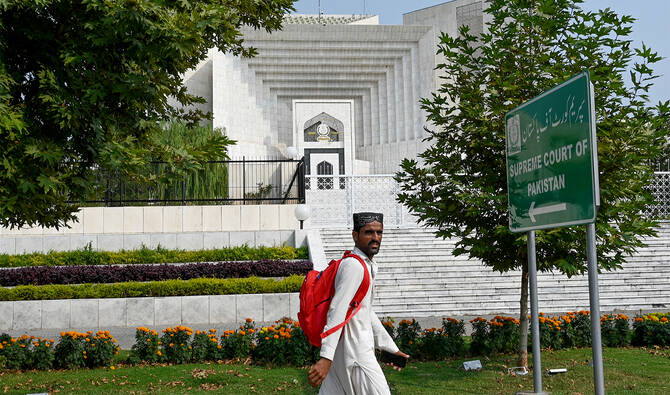
In this photograph taken on October 23, 2024, a man walks past the Pakistan's Supreme Court building in Islamabad. (AFP/File)
Short Url
Updated 08 September 2025
Follow

Pakistan chief justice seeks stronger Muslim world ties, unveils AI guidelines for courts

  • Efforts underway to expand Supreme Court’s collaboration with Saudi Arabia’s Muslim World League, says Justice Yahya Afridi
  • Says a ‘Charter on Ethical Use of AI’ being finalized by the Supreme Court to ensure technology supports judicial efficiency

ISLAMABAD: Pakistan’s Chief Justice Yahya Afridi on Monday said the Supreme Court was expanding partnerships with judicial bodies in Muslim countries and finalizing an ethics charter on artificial intelligence to improve court efficiency.

Justice Afridi was speaking at the Judicial Conference in Islamabad, which is held to mark the beginning of the judicial year. The ceremony was attended by senior judges of the country and members of bar councils to highlight the judiciary’s performance and initiatives. 

The Pakistani judge said that in an interconnected world, it is not possible to strengthen judicial institutions in isolation. He mentioned that the top court had prepared a memorandum of understanding (MoU) with the Supreme People’s Court of China, while a draft MoU with the Constitutional Court of Türkiye is also under review. 

“This Court is also engaged in cooperative exchanges with the Supreme Courts of Bangladesh, Iran, Azerbaijan, and Denmark, and efforts are underway to expand collaboration with the Muslim World League of Saudi Arabia,” Justice Afridi said. 

The Pakistani judge hoped these partnerships would lead to the strengthening of the Supreme Court’s institutional capacity and bring global best practices into Pakistan’s judicial system.

Justice Afridi also spoke about technological reforms taken by the court to improve its efficiency and transform its functions. He said the Supreme Court has introduced digital case filings through which case files are transferred electronically. 

He said the top court has also introduced e-notices, supported by WhatsApp, SMS, and email alerts, and upgraded the digital infrastructure in Islamabad and at the branch registries to facilitate online hearings. It added that the top court has also extended video link services to the country’s high courts. 

Justice Afridi said Model Civil and Criminal Courts are continuing to function with time-bound trials, while mediation facilities were expanded across the provinces and metropolitan family courts to provide speedy justice. 

“In parallel, a Charter on the Ethical Use of AI is being finalized to ensure technology supports judicial efficiency without replacing human discretion,” he said. 

The judge noted that exactly a year ago on Sept. 8, 2024, the number of pending cases with the top court had reached 60,635 while during the year, 20,811 new cases were instituted while 22,863 cases were decided by the Supreme Court. 

“I must add, however, that the backlog could have been reduced even further, had many of our judges not been engaged in larger Constitutional Benches which demand extended hearings,” Justice Afridi said. 


‘Fully stand with Bangladesh’: Pakistan PM backs decision to boycott India match

Updated 04 February 2026
Follow

‘Fully stand with Bangladesh’: Pakistan PM backs decision to boycott India match

  • Pakistan’s government have not allowed the national cricket team to play its World Cup match against India on Feb. 15
  • Pakistan has accused India of influencing ICC decisions, criticized global cricket body for replacing Bangladesh in World Cup

ISLAMABAD: Prime Minister Shehbaz Sharif on Wednesday backed his government’s decision to bar the national men’s cricket team from playing against India in the upcoming T20 World Cup tournament, reaffirming support for Bangladesh. 

Pakistan’s government announced on social media platform X last week that it has allowed its national team to travel to Sri Lanka for the World Cup. However, it said the Green Shirts will not take the field against India on their scheduled match on Feb. 15. 

Pakistan’s participation in the tournament was thrown into doubt after Pakistan Cricket Board (PCB) Chairman Mohsin Naqvi criticized the International Cricket Council (ICC) for replacing Bangladesh with Scotland. The decision was taken after Bangladesh said it would not let its team travel to India out of security concerns. 

During a meeting of the federal cabinet, Sharif highlighted that Pakistan has said that politics should be kept away from sports. 

“We have taken this stand after careful consideration and in this regard, we should stand fully with Bangladesh,” Sharif said in televised remarks. 

“And I believe this is a very reasonable decision.”

Pakistan has blamed India for influencing the ICC’s decisions. The global cricket governing body is currently led by Jay Shah, the head of the Board of Control for Cricket in India. Shah is the son of Indian Home Minister Amit Shah. 

Pakistan’s boycott announcement has triggered media frenzy worldwide, with several Indian cricket experts and analysts criticizing Islamabad for the decision. An India-Pakistan cricket contest is by far the most lucrative and eagerly watched match of any ICC tournament. 

The ICC has ensured that the two rivals and Asian cricket giants are always in the same group of any ICC event since 2012 to capitalize on the high-stakes game. 

The two teams have played each other at neutral venues over the past several years, as bilateral cricket remains suspended between them since 2013 due to political tensions. 

Those tensions have persisted since the two nuclear-armed nations engaged in the worst fighting between them since 1999 in May 2025, after India blamed Pakistan for an attack in Indian-administered Kashmir that killed tourists. 

Pakistan denied India’s allegations that it was involved in the attack, calling for a credible probe into the incident.