


ISLAMABAD: In Pakistan’s federal capital, where public transport options remain limited, Aisha Umar waits at her doorstep with her handbag clutched tightly under her arm. Within minutes, a motorbike with pink and white hues glides to a stop in front of her. The rider — helmet strapped — is not a man but a woman.
For Umer, a 29-year-old working woman, this is more than just a commute. It is relief, safety and a sense of dignity on the road.
While there is a lack of consolidated data, women in Pakistan have long complained of harassment by captains of mainstream ride-hailing apps, with some documented incidents. The helpline of non-profit Digital Rights Foundation, for instance, received eight complaints related to Careem and inDrive in 2022, while police have occasionally registered complaints against drivers in major cities. But experts say most of these cases go unreported, with UN Women and Aurat Foundation surveys showing up to 90% of women face some sort of harassment during commutes, which underscores why women-only services like VSisters are filling the gaps.
Launched in June this year, VSisters is Pakistan’s first women-only ride-hailing service, a bold move aimed at providing safe, comfortable and harassment-free transportation through cars and motorbikes exclusively for women, with both riders and passengers being female.
Currently, the app operates in Islamabad, Rawalpindi and Lahore, with active female captains numbering 464 in total: 64 in Islamabad, 44 in Rawalpindi and 356 in Lahore.
“I got to know about VSisters through Instagram,” Umar told Arab News. “I felt very happy that I can now travel with a female rider. I never felt comfortable with male captains, and the best thing is that their rates are much lower than other apps.”
According to Pakistan’s 2023 population census, women comprise 48.51% of the country’s roughly 241.5 million people. Thousands of them travel daily for education, work and other commitments.

Women wait for transportation in Islamabad on April 21, 2020. (AFP/File)
Umer said she was satisfied with the service, as they reached the desired pick-up point within five to ten minutes.
“I prefer bike because it is easy to get out in a rush and the best thing about them [female riders] is that they never speed recklessly,” she added.
Pakistan’s ride-hailing market is currently dominated by inDrive, Bykea, and Yango after Uber shut down its app in 2024 and Careem suspended its core ride-hailing service in June this year, citing “worsening economic conditions and stiff market competition.”
Hassan Tariq, the founder of VSisters, said the idea came from a painful memory of an incident at a traffic signal in Islamabad, where a woman jumped off the back of a bike and began beating the rider for his humiliating behavior.
“I could feel that the women are actually not very comfortable driving around with the stranger men,” he told Arab News.
“It made me believe that this is the right time to have a dedicated service exclusively for women, where female drivers operate both cars and motorbikes, and the service caters only to female passengers,” he added.
Tariq said the aim of the platform is for women to feel safe and secure, with services run by women, for women and centered entirely around them.
He said the service has completed over 3,500 rides in this short time in three cities and expansion is already underway.
“In just one week, we will expand to Karachi, Faisalabad and Multan, and in the near future, we aim to grow into a nationwide company,” he added.
Describing the criteria to become part of VSisters, he said that for both motorbikes and cars, the requirement was the same: applicants had to be over 18 years of age, with a valid license and a Computerized National Identity Card.
“That’s it. We don’t require anything else on the ground,” he added.
Tariq said that women have to bring their own cars, while motorbikes are provided by the company, as he neither had sponsors nor wanted to run the platform with heavy commercial interests.
“I only keep a small share of 10%, which is very nominal and quite normal,” he added.
Like drivers on other apps, VSisters captains are also considered independent contractors, not formal employees. Pakistan has yet to pass laws guaranteeing benefits for gig workers.
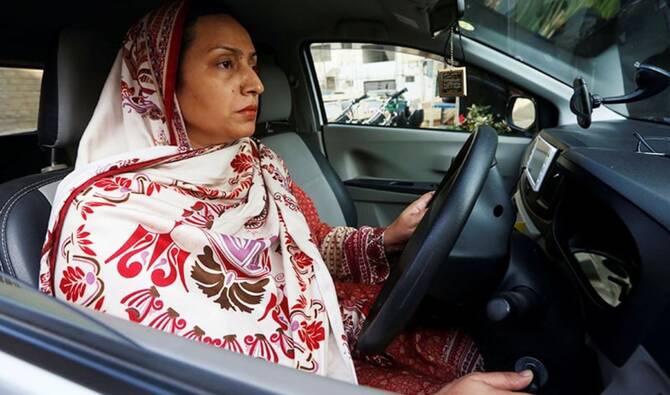
Uzma Ahmed, a VSisters captain, said she found strength behind the wheel.
A 50-year-old divorcee and mother of three, she previously worked as a schoolteacher before deciding to leave her job since her salary could no longer cover her rent and her children’s fees.
“I had no choice,” she said. “I had to run the house.”
Now, as a car captain, she not only earns a respectable livelihood but also gives comfort to other women riding with her.
“When women sit with me, they are happy,” she said, adding sometimes the passengers call their families and tell them they are going with a woman driver.
“We both feel comfortable and talk openly, which is very different from when women ride with men,” Ahmed added.
Today, she drives her own car across Islamabad’s gated communities, confident in her independence.
“It is respectable work,” she added with pride. “With this, I can pay my rent, my children’s fees and stand on my own feet.”
Nadia Shehzad, a bike rider and instructor at VSisters, said she first learned to ride a motorbike through the platform before its launch, and now she trains other young women so they too can start their own work.
“I teach them how to ride the bike, how to use the app, and it is going great,” she said, adding that the whole training was free of cost.
Talking about her experience as a rider, Shehzad said occasionally she faced jeers and abusive remarks, which she ignored.
“All men are not bad, even some praise and give good comments, but others make offensive remarks we usually ignore,” she added.
She explained that the service is mostly used by female university students and working women, whose parents feel more at ease with women drivers, and many passengers prefer bikes as the more affordable option.
“The income depends on the number of rides but usually if a rider does 12 rides in a day, she earns around Rs2,500 ($8.90),” she added.
At approximately Rs2,500 ($8.81) a day, a VSisters rider can earn more than Pakistan’s minimum wage of Rs37,000–40,000 ($140.8) a month. This is a little less than what many Careem and Bykea captains report taking home at around Rs3500 ($12.46), though incomes vary by number of hours.
Pakistani lawyer and activist Nighat Dad, who runs the not-for-profit Digital Rights Foundation organization, termed VSisters a welcome initiative that responds to the “very real fears” women face in Pakistan’s transport sector.
“It not only offers safer commuting options but also new economic opportunities for women drivers,” she told Arab News.
Dad said for VSisters to truly set a new benchmark, it needs to strengthen privacy protections and app reliability alongside its bold vision of women driving women.
“Genuine safety must also mean digital safety and at present the app’s own disclosures show that sensitive location and contact data is collected without encryption, in a country where we still lack a comprehensive data protection law,” she said.


