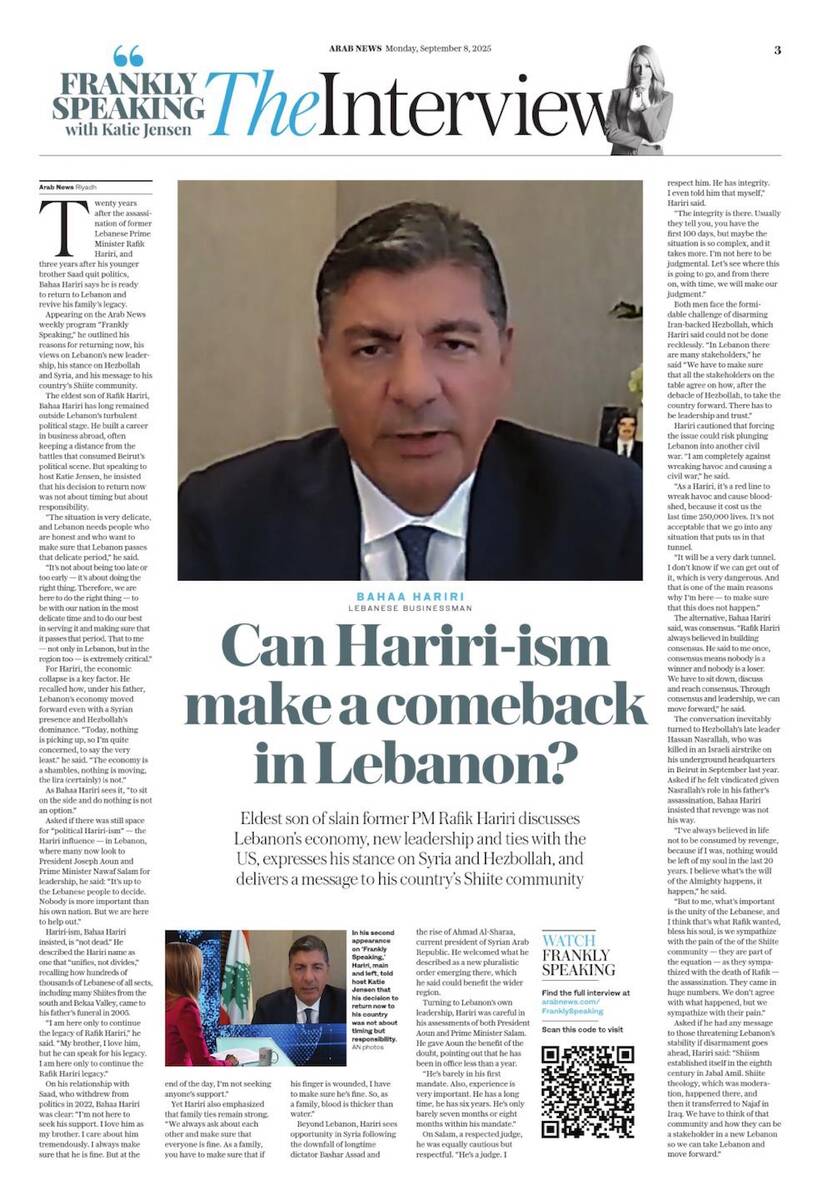
RIYADH: Twenty years after the assassination of former Lebanese Prime Minister Rafik Hariri, and three years after his younger brother Saad quit politics, Bahaa Hariri says he is ready to return to Lebanon and revive his family’s legacy.
Appearing on the Arab News weekly program “Frankly Speaking,” he outlined his reasons for returning now, his views on Lebanon’s new leadership, his stance on Hezbollah and Syria, and his message to his country’s Shiite community.
The eldest son of Rafik Hariri, Bahaa Hariri has long remained outside Lebanon’s turbulent political stage. He built a career in business abroad, often keeping a distance from the battles that consumed Beirut’s political scene. But speaking to host Katie Jensen, he insisted that his decision to return now was not about timing but about responsibility.
“The situation is very delicate, and Lebanon needs people who are honest and who want to make sure that Lebanon passes that delicate period,” he said.
“It’s not about being too late or too early — it’s about doing the right thing. Therefore we are here to do the right thing — to be with our nation in the most delicate time and to do our best in serving it and making sure that it passes that period. That to me — not only in Lebanon, but in the region too — is extremely critical.”

Appearing on the Arab News weekly program “Frankly Speaking,” Hariri outlined his reasons for returning now, his views on Lebanon’s new leadership, his stance on Hezbollah and Syria, and his message to his country’s Shiite community. (AN Photo)
For Hariri, the economic collapse is a key factor. He recalled how, under his father, Lebanon’s economy moved forward even with a Syrian presence and Hezbollah’s dominance. “Today, nothing is picking up, so I’m quite concerned, to say the very least.” he said. “The economy is a shambles, nothing is moving, the lira (certainly) is not.”
As Bahaa Hariri sees it, “to sit on the side and do nothing is not an option.”
Asked if there was still space for political “Hariri-ism” — the Hariri influence — in Lebanon, where many now look to President Joseph Aoun and Prime Minister Nawaf Salam for leadership, he said: “It’s up to the Lebanese people to decide. Nobody is more important than his own nation. But we are here to help out. We are here with our relations to do our best. And I can feel that it’s very much needed because, as we see, the situation is a shambles. It’s only getting worse, not getting better.”
Hariri-ism, Bahaa Hariri insisted, is “not dead.” He described the Hariri name as one that “unifies, not divides,” recalling how hundreds of thousands of Lebanese of all sects, including many Shiites from the south and Bekaa Valley, came to his father’s funeral in 2005.
“I am here only to continue the legacy of Rafik Hariri,” he said. “My brother, I love him, but he can speak for his legacy. I am here only to continue the Rafik Hariri legacy.”
On his relationship with Saad, who withdrew from politics in 2022, Bahaa Hariri was clear: “I’m not here to seek his support. I love him as my brother. I care about him tremendously. I always make sure that he is fine. But at the end of the day, I’m not seeking anyone’s support.”
Yet Hariri also emphasized that family ties remain strong. “We always ask about each other and make sure that everyone is fine. As a family, you have to make sure that if his finger is wounded, I have to make sure he’s fine. So, as a family, blood is thicker than water.”
Beyond Lebanon, Hariri sees opportunity in Syria following the downfall of longtime dictator Bashar Assad and the rise of Ahmad Al-Sharaa, current president of Syrian Arab Republic. He welcomed what he described as a new pluralistic order emerging there, which he said could benefit the wider region.
“It’s crystal clear to me that there is a blessing from everywhere. And it’s crystal clear now that many have joined,” he said.
“There are 2.5 million Orthodox Christians. You have the Shiites that’s looking good. We have the Alawites also coming in. The others who don’t want to be in, they’re welcome when they decide to be in that equation and believe they’re part of Syria. When I see moderation, plurality and diversity, I’m very comfortable, and I wish him all the best in moving forward with his nation.”
Looking to the future, Hariri said: “I am very glad that a tyranny, a massive tyranny that cost 700,000 dead under Assad’s leadership, the almost disintegration of Syria, is over. I wish all the best for the Syrian leadership to move forward.”
Pressed on whether Assad should face justice, Hariri replied: “It’s the Syrian people who decide. But with the killing that happened and everything, Assad has to be prosecuted. It is something that is an international standard. When we have 700,000 people who were killed, there has to be the rule of law that is above all else.
“The families ought to have the right to ask for that and it’s crystal clear they are, and we are fully supporting the demands of these families for, of course, the rule of law — not by blood — but the rule of law to prevail, that there will be a trial, that there will be prosecution.”
Turning to Lebanon’s own leadership, Hariri was careful in his assessments of both President Aoun and Prime Minister Salam.

Lebanese President Aoun (R), Prime Minister Salam (C) and members of the cabinet stand as they attend a cabinet session to discuss the army's plan to disarm Hezbollah. (Reuters)
He gave Aoun the benefit of the doubt, pointing out that he has been in office less than a year. “I would not say that it’s failure. He’s barely in his first mandate. Also, experience is very important. He has a long time, he has six years. He’s only barely seven months or eight months within his mandate,” Hariri said.
“In life you reach a point and you start learning, and I hope through that learning process, he can move forward, and we can take the country to another place. That’s what I wish for.”
On Salam, a respected judge, Hariri was equally cautious but respectful. “He’s a judge. I respect him. He has integrity. I even told him that myself,” he said.
“The integrity is there. Usually they tell you, you have the first 100 days, but maybe the situation is so complex, and it takes more. I’m not here to be judgmental. Let’s see where this is going to go, and from there on, with time, we will make our judgment. We will take our stand.”
Both men face the formidable challenge of disarming Iran-backed Hezbollah, which Hariri said could not be done recklessly. “In Lebanon there are many stakeholders,” he said “We have to make sure that all the stakeholders on the table agree on how, after the debacle of Hezbollah, to take the country forward. There has to be leadership and trust. That’s what is needed badly now.”
Hariri cautioned that forcing the issue could risk plunging Lebanon into another civil war. “I am completely against wreaking havoc and causing a civil war,” he said.
“As a Hariri, it’s a red line to wreak havoc and cause bloodshed, because it cost us the last time 250,000 lives. It’s not acceptable that we go into any situation that puts us in that tunnel.
“It will be a very dark tunnel. I don’t know if we can get out of it, which is very dangerous. And that is one of the main reasons why I’m here, to make sure that this does not happen.”
The alternative, Bahaa Hariri said, was consensus. “Rafik Hariri always believed in building consensus. He said to me once, consensus means nobody is a winner and nobody is a loser. We have to sit down, discuss and reach consensus. Through consensus and leadership, we can move forward,” he said.
Asked if Washington would ultimately stand by Lebanon, Bahaa Hariri highlighted his long support for transatlantic ties, noting his role in founding the Hariri Center at the Atlantic Council.
“I’m an ardent supporter of the transatlantic relationship. The United States must be fully engaged,” he said.
“We fully, fully appreciate the support that it has given, not only today, but throughout the years, especially to the Lebanese army. And I surely, truly believe, yes, pressure, but at the end of the day, they want solutions. And we agree with them that there has to be a solution to move forward. And I truly believe if they commit, they will help.”

Lebanon’s President Joseph Aoun (R) receiving US Navy Admiral Brad Cooper, Commander of USCENTCOM, at the presidential palace in Baabda. (AFP/Lebanese Presidency)
At the same time, he acknowledged the dangers of missteps, saying: “It’s a very sensitive period. Every day, there is something happening. The situation is extremely fluid.”
“But, going back to the US, I truly believe that with the right approach, we can move forward, because they are an absolute must in making sure how we can move forward,” Bahaa Hariri said.
“We saw Ukraine. It’s very important for us to engage the US and make sure that they are approving of where we go. But as a Hariri, I always believe consensus is the key and leadership is the key for us to move forward.”
Asked about his views on the Saudi-brokered Lebanese-Syrian defense deal, Bahaa Hariri stressed his family’s historic ties with Saudi Arabia, dating back to the 1980s. “To us, as Hariris, we’ve always had a long-term relationship with the Saudis. This goes back to the 1980s. It’s very important, for me personally, for Lebanon to have a special relationship with Saudi Arabia.”
The conversation inevitably turned to Hezbollah’s late leader Hassan Nasrallah, who was killed in an Israeli airstrike on his underground headquarters in Beirut in September last year. Asked if he felt vindicated given Nasrallah’s role in his father’s assassination, Bahaa Hariri insisted that revenge was not his way.
“I’ve always believed in life not to be consumed by revenge, because if I was, nothing would be left of my soul in the last 20 years. I believe what’s the will of the Almighty happens, it happen,” he said.
“But to me, what’s important is the unity of the Lebanese, and I think that’s what Rafik wanted, bless his soul, is we sympathize with the pain of the of the Shiite community — they are part of the equation — as they sympathized with the death of Rafik — the assassination. They came in huge numbers. We don’t agree with what happened, but we sympathize with their pain.”
Pressed again if he felt vindicated, Bahaa Hariri said: “To me, it’s justice. I am a man who believes, and I think the divine will is for that to happen. If all of humanity wanted a person to go, but the divine will (is that) he will not, then he will not go. Well, the divine will happened, and he’s gone. And now we have to move forward. And the divine will is the vindication. To me, that’s what’s important.”
Asked about Lebanese Parliament Speaker Nabih Berri, Hariri said he had never met the man but acknowledged the veteran Shiite politician’s responsibility as a leader.
“I wish Berri all the best as being a leader in Lebanon and for him to lead to make sure that we don’t enter into a black hole. He has a responsibility toward the Shiite community to make sure that they are, with the change, a key stakeholder,” he said.
Hariri added: “It’s not like disarm and then what? Post-disarm, where do we go from here? The Shiite community are a key component of the Lebanese configuration. We cannot ignore that. That is a recipe for disaster.”
“I truly believe that, with the right configuration and the right approach, we can convince all the stakeholders that we can move forward. There is hope — with the right leadership.”

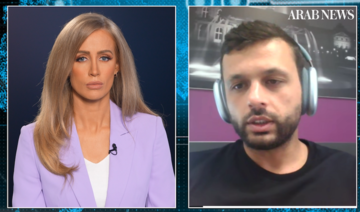
Hariri has long remained outside Lebanon’s turbulent political stage. He built a career in business abroad, often keeping a distance from the battles that consumed Beirut’s political scene. But speaking to host Katie Jensen, he insisted that his decision to return now was not about timing but about responsibility. (AN Photo)
Asked if he had any message for Hezbollah chief Naim Qassem and those threatening Lebanon’s stability if disarmament goes ahead, Hariri said: “Shiism established itself in the eighth century in Jabal Amil. Shiite theology, which was moderation, happened there, and then it transferred to Najaf in Iraq. We have to think of that community and how they can be a stakeholder in a new Lebanon so we can take Lebanon and move forward.
“Because the reality is going to happen in no time in Syria. And that reality will exert a new way to move forward. And it is best for us to say, “Let us adapt ourselves, be all stakeholders, sit down and move forward.”
As Lebanon struggles with economic collapse, frozen banks, stalled reforms and the ever-present specter of conflict, Bahaa Hariri’s return injects a familiar name into the political debate.
But for him, the mission is personal. “I’ve always lived by the values of Rafik in my business and everything I’ve done. And I am not here to take anyone’s continuation, but the Hariri legacy,” Bahaa Hariri said.
“Rafik Hariri, my dad, bless his soul — that’s the only thing that I am bound to.”
Whether the Lebanese public is willing to embrace another Hariri remains to be seen.