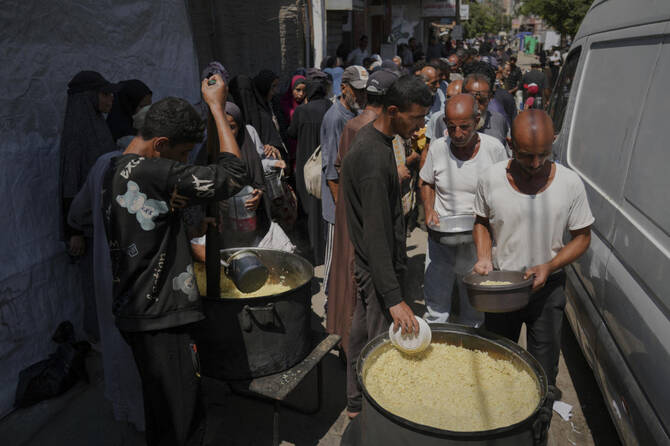
JERUSALEM: There is a “narrow window” to prevent famine from spreading further in Gaza, a top UN official said on Sunday, calling on Israel to allow unimpeded aid delivery in the territory, where it is fighting Palestinian militant group Hamas.
According to a global hunger monitor, hundreds of thousands of Palestinians are already experiencing or at risk of famine in areas including Gaza City, the enclave’s largest urban center, where Israel has launched a new offensive against Hamas.
Israel, which stopped all aid for 11 weeks from March until mid-May, says it is doing more to let aid enter and be distributed in the enclave to prevent food shortages, though international agencies say far more is needed.
“There is a narrow window – until the end of September – to prevent famine from spreading to Deir al Balah (in central Gaza) and Khan Younis (southern Gaza). That window is now closing fast,” said United Nations aid chief Tom Fletcher.
COGAT, the Israeli defense agency that deals with humanitarian issues, said on Sunday that over the past week aid from more than 1,900 trucks, most supplying food, was distributed in Gaza.
“We will continue facilitating humanitarian aid into Gaza for the civilian population — not Hamas,” COGAT said in a statement.
Israel last month launched an assault on the outskirts of Gaza City and its forces are now just a few kilometers from the city center, where it issued warnings over the weekend to civilians to evacuate high rise buildings it says are being used by Hamas, before bombing them.
Israel did not provide evidence to show Hamas was using the buildings, an accusation the militant group denied.
Overnight, strikes killed 14 people across the city, local health officials said, including a strike on a school in southern Gaza City sheltering displaced Palestinians.
The Israeli military said it had struck a Hamas militant and that civilians had been warned before the strike was carried out.
The military on Saturday also warned Gaza City’s civilians to leave for the south, including Khan Younis, where hundreds of thousands of Palestinians are already sheltering in cramped tent encampments along the coast.
“Enough is enough”
With hundreds of thousands of people remaining in Gaza City, pressure is growing to end the war.
“We say to Hamas, we want a ceasefire, end this war before Gaza City is turned into ruins like Rafah,” said Gaza City resident Emad, referring to a southern Gaza City that Israel destroyed earlier in the war.
“We want an end to this war. How long is this going to go on? How many lives are going to be wasted? Enough is enough,” he said by phone, asking for his surname not to be published.
The war has grown increasingly unpopular among Israelis too. On Saturday night, tens of thousands of protesters joined families of hostages at rallies, calling for an end to the war and demanding the release of the hostages.
Twenty of the 48 hostages still in Gaza are believed to still be alive.
Israeli Foreign Minister Gideon Saar said that the war could end immediately if Hamas released the hostages and laid down its weapons.
“We will be more than happy to reach this objective with political means,” he told a press conference in Jerusalem.
In response, senior Hamas official Basem Naim said the group would not disarm but would release all hostages if Israel ended the war and withdrew all its forces from Gaza, reiterating Hamas’ long-standing position.
More than 64,000 Palestinians have been killed by Israel’s military assault, launched after Hamas-led militants carried out the surprise October 7, 2023 attack that killed 1,200 people and saw another 251 abducted and taken into Gaza.
Danish Foreign Minister Lars Lokke Rasmussen, speaking to reporters in Jerusalem alongside his Israeli counterpart, called on Israel to “change course” and stop its military campaign.
“We are extremely concerned about the humanitarian (situation),” he said, also calling for the hostages to be freed.


![]()
UN says time is short to stop famine spreading as Israel bombards Gaza City

Short Url
https://arab.news/9g34t
UN says time is short to stop famine spreading as Israel bombards Gaza City
- According to a global hunger monitor, hundreds of thousands of Palestinians are already experiencing or at risk of famine in areas including Gaza City


Latest updates


© 2026 SAUDI RESEARCH & PUBLISHING COMPANY, All Rights Reserved And subject to Terms of Use Agreement.