Pope feeds fish as he opens Vatican’s ambitious model of sustainable farming and education

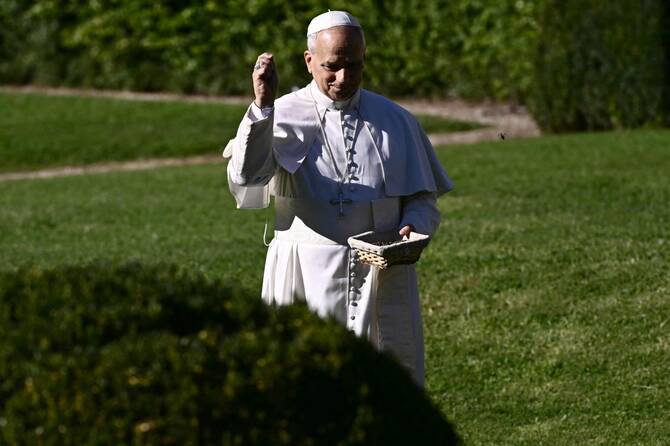
Pope Leo XIV feeds fishes of a pond during the inauguration of the “Borgo Laudato Si’” Advanced Training Center at the papal summer residence in Castel Gandolfo, on Sept. 5, 2025. (AFP)
Short Url
Updated 05 September 2025
Follow

Pope feeds fish as he opens Vatican’s ambitious model of sustainable farming and education

  • Leo has strongly reaffirmed Francis’ focus on the need to care for God’s creation
  • Leo recalled that according to the Bible, human beings have a special place in the act of creation, created in the “image and likeness of God”

ROME: Pope Leo XIV fed fish in the fishpond, pet horses and visited organic vineyards Friday as he inaugurated the Vatican’s ambitious project to turn Pope Francis’ preaching about caring for the environment into practice.
Leo formally opened Borgo Laudato Si, a 55-acre utopian experiment in sustainable farming, vocational training and environmental education located on the grounds of the papal summer retreat in Castel Gandolfo. The Vatican hopes the center, open to student groups, CEOs and others, will be a model of ecological stewardship, education and spirituality for the Catholic Church and beyond.
Leo traveled by helicopter to Castel Gandolfo and then zoomed around the estate’s cypress-lined gardens in an electric golf cart to reach the center, which is named for Francis’ landmark 2015 encyclical “Laudato Si,” or Praised Be. The document, which inspired an entire church movement, cast care for the planet as an urgent and existential moral concern that was inherently tied to questions of human dignity and justice, especially for the poor.
Leo has strongly reaffirmed Francis’ focus on the need to care for God’s creation, and celebrated the first “green” Mass in the estate’s gardens earlier this summer, using a new set of prayers inspired by the encyclical that specifically invoke prayers for creation. On Friday, some 10 years after Laudato Si was published, Leo presided over a liturgy to bless the new center after touring its gardens, farm and classrooms.
Leo recalled that according to the Bible, human beings have a special place in the act of creation, created in the “image and likeness of God.”
“But this privilege comes with a great responsibility: that of caring for all other creatures, in accordance with the creator’s plan,” he said. “Care for creation, therefore, represents a true vocation for every human being, a commitment to be carried out within creation itself, without ever forgetting that we are creatures among creatures, and not creators.”
A greenhouse inspired by St. Peter’s Square
Leo spoke from the heart of the project: a huge greenhouse in the same curved, embracing shape as the colonnade of St. Peter’s Square that faces a 10-room educational facility and dining hall. Once it’s up and running, visiting groups can come for an afternoon school trip to learn about organic farming, or a weekslong course on regenerative agriculture.
The center aims to accomplish many of the goals of the environmental cause. Solar panels provide all the power the facility needs, plastics are banned and recycling and composting systems used to reach zero-waste. Officials say water will be conserved and maximized via “smart irrigation” systems that use artificial intelligence to determine plants’ needs, along with rainwater harvesting and the installation of wastewater treatment and reuse systems.
There is a social component as well. The Vatican’s first-ever vocational school on the grounds will aim to provide on-site training in sustainable gardening, organic winemaking and olive harvesting to offer new job opportunities for particularly vulnerable groups: victims of domestic violence, refugees, recovering addicts and rehabilitated prisoners.
The products made will be sold on-site, with profits re-invested in the educational center: Laudato Si wine, organic olive oil, herbal teas from the farm’s aromatic garden and cheese made from its 60 dairy cows, continuing a tradition of agricultural production that for centuries have subsidized monasteries and convents.
While school groups are a core target audience, organizers also want to invite CEOs and professionals for executive education seminars, to sensitize the world of business to the need for sustainable economic growth.
Officials declined to discuss the financing of the project, other than to say an undisclosed number of partners had invested in it and that confidential business plans precluded the Vatican from releasing further information.


San Francisco parents scramble as teachers strike leaves 50,000 students out of school

Updated 3 sec ago
Follow

San Francisco parents scramble as teachers strike leaves 50,000 students out of school

  • On Tuesday, the San Francisco Unified School District’s 120 schools remained closed for a second day
  • About 6,000 teachers are striking over wages, health benefits, and resources for special needs students
SAN FRANCISCO: Connor Haught has been juggling virtual work meetings and arts and crafts projects for his two daughters as his family tries to navigate a teachers strike in San Francisco with no end date in sight.
Haught’s job in the construction industry allows him to work from home but, like many parents in the city, he and his wife were scrambling to plan activities for their children amid the uncertainty of a strike that has left nearly 50,000 students out of the classroom.
“The big concern for parents is really the timeline of it all and trying to prepare for how long this could go on,” Haught said.
The San Francisco Unified School District’s 120 schools were set to remain closed for a third day Wednesday, after about 6,000 public schoolteachers went on strike over higher wages, health benefits, and more resources for students with special needs.
Some parents are taking advantage of after-school programs offering full-day programming during the strike, while others are relying on relatives and each other for help with child care.
Haught said he and his wife, who works evenings at a restaurant, planned to have their 8- and 9-year-old daughters at home the first week of the strike. They hope to organize play dates and local excursions with other families. They have not yet figured out what they will do if the strike goes on a second week.
“We didn’t try to jump on all the camps and things right away because they can be pricey, and we may be a little more fortunate with our schedule than some of the other people that are being impacted,” Haught said.
The United Educators of San Francisco and the district have been negotiating for nearly a year, with teachers demanding fully funded family health care, salary raises and the filling of vacant positions impacting special education and services.
Teachers on the picket lines said they know the strike is hard on students but that they walked out to offer children stability in the future.
“This is for the betterment of our students. We believe our students deserve to learn safely in schools and that means having fully staffed schools. That means retaining teachers by offering them competitive wage packages and health care and it means to fully fund all of the programs we know the student need the most,” said Lily Perales, a history teacher at Mission High School.
Superintendent Maria Su said Tuesday there was some progress in the negotiations Monday, including support for homeless families, AI training for teachers and establishing best practices for the use of AI tools.
But the two sides have yet to agree on a wage increase and family health benefits. The union initially asked for a 9 percent raise over two years, which they said could help offset the cost of living in San Francisco, one of the most expensive cities in the country. The district, which faces a $100 million deficit and is under state oversight because of a long-standing financial crisis, rejected the idea. Officials countered with a 6 percent wage increase paid over three years.
On Tuesday, Sonia Sanabria took her 5-year-old daughter and 11-year-old nephew to a church in the Mission District neighborhood that offered free lunch to children out of school.
Sanabria, who works as a cook at a restaurant, said she stayed home from work to take care of the children.
“If the strike continues, I’ll have to ask my job for a leave of absence, but it will affect me because if I don’t work, I don’t earn,” Sanabria said.
She said her elderly mother helps with school drop off and pick up but leaving the children with her all day is not an option. Sanabria said she has given them reading and writing assignments and worked with them on math problems. Sanabria said she is making plans for the children day-by-day and expressed support for the striking teachers.
“They are asking for better wages and better health insurance, and I think they deserve that because they teach our children, they take care of them and are helping them to have a better future,” she said, adding, “I just hope they reach agreement soon.”