

Xi and Putin heard on hot mic talking about how long science will extend the human life span

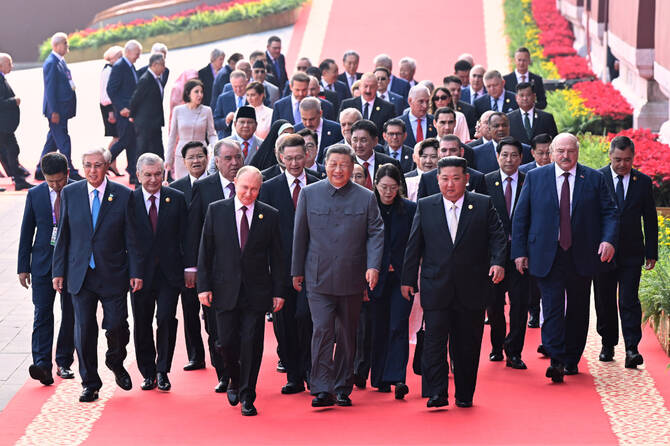
Chinese President Xi Jinping, center, and foreign leaders including Russia President Vladimir Putin, center left, and North Korean leader Kim Jong Un, center right, walk to Tiananmen Rostrum in Beijing on Sept. 3, 2025, ahead of a ceremony to commemorate the 80th anniversary of Japan's World War II surrender in Beijing. (Xinhua News Agency via AP)
Short Url
Updated 05 September 2025
Follow

Xi and Putin heard on hot mic talking about how long science will extend the human life span

  • “In a few decades, ... people will become younger and perhaps even achieve immortality,” Putin says
  • “Some predict that within this century, it may be possible ... may be able to live up to 150 years old,” Xi responds

BEIJING: Chinese leader Xi Jinping and Russia President Vladimir Putin chatted about how advances in science could prolong the human life span in a rare hot mic moment in the Chinese capital.
The brief exchange was captured on a live news video feed of Xi and Putin as they walked on a red carpet with North Korean leader Kim Jong Un at the head of a large cluster of high-level guests. The group was going toward the viewing platform for a major Chinese military parade on Wednesday.
Xi spoke first, and although only parts of his words can be made out, a translator followed in Russian: “Before it’s said to be very rare to live up to 70, and now it’s said that you are still a child at 70.”
Putin, turning toward Xi, gesticulated with pointed fingers as he responded. Kim, on the other side of Xi, turned in to listen to both, breaking into an occasional smile.
The Russian president’s words are inaudible, but after he spoke, an interpreter can be heard translating what he said into Chinese.
“In a few decades, as biotechnology continues to develop, human organs will continue to be transplanted and people will become younger and perhaps even achieve immortality,” the interpreter said.

Xi appeared to break into a slight smile as the interpreter spoke, turning his head once to look at Putin briefly.
The live feed then switched to an overhead view of the viewing platform on historic Tiananmen Gate, but the audio from the walking leaders continued.
A voice that sounded like Xi said, “Some predict that within this century, it may be possible ... .”
Then the audio paused briefly. When it came back, someone can be heard saying at much lower volume, ” ... may be able to live up to 150 years old.”
The second phrase follows naturally from the first one in Chinese, but it’s not clear whether the second one is also Xi or someone else. A translator than said in Russian, “There are forecasts that in this world a person will live up to 100.”
The feed was provided by the parade media center to international news agencies including The Associated Press.
Xi presided over a parade that marked the 80th anniversary of the end of World War II. The fighter jets, missiles and other military hardware were a display of strength intended in part to show the progress the country has made under Communist Party rule.
Later in the day, Putin said at a news conference that Xi had brought up life expectancy while they were walking to the parade.
“The chairman mentioned this,” he said, referring to the Chinese leader. He added that former Italian Prime Minister Silvio Berlusconi had actively promoted the topic in the past.
“Modern health and medical technologies, surgical procedures connected with organ replacements and so on give humanity reason to hope that an active life can continue differently than now,” Putin said. “The average age varies across countries, of course, but life expectancy is significantly increasing.”


UN slams world’s ‘apathy’ in launching aid appeal for 2026

Updated 08 December 2025
Follow

UN slams world’s ‘apathy’ in launching aid appeal for 2026

  • ‘Prioritized’ plan to raise at least $23 billion to help 87 million people in the world’s most dangerous places such as Gaza and Ukraine

UNITED NATIONS, United States:  The United Nations on Monday hit out at global “apathy” over widespread suffering as it launched its 2026 appeal for humanitarian assistance, which is limited in scope as aid operations confront major funding cuts.

“This is a time of brutality, impunity and indifference,” UN humanitarian chief Tom Fletcher told reporters, condemning “the ferocity and the intensity of the killing, the complete disregard for international law, horrific levels of sexual violence” he had seen on the ground in 2025.

“This is a time when the rules are in retreat, when the scaffolding of coexistence is under sustained attack, when our survival antennae have been numbed by distraction and corroded by apathy,” he said.

He said it was also a time “when politicians boast of cutting aid,” as he unveiled a streamlined plan to raise at least $23 billion to help 87 million people in the world’s most dangerous places such as Gaza, Ukraine, Sudan, Haiti and Myanmar.

The United Nations would like to ultimately raise $33 billion to help 135 million people in 2026 — but is painfully aware that its overall goal may be difficult to reach, given US President Donald Trump’s slashing of foreign aid.

Fletcher said the “highly prioritized appeal” was “based on excruciating life-and-death choices,” adding that he hoped Washington would see the choices made, and the reforms undertaken to improve aid efficiency, and choose to “renew that commitment” to help.

The world body estimates that 240 million people in conflict zones, suffering from epidemics, or victims of natural disasters and climate change are in need of emergency aid.

‘Lowest in a decade’

In 2025, the UN’s appeal for more than $45 billion was only funded to the $12 billion mark — the lowest in a decade, the world body said.

That only allowed it to help 98 million people, 25 million fewer than the year before.

According to UN data, the United States remains the top humanitarian aid donor in the world, but that amount fell dramatically in 2025 to $2.7 billion, down from $11 billion in 2024.

Atop the list of priorities for 2026 are Gaza and the West Bank.

The UN is asking for $4.1 billion for the occupied Palestinian territories, in order to provide assistance to three million people.

Another country with urgent need is Sudan, where deadly conflict has displaced millions: the UN is hoping to collect $2.9 billion to help 20 million people.

In Tawila, where residents of Sudan’s western city of El-Fasher fled ethnically targeted violence, Fletcher said he met a young mother who saw her husband and child murdered.

She fled, with the malnourished baby of her slain neighbors along what he called “the most dangerous road in the world” to Tawila.

Men “attacked her, raped her, broke her leg, and yet something kept her going through the horror and the brutality,” he said.

“Does anyone, wherever you come from, whatever you believe, however you vote, not think that we should be there for her?”

The United Nations will ask member states top open their government coffers over the next 87 days — one day for each million people who need assistance.

And if the UN comes up short, Fletcher predicts it will widen the campaign, appealing to civil society, the corporate world and everyday people who he says are drowning in disinformation suggesting their tax dollars are all going abroad.

“We’re asking for only just over one percent of what the world is spending on arms and defense right now,” Fletcher said.

“I’m not asking people to choose between a hospital in Brooklyn and a hospital in Kandahar — I’m asking the world to spend less on defense and more on humanitarian support.”