
LONDON: Marking the latest step in Washington’s policy adjustments toward Damascus, the US Treasury Department said on Aug. 25 it will remove Syria from its sanctions list, allowing American firms to conduct business there.
The change, issued by the Treasury’s Office of Foreign Assets Control, took effect on Aug. 26, ending restrictions first imposed in 2004 and later broadened during Syria’s civil war, rolling back years of measures that had cut the nation off from international markets.
“The decision to update OFAC’s regulations to remove the Syria sanctions program officially formalizes the June 30 executive order and will trigger companies to adjust their compliance programs,” Sameer Saboungi, policy officer and director of legal affairs at the Syrian American Council, told Arab News.
Saboungi said the move should encourage firms to revisit their policies on Syria, calling it “yet another step towards the reintegration of Syria into the global markets.”
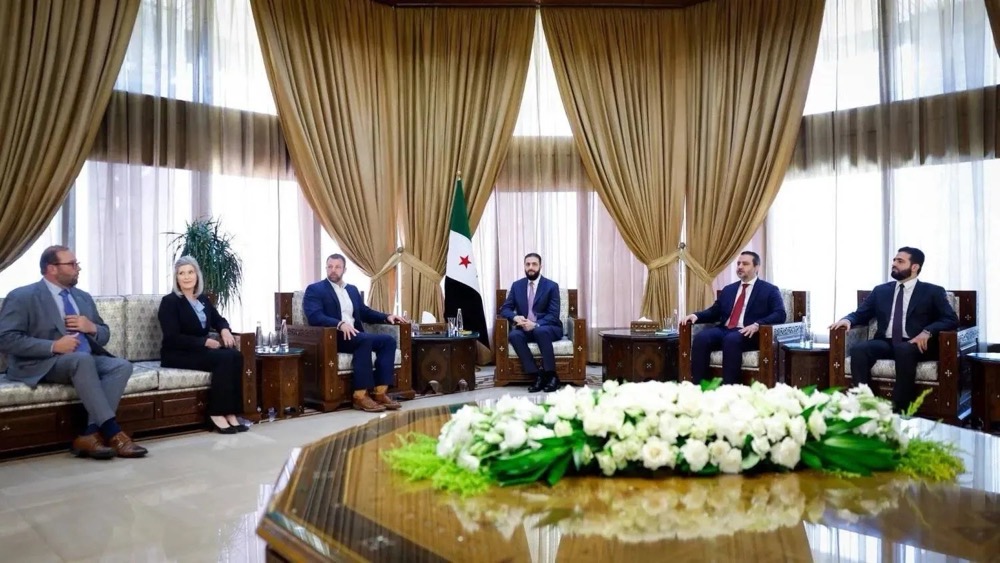
US officials discussed security progress with Al-Sharaa, amid ongoing violence and hardship. (Supplied)
However, while the US government “has done a lot in a remarkably short span of time,” much now “depends on private companies and how they decide to capitalize on the economic opportunities in Syria, as well as on the Syrian government and how they choose to use these opportunities.”
In its statement, OFAC said it was “removing from the Code of Federal Regulations the Syrian Sanctions Regulations as a result of the termination of the national emergency on which the regulations were based and further changes to the policy of the United States towards Syria.”
The Treasury’s decision follows President Donald Trump’s June 30 executive order ending the sanctions program to clear the way for reconstruction. Initially designed to pressure the Bashar Assad regime, the penalties have become a barrier to economic recovery since his removal.
That same order also instructed the secretary of state to review the designation of the interim president, Ahmad Al-Sharaa, and his faction, Hayat Tahrir Al-Sham — which led the offensive that forced Assad from power — as Specially Designated Global Terrorists.
Yet uncertainty persists. The order directed the State Department “to examine whether to suspend the imposition of some or all of the sanctions required under the Caesar Act,” but those measures cannot be unilaterally revoked by the White House or extended beyond 180 days without congressional approval.

Bedouin fighters ride a motorcycle next to a burned building in the village of Al-Mazraa. (Reuters/File)
On Aug. 25, Sen. Jeanne Shaheen, the ranking member of the US Senate’s Foreign Relations Committee, and her bipartisan colleague Rep. Joe Wilson visited Syria for talks with Al-Sharaa, marking the first such visit since the Assad regime’s ouster.
Joined by US envoy Tom Barrack, they discussed Syria’s security progress, reconstruction, inclusive governance, and the potential for lifting Caesar Act sanctions.
The Caesar Syria Civilian Protection Act, enacted in 2020 to isolate Assad and deter foreign investment, remains on the books. Critics argue that despite a 180-day waiver that started on May 23, the legislation has outlived its purpose since Assad’s ouster and now deters non-US foreign investors with the threat of secondary sanctions.
“The Caesar Act was originally designed to target the Assad regime as it was in power, and now that it’s not in power anymore, it doesn’t hold anymore,” Vittorio Maresca di Serracapriola, sanctions lead analyst at the New Zealand-based Karam Shaar Advisory, told Arab News.
Keeping the act, even with a waiver, “would signal a break from the Trump administration’s current approach because it embeds a two-year monitoring requirement,” he said. “That would push the Caesar Act expiration into 2028 at the earliest, effectively locking Syria into at least three more years of sanctions regardless of compliance.”
Congress has already reopened the debate, prompted by sectarian violence in southern Syria.

A drone view of a displacement camp in Idlib, Syria. (Reuters/File)
On July 16, the House Financial Services Committee approved a draft amendment to the Caesar Act, tying sanctions relief to conditions on civilian protection and human rights. The measure, House Resolution 4427, introduced by Rep. Michael Lawler, would extend waivers for up to two years and potentially delay full suspension until 2029.
The amendment also calls for tighter oversight of Syria’s central bank, a review of financial restrictions, and Treasury reports on terrorism financing and money laundering. About a week later, the committee advanced the bill, allowing Trump to lift sanctions permanently after two years if Syria’s interim government meets the conditions.
“The Al-Sharaa administration certainly has a lot of work to do to reintegrate Syria with the US and our allies,” Lawler said. However, Rep. Wilson called for an unconditional repeal of the Caesar Act, arguing it would better align with Trump’s Syria policy.
For its part, Al-Sharaa’s government has pledged to make the transitional period rights-respecting, transparent, and accountable, with commissions and legal guarantees built into policy. But renewed violence is testing the country’s prospects for stability.
Armed clashes erupted on July 12 in the southern province of Suweida between the Bedouin and Druze communities. The fighting quickly escalated into widespread violence involving militias, interim government forces, and allied groups, according to media reports.

Children sit inside a school that is used as a shelter centre, in Dael, Deraa governorate. (Reuters/File)
On July 16, Al-Sharaa said in a televised address that his priority was protecting Syria’s Druze citizens, after Israel vowed to destroy government forces, which it accused of attacking members of the minority group in Suwieda.
“We are eager to hold accountable those who transgressed and abused our Druze people because they are under the protection and responsibility of the state,” Al-Sharaa said, describing the Druze community as “a fundamental part of the fabric of this nation.”
Although a ceasefire has largely held since July 21, UN experts said on Aug. 21 that they were alarmed by accounts of killings, abductions, looting, sexual violence, and other abuses against Druze communities in the area.
They said at least 1,000 people were killed in three villages, including 539 identified as Druze civilians, with more than 196 extrajudicial executions — including eight children and 30 women — and 33 villages burned.
Maresca di Serracapriola warned that H.R. 4427 “threatens to extend the Caesar Act despite the Trump administration’s general push for sanction relief.
“The bill’s most consequential provision is that it wants to keep the Caesar Act firmly in place, and it would offer only a narrow path to suspend it — only if Syria meets nine stringent conditions for two consecutive years,” he said.
SANCTIONS TIMELINE
• Dec. 1979: Syria added to the US list of state sponsors of terrorism.
• May 2004: US imposes broader sanctions over Lebanon occupation.
• April 2011: US sanctions Syrian officials over human rights abuses.
• June 2020: Caesar Act expands sanctions over regime and supporters.
• Feb. 2025: EU suspends sanctions on banking, energy, and transport.
• May: Treasury issues General License 25, authorizing transactions.
• June: Trump signs Executive Order 14312, terminating sanctions program.
• July: State Department revokes terrorist designation for HTS.
That would carry both symbolic and practical consequences. “The Caesar Act has perhaps been the most impactful statutory sanction imposed on Syria, because it expanded the possibility of secondary sanctions,” he said.
“So, keeping it in place would still signal some reluctance from the US administration and, more broadly, from Congress to fully lift sanctions on Syria — and that could send negative signals to (non-US) investors about restoring confidence.
“The second issue,” he added, “is the potential liability of those doing business with Syria, who could become targets of the Caesar Act due to its secondary sanctions.”
Nevertheless, the bill leaves room for progress. “The bill does not necessarily have a very hawkish view on keeping sanctions on Syria because it also wants to advance Syria’s reintegration into the global financial system,” he said.
“For instance, the bill aims to strengthen anti-money laundering capacity and update sanctions policy to reflect current conditions.”

Displaced people who fled from Aleppo countryside, sit together on the back of a truck in Tabqa, Syria. (Reuters/File)
Furthermore, “section two (of the bill) requires the director of FinCEN (Financial Crimes Enforcement Network) to brief Congress within 360 days on the impact of recent regulatory relief for the Commercial Bank of Syria.”
In addition, it includes “provisions to instruct US representatives at the IMF and the World Bank to restore economic monitoring on Syria and, in general, provide technical assistance on anti-money laundering, non-proliferation, and anti-corruption.”
Saboungi of the Syrian American Council echoed the cautious optimism. “There are no sanctions, prohibitions, or other regulations that would prohibit or prevent US companies from working in Damascus now,” he said.
“There may be some leftover restrictions on some transactions with the government, due to the state sponsor of terrorism designation,” he added. “But otherwise, US companies can find many lawful ways to operate in and provide their services in Syria.
“Export controls continue to be an impediment, but they’re an impediment that can be surmounted, and we believe they will soon be eased too,” he said.

Smoke rises while Syrian security forces sit in the back of a truck, as Syrian troops enter the predominantly Druze city of Sweida. (Reuters/File)
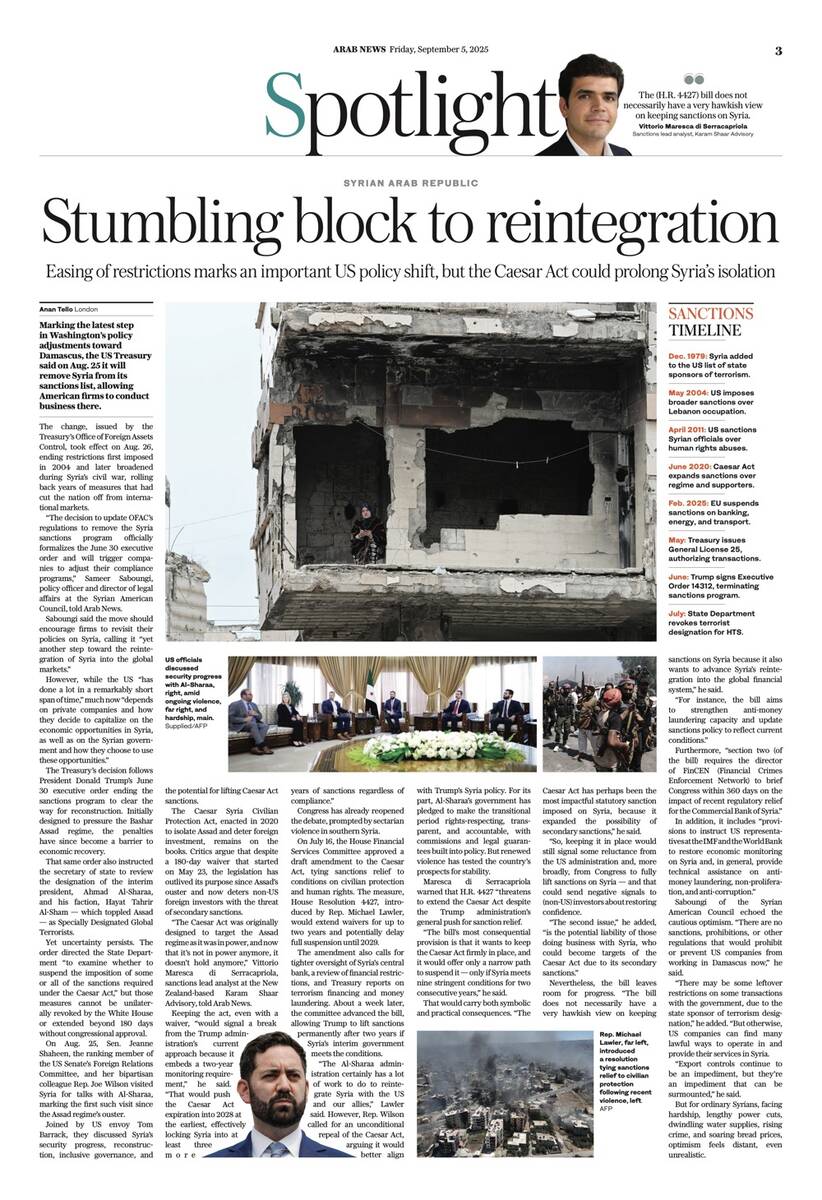
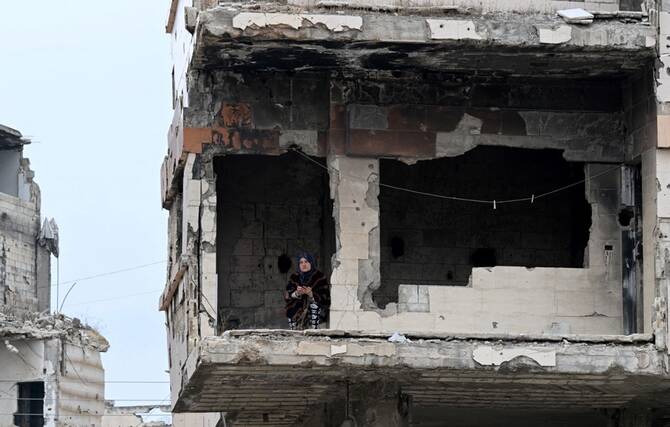
But for ordinary Syrians, optimism feels distant, even unrealistic. Even in the capital Damascus, people continue to face hardship, lengthy power cuts, dwindling water supplies, rising crime, and soaring bread prices.
Nearly 90 percent of the population now lives below the poverty line, unable to afford basic necessities such as food, health care, clean water, or education.
Inflation, currency devaluation, and limits on banking and foreign aid continue to erode living standards, emphasizing the gap between policy shifts abroad and realities on the ground.