New Ebola outbreak in DR Congo kills 15: health minister

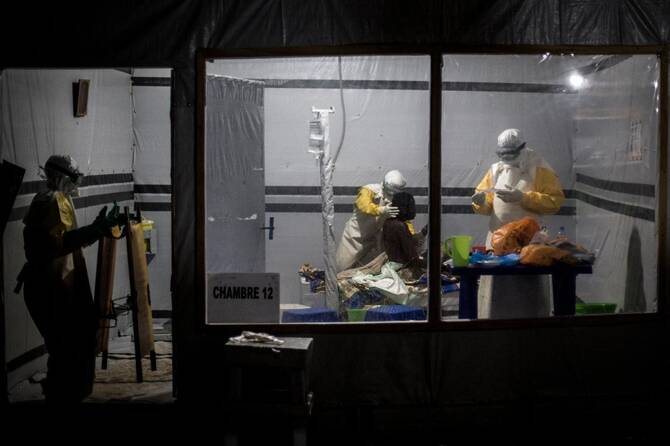
Health workers treat an unconfirmed Ebola patient, inside a MSF (Doctors Without Borders) supported Ebola Treatment Center (ETC) on Nov. 3, 2018 in Butembo, Democratic Republic of the Congo. (AFP/File)
Short Url
Updated 04 September 2025
Follow

New Ebola outbreak in DR Congo kills 15: health minister

  • The last outbreak of Ebola in the vast central African nation was three years ago and killed six people
  • Twenty-eight suspected cases have been recorded in Kasai Province

KINSHASA: Health authorities in the Democratic Republic of Congo have declared a new outbreak of the Ebola virus, which has killed 15 people since the end of August, the health minister said Thursday.
The new outbreak is in central Kasai Province, Samuel Roger Kamba told reporters in the capital Kinshasa.
The last outbreak of Ebola in the vast central African nation was three years ago and killed six people.
Twenty-eight suspected cases have been recorded in Kasai Province, according to provisional figures, with the first case reported on August 20 in a 34-year-old pregnant woman who was admitted to hospital.
“It’s the 16th outbreak recorded in our country,” Kamba said.
Case numbers are likely to increase, according to the World Health Organization, which has dispatched experts alongside a Congolese response team to Kasai Province.
The DRC has a stockpile of treatments for this viral haemorrhagic fever as well as 2,000 doses of vaccines that will be moved to Kasai from the capital Kinshasa.
“We’re acting with determination to rapidly halt the spread of the virus and protect communities,” said WHO Regional Director for Africa Mohamed Janabi.
First identified in 1976 and thought to have crossed over from bats, Ebola is a deadly viral disease spread through direct contact with bodily fluids, causing severe bleeding and organ failure.
The deadliest outbreak in the DRC — whose population numbers more than 100 million — killed nearly 2,300 people between 2018 and 2020.
Six strains of Ebola exist.
Health authorities say the Zaire strain — for which there is a vaccine — is the cause of the new outbreak.
“Fortunately we have a vaccine for this Zaire strain but to deploy it we need to ensure the logistics,” Health Minister Kamba said.
Four times the size of France, the DRC has poor infrastructure, with often limited and poorly maintained lines of communication.


Australian bushfires raze homes in two states; firefighter dies

Updated 2 sec ago
Follow

Australian bushfires raze homes in two states; firefighter dies

  • Sixteen homes lost on Central Coast region in New South Wales
  • Tasmania 700-hectare blaze destroys 19 homes at Dolphin Sands
SYDNEY/WELLINGTON: An Australian firefighter was killed overnight after he was struck by a tree while trying to control a bushfire that had destroyed homes and burnt large swathes of bushland north of Sydney, authorities said on Monday.
Emergency crews rushed to bushland near the rural town of Bulahdelah, 200 kilometers north of Sydney, after reports that a tree had fallen on a man. The 59-year-old suffered a cardiac arrest and died at the scene, officials said.
Prime Minister Anthony Albanese said the “terrible news is a somber reminder” of the dangers faced by emergency services personnel as they work to protect homes and families.
“We honor that bravery, every day,” Albanese said in a statement.
A fast-moving fire over the weekend destroyed 16 homes in New South Wales state’s Central Coast region, home to about 350,000 people and a commuter region just north of Sydney.
Resident Rouchelle Doust, from the hard-hit town of Koolewong, said she and her husband tried to save their home as flames advanced.
“He’s up there in his bare feet trying to put it out, and he’s trying and trying, and I’m screaming at him to come down,” Doust told the Australian Broadcasting Corp.
“Everything’s in it: his grandmother’s stuff, his mother’s stuff, all my stuff — everything, it’s all gone, the whole lot.”
Conditions eased overnight, allowing officials to downgrade fire danger alerts, though the weather bureau warned some inland towns in the state could hit more than 40 degrees Celsius (104 Fahrenheit) on Tuesday, raising fire dangers.
More than 50 bushfires were burning across New South Wales as of Monday.
On the island state of Tasmania, a 700-hectare blaze at Dolphin Sands, about 150km northeast of the state capital of Hobart, destroyed 19 homes and damaged 40. The fire has been contained, but residents have been warned not to return as conditions remain dangerous, officials said.
Authorities have warned of a high-risk bushfire season during Australia’s summer months from December to February, with increased chances of extreme heat across large parts of the country following several relatively quiet years.
New Zealand national park fire
In neighboring New Zealand, five helicopters and multiple crews were working to put out a fire near the country’s oldest national park, a month after a wildfire burnt through 2,589 hectares of alpine bush there.
Police said they had closed a road near the state highway and advised motorists to avoid the area and expect delays, after the blaze near Tongariro National Park, a popular hiking spot, spread to 110 hectares by Monday afternoon.