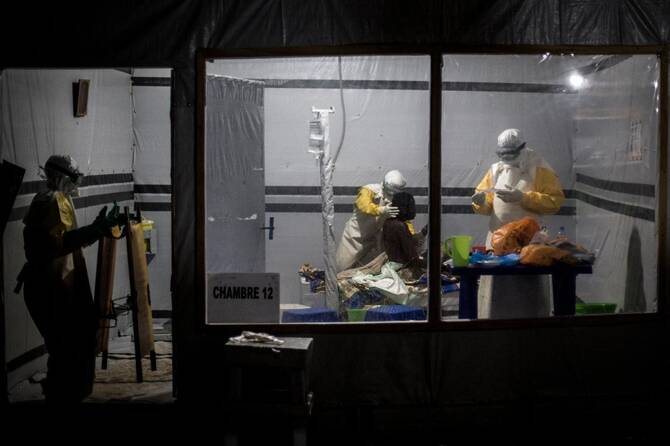
KINSHASA: Health authorities in the Democratic Republic of Congo have declared a new outbreak of the Ebola virus, which has killed 15 people since the end of August, the health minister said Thursday.
The new outbreak is in central Kasai Province, Samuel Roger Kamba told reporters in the capital Kinshasa.
The last outbreak of Ebola in the vast central African nation was three years ago and killed six people.
Twenty-eight suspected cases have been recorded in Kasai Province, according to provisional figures, with the first case reported on August 20 in a 34-year-old pregnant woman who was admitted to hospital.
“It’s the 16th outbreak recorded in our country,” Kamba said.
Case numbers are likely to increase, according to the World Health Organization, which has dispatched experts alongside a Congolese response team to Kasai Province.
The DRC has a stockpile of treatments for this viral haemorrhagic fever as well as 2,000 doses of vaccines that will be moved to Kasai from the capital Kinshasa.
“We’re acting with determination to rapidly halt the spread of the virus and protect communities,” said WHO Regional Director for Africa Mohamed Janabi.
First identified in 1976 and thought to have crossed over from bats, Ebola is a deadly viral disease spread through direct contact with bodily fluids, causing severe bleeding and organ failure.
The deadliest outbreak in the DRC — whose population numbers more than 100 million — killed nearly 2,300 people between 2018 and 2020.
Six strains of Ebola exist.
Health authorities say the Zaire strain — for which there is a vaccine — is the cause of the new outbreak.
“Fortunately we have a vaccine for this Zaire strain but to deploy it we need to ensure the logistics,” Health Minister Kamba said.
Four times the size of France, the DRC has poor infrastructure, with often limited and poorly maintained lines of communication.


![]()

New Ebola outbreak in DR Congo kills 15: health minister
Short Url
https://arab.news/4n2eq
New Ebola outbreak in DR Congo kills 15: health minister
- The last outbreak of Ebola in the vast central African nation was three years ago and killed six people
- Twenty-eight suspected cases have been recorded in Kasai Province


Latest updates


© 2026 SAUDI RESEARCH & PUBLISHING COMPANY, All Rights Reserved And subject to Terms of Use Agreement.