

Just 25% of Gaza war detainees are combatants: Israeli data 

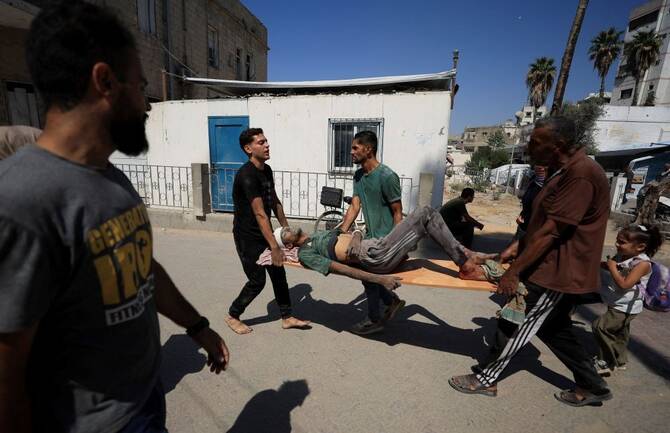
Palestinians transport a wounded man injured in an Israeli strike at Al-Ahli Arab Hospital in Gaza City, September 4, 2025. (Reuters)
Short Url
Updated 04 September 2025
Follow

Just 25% of Gaza war detainees are combatants: Israeli data 

  • Probe: Overwhelming majority are civilians, including elderly, sick, children, healthcare workers
  • Rights group: ‘We believe the proportion of civilians among those detained is even higher than Israel’s own figures suggest’

LONDON: Three-quarters of Palestinians arrested in Gaza are civilians, including children, disabled people and healthcare workers, according to classified Israeli data.

The revelation comes after a joint investigation by The Guardian, +972 Magazine and Local Call, which found that among the detained were an 82-year-old woman with Alzheimer’s who was held for six weeks without charge, and a single mother taken for 53 days, forcing her children to beg on the street.

More than 47,000 people have been identified by Israel as militants fighting for Hamas and Islamic Jihad, drawn largely from the groups’ own files seized in Gaza.

Of these, 1,450 were identified in May as being in Israeli captivity, or just under 25 percent of all Palestinians detained in Gaza under Israel’s “unlawful combatants” law since the outbreak of the war in October 2023.

The law allows indefinite detention without charge. An additional 300 people identified by Israel as participants in the Hamas attack of Oct. 7, 2023, are also being held. 

No one has been charged in relation to Oct. 7 or the war so far, with Israel allowing a 180-day period before detainees gain access to a lawyer, and 75 days before appearing in front of a judge to confirm the legality of the detention.

However, the large number of civilian prisoners held under the law could be even greater, with Israeli newspaper Haaretz quoting senior officers in late 2023 that “85 to 90 percent” of prisoners taken by Israel were not Hamas members.

Tal Steiner, director of the Public Committee Against Torture, told The Guardian: “As soon as the wave of mass arrests began in Gaza in October 2023, there was serious concern that many uninvolved people were being detained without cause.

“This concern was confirmed when we learned that half of those arrested at the beginning of the war were eventually released, demonstrating that there had been no basis for their detention in the first place.”

The Sde Teiman military base at one point had so many elderly and disabled prisoners that the wing they were kept in was nicknamed “the geriatric pen,” an Israeli soldier who served there told the investigation.

“They brought men in wheelchairs, people without legs,” he said. “I always assumed the supposed excuse for arresting patients was that maybe they had seen the hostages or something.”

Samir Zaqout, deputy director of Al-Mezan Center for Human Rights, which has represented hundreds of civilians imprisoned by Israel, said: “We believe the proportion of civilians among those detained is even higher than Israel’s own figures suggest.”

He added: “At most, perhaps one in six or seven might have any link to Hamas or other militant factions, and even then, not necessarily through their military wings.”

A military medic who treated 82-year-old Alzheimer’s patient Fahamiya Al-Khalidi at Anatot detention center after she was taken from Gaza City in December 2023 told The Guardian: “I remember her limping badly toward the clinic. And she’s classified as an unlawful combatant. The way that label is used is insane.”

He added that he had treated a woman bleeding after suffering a miscarriage, and a breastfeeding mother who had been separated from her infant.

The mother, Abeer Ghaban, knew after she was detained that Israeli authorities had mistaken her estranged husband for a Hamas member with the same name.

Despite proving his identity through comparing photos, she was not released for weeks, leaving her three children to fend for themselves in a war zone. “They were alive, but seeing the state they had been in for 53 days without me broke me,” Ghaban said.

Hassan Jabareen, director of the Palestinian legal rights group Adalah, said the Israeli system “strips detainees of protections guaranteed under international law, including safeguards specifically intended for civilians, using the ‘unlawful combatant’ label to justify the systematic denial of their rights.”

An Israeli source at another military facility said soldiers wanted to hold innocent civilians longer to be used as leverage in hostage negotiations.

A spokesperson for Al-Mezan said: “Even before Oct. 7, Israel withheld the bodies of hundreds of Palestinians, using them as bargaining chips instead of returning them to their families for burial.

“We believe the thousands of civilians from Gaza now in detention are likewise intended to be used as bargaining chips.”


First Ramadan after truce brings flicker of joy in devastated Gaza

Updated 5 sec ago
Follow

First Ramadan after truce brings flicker of joy in devastated Gaza

  • Ramadan lanterns and string lights appear on streets lined with collapsed buildings and piles of rubble in Gaza City
  • The first holy month since the October ceasefire brings mixed feelings for the many still living in tents
GAZA CITY: Little Ramadan lanterns and string lights appeared on streets lined with collapsed buildings and piles of rubble in Gaza City, bringing joy and respite as Islam’s holiest month began — the first since October’s ceasefire.
In the Omari mosque, dozens of worshippers performed the first Ramadan morning prayer, fajr, bare feet on the carpet but donning heavy jackets to stave off the winter cold.
“Despite the occupation, the destruction of mosques and schools, and the demolition of our homes... we came in spite of these harsh conditions,” Abu Adam, a resident of Gaza City who came to pray, told AFP.
“Even last night, when the area was targeted, we remained determined to head to the mosque to worship God,” he said.
A security source in Gaza told AFP Wednesday that artillery shelling targeted the eastern parts of Gaza City that morning.
The source added that artillery shelling also targeted a refugee camp in central Gaza.
Israel does not allow international journalists to enter the Gaza Strip, preventing AFP and other news organizations from independently verifying casualty figures.

‘Stifled joy’

In Gaza’s south, tens of thousands of people still live in tents and makeshift shelters as they wait for the territory’s reconstruction after a US-brokered ceasefire took hold in October.
Nivin Ahmed, who lives in a tent in the area known as Al-Mawasi, told AFP this first Ramadan without war brought “mixed and varied feelings.”
“The joy is stifled. We miss people who were martyred, are still missing, detained, or even traveled,” she said.
“The Ramadan table used to be full of the most delicious dishes and bring together all our loved ones,” the 50-year-old said.
“Today, I can barely prepare a main dish and a side dish. Everything is expensive. I can’t invite anyone for Iftar or suhoor,” she said, referring to the meals eaten before and after the daily fast of Ramadan.
Despite the ceasefire, shortages remain in Gaza, whose battered economy and material damage have rendered most residents at least partly dependent on humanitarian aid for their basic needs.
But with all entries into the tiny territory under Israeli control, not enough goods are able to enter to bring prices down, according to the United Nations and aid groups.

‘Still special’

Maha Fathi, 37, was displaced from Gaza City and lives in a tent west of the city.
“Despite all the destruction and suffering in Gaza, Ramadan is still special,” she told AFP.
“People have begun to empathize with each other’s suffering again after everyone was preoccupied with themselves during the war.”
She said that her family and neighbors were able to share moments of joy as they prepared food for suhoor and set up Ramadan decorations.
“Everyone longs for the atmosphere of Ramadan. Seeing the decorations and the activity in the markets fills us with hope for a return to stability,” she added.
On the beach at central Gaza’s Deir el-Balah, Palestinian artist Yazeed Abu Jarad contributed to the holiday spirit with his art.
In the sand near the Mediterranean Sea, he sculpted “Welcome Ramadan” in ornate Arabic calligraphy, under the curious eye of children from a nearby tent camp.
Nearly all of Gaza’s 2.2 million residents were displaced at least once during the more than two years of war between Israel and Hamas, sparked by the latter’s unprecedented October 7 attack on Israel.
Mohammed Al-Madhoun, 43, also lives in a tent west of Gaza City, and hoped for brighter days ahead.
“I hope this is the last Ramadan we spend in tents. I feel helpless in front of my children when they ask me to buy lanterns and dream of an Iftar table with all their favorite foods.”
“We try to find joy despite everything,” he said, describing his first Ramadan night out with the neighbors, eating the pre-fast meal and praying.
“The children were as if they were on a picnic,” he said.