

Rubio eyes tough security ally in Ecuador

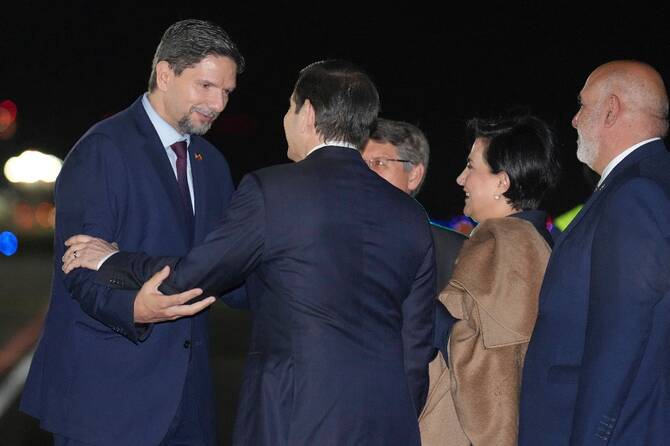
US Secretary of State Marco Rubio greets Ambassador to Ecuador Pablo Zambrano as he arrives in Quito, Ecuador. (AP)
Short Url
Updated 04 September 2025
Follow

Rubio eyes tough security ally in Ecuador

  • Rubio will meet Ecuador’s President Daniel Noboa, who has deployed troops to combat violence that has transformed the country from one of Latin America’s safest to one of its most dangerous
  • The stop comes two days after US forces said they blew up an alleged drug running boat from a gang tied to Venezuela’s leftist government, in an operation President Donald Trump said killed 11 people

QUITO: US Secretary of State Marco Rubio is expected to discuss bolstering security cooperation Thursday in violence-swept Ecuador, as he champions a shoot-first crackdown on the region’s criminal groups.
Rubio will meet Ecuador’s President Daniel Noboa, who has deployed troops to combat violence that has transformed the country from one of Latin America’s safest to one of its most dangerous.
The stop comes two days after US forces said they blew up an alleged drug-running boat from a gang tied to Venezuela’s leftist government, in an operation President Donald Trump said killed 11 people.
In Noboa, a businessman who has consolidated power since his surprise 2023 victory, Rubio could find a new ally in his campaign to strengthen security-minded right-wing leaders across Latin America.
For Rubio, a Cuban-American and vociferous critic of the region’s leftists, Noboa could follow in the steps of El Salvador’s Nayib Bukele, whose iron-fisted clampdown on crime has drawn complaints from rights groups but made him popular at home and a darling of the Trump administration.
Rubio, speaking Wednesday in Mexico on the first stop of his two-country tour, vowed no mercy against criminal groups.
He warned of more US attacks like the one in the Caribbean, a dramatic escalation by the United States after decades of routine policing work to seize drugs.
Rubio said that such interdictions did not work as they were not costly enough to gangs.
The United States “blew it up and it’ll happen again. Maybe it’s happening right now,” Rubio told a news conference Wednesday.
AFP has not been able to verify independently the details of the attack presented by the United States.
Trump said the boat belonged to Tren de Aragua, a Venezuelan gang he has designated as a terrorist organization, although the group is not known primarily for narcotics trafficking.
Venezuela’s Interior Minister Diosdado Cabello accused the United States of committing extrajudicial killings, saying “they murdered 11 people without due process.”

- Ecuador eyes agreements -

Ecuador’s Interior Minister John Reimberg said he expected greater cooperation with the United States on combatting violence.
The United States “is a country that has maintained constant assistance in various issues,” Reimberg told the Teleamazonas channel.
“We will see many more agreements that are fundamental to the security of our country.”
Located between Colombia and Peru, the world’s largest producers of cocaine, Ecuador is the departure point for 70 percent of the world’s cocaine, nearly half of which goes to the United States, according to official data.
For years, the United States operated a military base at the Pacific port of Manta, and the Drug Enforcement Administration had a sizeable footprint in the country.
The base was closed in 2009, after leftist then-president Rafael Correa refused to renew the lease.
Noboa has moved to allow US forces to return, although a US official downplayed the possibility of any imminent return of a military presence.
The official said that Rubio will also present Ecuador as a cautionary tale after it amassed billions of dollars in debt to China.
The United States sees China as its top global adversary and has moved aggressively to combat its influence, but Beijing has eyed headway as the United States under Trump retreats from global aid.


Top UN court to hear Rohingya genocide case against Myanmar

Updated 6 sec ago
Follow

Top UN court to hear Rohingya genocide case against Myanmar

THE HAGUE: Did Myanmar commit genocide against its Rohingya Muslim minority? That’s what judges at the International Court of Justice will weigh during three weeks of hearings starting Monday.
The Gambia brought the case accusing Myanmar of breaching the 1948 Genocide Convention during a crackdown in 2017.
Legal experts are watching closely as it could give clues for how the court will handle similar accusations against Israel over its military campaign in Gaza, a case brought to the ICJ by South Africa.
Hundreds of thousands of Rohingya Muslims fled violence by the Myanmar army and Buddhist militias, escaping to neighboring Bangladesh and bringing harrowing accounts of mass rape, arson and murder.
Today, 1.17 million Rohingya live crammed into dilapidated camps spread over 8,000 acres in Cox’s Bazar in Bangladesh.
From there, mother-of-two Janifa Begum told AFP: “I want to see whether the suffering we endured is reflected during the hearing.”
“We want justice and peace,” said the 37-year-old.

’Senseless killings’

The Gambia, a Muslim-majority country in West Africa, brought the case in 2019 to the ICJ, which rules in disputes between states.
Under the Genocide Convention, any country can file a case at the ICJ against any other it believes is in breach of the treaty.
In December 2019, lawyers for the African nation presented evidence of what they said were “senseless killings... acts of barbarity that continue to shock our collective conscience.”
In a landmark moment at the Peace Palace courthouse in The Hague, Nobel Peace laureate Aung San Suu Kyi appeared herself to defend her country.
She dismissed Banjul’s argument as a “misleading and incomplete factual picture” of what she said was an “internal armed conflict.”
The former democracy icon warned that the genocide case at the ICJ risked reigniting the crisis, which she said was a response to attacks by Rohingya militants.
Myanmar has always maintained the crackdown by its armed forces, known as the Tatmadaw, was justified to root out Rohingya insurgents after a series of attacks left a dozen security personnel dead.

‘Physical destruction’

The ICJ initially sided with The Gambia, which had asked judges for “provisional measures” to halt the violence while the case was being considered.
The court in 2020 said Myanmar must take “all measures within its power” to halt any acts prohibited in the 1948 UN Genocide Convention.
These acts included “killing members of the group” and “deliberately inflicting on the group conditions of life calculated to bring about its physical destruction in whole or in part.”
The United States officially declared that the violence amounted to genocide in 2022, three years after a UN team said Myanmar harbored “genocidal intent” toward the Rohingya.
The hearings, which wrap up on January 30, represent the heart of the case.
The court had already thrown out a 2022 Myanmar challenge to its jurisdiction, so judges believe they have the power to rule on the genocide issue.
A final decision could take months or even years and while the ICJ has no means of enforcing its decisions, a ruling in favor of The Gambia would heap more political pressure on Myanmar.
Suu Kyi will not be revisiting the Peace Palace. She has been detained since a 2021 coup, on charges rights groups say were politically motivated.
The ICJ is not the only court looking into possible genocide against the Rohingya.
The International Criminal Court, also based in The Hague, is investigating military chief Min Aung Hlaing for suspected crimes against humanity.
Another case is being heard in Argentina under the principle of universal jurisdiction, the idea that some crimes are so heinous they can be heard in any court.