

Pakistan’s textile industry braces for $3 billion cotton import bill as floods devastate crops

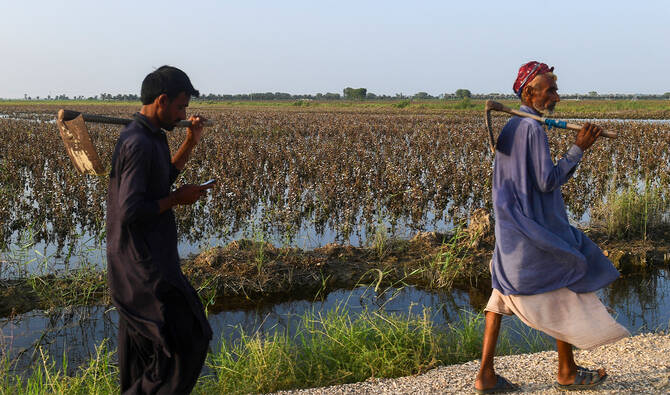
In this picture taken on August 30, 2022 labourers walk past cotton crops damaged by flood waters at Sammu Khan Bhanbro village in Sukkur, Sindh province. (AFP/File)
Short Url
Updated 03 September 2025
Follow

Pakistan’s textile industry braces for $3 billion cotton import bill as floods devastate crops

  • Textile mills warn of severe cotton crop loss, urge government to declare national emergency
  • Analysts project up to five million bales lost, threatening $6 billion in damages for the industry

KARACHI: Pakistan’s textile manufacturers expect cotton imports to surge to as much as $3 billion this year, double last year’s bill, after floods devastated key growing areas in Punjab and now threaten Sindh, industry officials and analysts said.

The monsoon deluges, which have already swamped central Punjab, the nation’s breadbasket, are moving south toward Sindh, the country’s second-largest cotton belt, raising fears that further damage to fields will deepen losses in the days ahead. Agriculture makes up nearly a quarter of GDP and employs almost half of the labor force, according to the Pakistan Bureau of Statistics.

“Probably, our cotton import can exceed $2.5 to $3 billion this year alone,” said Kamran Arshad, chairman of the All Pakistan Textile Mills Association (APTMA), adding that millers imported $1.5 billion worth of cotton last year from Brazil, the United States, Africa and Australia.

Arshad said cotton-growing areas in central Punjab such as Vehari, Mailsi, Chichawatni and Burewala had been “negatively affected,” while some genetically modified Bt cotton crops were also under water. 

“This can lead to a crisis, because a lot of people will be losing their livelihoods. Their crops will be at stake,” he said, urging the government to declare a national emergency and curb luxury imports to conserve foreign exchange.

He also blamed record water releases from upstream India for compounding the devastation. Under the 1960 Indus Waters Treaty, India controls the eastern rivers but is required to notify Pakistan of dam discharges that can cause downstream flooding.

Flood damage has also undermined projections for Pakistan’s top export industry, which earned $18 billion last year.

“We were projecting a growth in textile exports from $18 billion to up to $20 billion in the coming year, but I don’t think that level will be achieved because of the unavailability of cotton and the higher cost of production,” said Ahsan Mehanti, chief executive of Arif Habib Commodities.

He estimated the industry could face a $6 billion hit, including about $4 billion in additional import costs and $2 billion in lost export potential. “This flood will have a devastating impact not only on cotton output but the exchange rate will equally be impacted,” Mehanti said.

PRODUCTION LOSSES

Analysts warned Pakistan may lose up to five million bales from this year’s 10.2 million bale production target, with overall output falling below last year’s seven million.

“The government’s target to produce 5.5 million bales in Punjab does not seem achievable now … cotton output may not exceed 4.5 million bales if flooding increases,” said Naseem Usman, chairman of the Karachi Cotton Brokers Forum.

Official data confirm the downturn. Pakistan’s cotton production as of Aug. 15 had already contracted by more than 17 percent to 887,401 bales, compared with 1.1 million a year earlier, according to a Sept. 2 report by the Pakistan Central Cotton Committee.

Usman said consumption would remain higher than domestic output, forcing Pakistan to rely heavily on imports that could exceed $2 billion, including raw cotton, seed and oil for animal feed.


Pakistan court directs authorities to form medical board to assess Imran Khan’s eye condition

Updated 12 March 2026
Follow

Pakistan court directs authorities to form medical board to assess Imran Khan’s eye condition

  • Islamabad High Court rejects jailed ex-PM’s request for immediate transfer to private hospital
  • Medical board comprising doctors from PIMS and Shifa to submit report on possible transfer

ISLAMABAD: A Pakistani high court on Thursday directed authorities to form a medical board of government doctors to assess whether jailed former prime minister Imran Khan needs to be transferred to a hospital, his party said, following a rejection of his request to be moved to a private facility for treatment.

The development comes after the Pakistan Institute of Medical Sciences (PIMS) said last week that Khan’s vision had “improved remarkably” since he was given an Anti-VEGF injection amid concerns related to his eyesight.

Anti-VEGF injections are commonly used to treat retinal vein occlusion and other retinal vascular disorders by reducing swelling and abnormal blood vessel growth inside the eye. Prior to the development, the ex-premier had complained of rapid deterioration in vision in one of his eyes.

“The Islamabad High Court has rejected Imran Khan’s request for immediate transfer to Shifa International Hospital,” the Pakistan Tehreek-e-Insaf (PTI) party said in a post on X.

“The court directed that the Chief Commissioner immediately constitute a medical board comprising doctors from PIMS and Shifa Hospital,” it continued. “The medical board will submit a report, on the basis of which the Chief Commissioner will decide whether a hospital transfer is to take place or not.”

The PTI said the court’s decision had raised questions over the judiciary’s independence.

“Delaying a medical emergency and handing it over to administrative discretion is a violation of human rights,” it said. “The issue of Imran Khan’s health is not just about one individual but reflects the entire judicial and state system.”

The 74-year-old cricketer-turned politician has been in prison since August 2023 in cases that he and his party say are politically motivated.

Khan was taken to PIMS for a medical procedure earlier this year, as his party questioned the transparency of the medical update and demanded independent access to his care.

Khan was removed from office in April 2022 through a parliamentary vote of no confidence that he says was orchestrated at the behest of the former administration in Washington by his political rivals with backing from the military. His allegation has been denied by all parties involved.

Since his imprisonment, Khan has faced multiple convictions and ongoing legal proceedings that authorities say follow due process, while his party describes them as efforts to sideline him from politics.