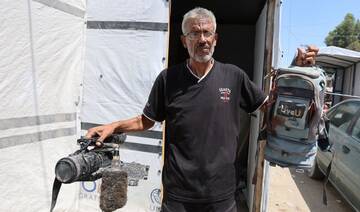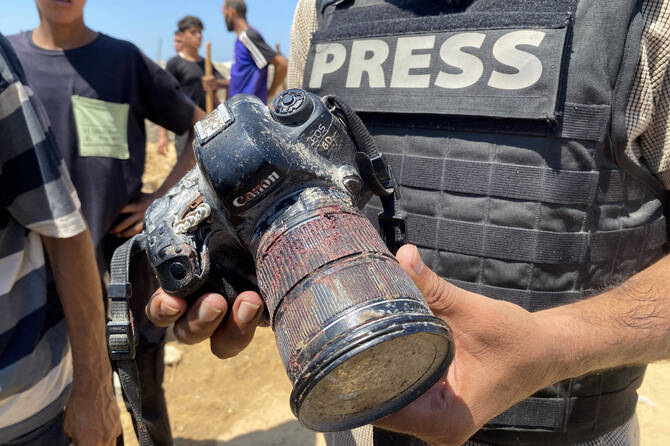


LONDON: It’s not every day that an Excel spreadsheet possesses the power to shock. But the stark clarity of the constantly updated document recording the names of every journalist killed in Gaza since October 2023 brings home the sheer scale of Israel’s unprecedented killing of journalists.
As of Sunday, 198 journalists have been killed in Gaza over the past two years. Since the beginning of the war, each name and the date and place of their death have been faithfully documented by the New York-based Committee to Protect Journalists.
Scrolling through the CPJ’s Excel document, with its clean, neat rows and columns that somehow emphasize the chaos and suffering to which they attest, is akin to visiting a digital wall of remembrance.
And more than that, with the credentials of each journalist on the list and the details of their death verified by the CPJ, it constitutes evidence.
The first death recorded was that of Ibrahim Marzouq, a Palestinian media worker for the logistics department of the Gaza Bureau of the Palestinian Authority-run broadcaster Palestine Today TV.

A combination image shows the journalists killed in Israeli strikes on Nasser hospital in the south of the Gaza Strip on August 25, 2025. (Reuters)
Marzouq and his family were killed in an Israeli airstrike on his home in Gaza’s Al-Tuffah neighborhood on Oct. 24, 2023, just weeks after the conflict began in the wake of the Hamas-led Oct. 7 attack.
The most recent victims were the five journalists killed on Aug. 25, along with more than a dozen civilians and health workers, by what appeared to be three tank shells on Nasser Hospital in Khan Yunis.
Ahed Abu Aziz, Hussam Al-Masri, Mariam Dagga, Mohammed Salama, and Moaz Abu Taha worked for international outlets including Middle East Eye, the Associated Press, Al Jazeera, and Reuters.
Reuters said it had notified the Israel Defense Forces of the whereabouts of its cameraman, Al-Masri, prior to the attack, but this was not enough to protect him.
Aged 49, he is survived by his wife and their four children, who are living in a tent and, like everyone else in Gaza, struggling to find food.

Family and relatives mourn over the body of Palestinian journalist Ahmed Al-Shayah, covered with a press vest, after he was killed during an Israeli strike the previous night in Khan Yunis, at Nasser Hospital, in the southern Gaza Strip, on January 16, 2025. (AFP)
The UN human rights office said the killings “should shock the world, not into stunned silence, but into action, demanding accountability and justice.”
Israeli Prime Minister Benjamin Netanyahu described the attack as “a mishap.” Meanwhile, the IDF said it had launched an internal investigation, adding that it “regrets any harm to uninvolved individuals and does not target journalists as such.”
The CPJ has submitted a series of questions about the attack to the IDF and is calling for an independent investigation.
As Jodie Ginsberg, CEO of the CPJ, said in a statement on Aug. 28: “Our experience over decades is that Israeli-led investigations into killings are neither transparent, nor independent — and in not a single case over the past 24 years has anyone in Israel ever been held accountable for the killing of a journalist.”
The CPJ, an independent, non-profit organization that was founded in 1981 by a group of US correspondents to promote press freedom worldwide, works to “defend the right of journalists to report the news safely and without fear of reprisal.”

Al-Jazeera correspondent Anas Al-Sharif reports near the Arab Ahli (Baptist) Hospital in Gaza City on October 10, 2024. (AFP)
It has its work cut out. In August alone, it was dealing with dozens of cases worldwide, highlighting and advocating for individual journalists facing investigations, arrests and attacks in countries including Nigeria, Sri Lanka, Vietnam, Somaliland, Kazakhstan, Madagascar, Iraq and Ethiopia.
But what it has been bearing witness to in Gaza for the past two years is beyond anything in its four decades of experience.
Despite Israel’s attempts to smear the journalists it has killed, suggesting some of them were Hamas operatives, “they were all journalists,” Sara Qudah, the CPJ’s Middle East and North Africa regional director, told Arab News.
“They studied journalism and then graduated, just like any normal person anywhere, and worked for various media outlets.”
CPJ vets and confirms the credentials of every journalist who is killed before reporting and documenting their deaths. Of the dead to date, 65 were freelancers and 124 were staffers working for a wide range of organizations inside and outside the Palestinian territories.

Mourners carry the body of one of five journalists killed in an Israeli strike on Nasser hospital in Khan Yunis in the southern Gaza Strip, during their funeral on August 25, 2025. (AFP)
Twenty-three of the victims were women.
Ever since the war in Gaza began, said Qudah, “the international media and the international community took a decision to turn a blind eye to what the local media and the journalists are seeing and saying, and the footage they are sending. They have preferred to believe the official narrative from Israel and the Israeli media.
“But after what happened in August, there’s no way that the international community and the international media can deny what is happening on the ground. We are starting to see and hear more voices, more condemnation, asking for accountability.”
She paid tribute to the courage of Gaza’s journalists.
“It’s not only courage; it’s a sense of responsibility. They know that if they stop reporting, the truth will die and no one will know what is happening, no one will document what is happening on the ground.

Palestinians gather outside Nasser hospital in Khan Yunis in the southern Gaza Strip on August 25, 2025, following Israeli strikes. (AFP)
“This is part of being a journalist, to be a witness to the truth, and this is why it’s so important for them to do that, even if it costs them their life, because at the end of the day they need to make sure that their deaths and the deaths of their loved ones is not is not happening for nothing.”
Journalists often find themselves reporting from war zones, perhaps for a few weeks at a time before travelling home again. But Gaza’s journalists “are documenting a war that they are living. On a daily basis, they are living this war.
“You are going back to a tent. You are displaced. You don’t have food, and you are afraid of being killed at any point, and you are also afraid that your family and your loved ones and your colleagues will be targeted and killed.”
There is, she said, no doubt that journalists are being targeted deliberately by Israel, which refuses to allow foreign journalists into Gaza.
“This is why Israel is killing them, because they want to kill their witnesses and they want to hide the truth, to hide the evidence.
“But one day, justice has to happen, and it will happen thanks to these journalists, the witnesses who are documenting all of Israel’s war crimes.”