

India warns Pakistan of more cross-border flooding as monsoon death toll tops 880

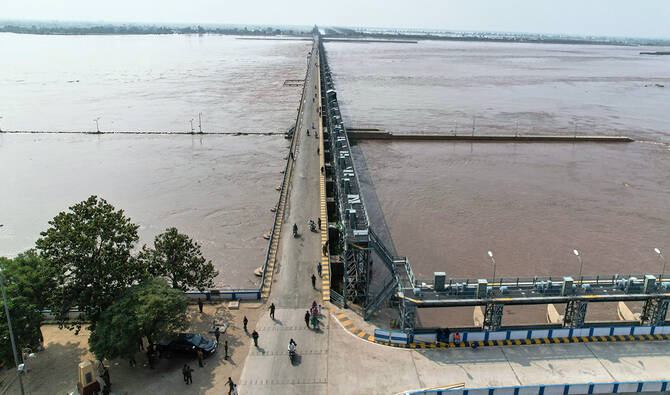
Motorcyclists drive through Trimmu Barrage on the River Chenab, which overflowed after torrential rains and water releases from Indian dams, in Jhang district, Pakistan, on September 1, 2025. (AP)
Short Url
Updated 02 September 2025
Follow

India warns Pakistan of more cross-border flooding as monsoon death toll tops 880

  • Pakistan is facing a flood emergency, with more than 2.4 million affected in Punjab province in the last 10 days
  • The latest warning concerns a surge in the Sutlej River, with floodwaters expected to enter Pakistan on Wednesday

ISLAMABAD: India has warned Pakistan about possible cross-border flooding for the second time in as many weeks, Pakistani disaster management authorities announced on Tuesday, as the nationwide monsoon death toll surged past 880.

Pakistan has been facing a flood emergency, with at least 41 people killed and more than 2.4 million affected in its breadbasket province of Punjab over the last 10 days, according to the Provincial Disaster Management Authority (PDMA).

Nationwide, rains, floods, landslides and similar incidents have killed 881 people since June 26, reviving memories of the catastrophic 2022 deluges when a third of Pakistan was submerged, more than 1,700 people were killed, 30 million displaced and damages topped $35 billion.

An Indian government official told AP news agency that New Delhi shared the warning with Pakistan on ‘humanitarian grounds’ through its high commission in Islamabad as Pakistan’s national disaster management authority (NDMA) warned of further rains in flood-hit Punjab.

“These rains may increase problems in flood-affected areas in Punjab,” the NDMA said on Tuesday evening. “Stay away from rivers, streams and drains. Residents of low-lying areas should take precautionary measures. Follow the instructions of the administration.”

Widespread heavy rains are expected in Punjab, including Sialkot, Narowal, Lahore, Sheikhupura, Gujrat, Gujranwala, Hafizabad, Chiniot, Faisalabad, Sargodha and adjoining areas in the next 12 to 24 hours, according to the authority.

Intermittent rain is also likely in Islamabad, Rawalpindi, Jhelum, Chakwal, Attock and Multan, Khanewal, Bahawalnagar, Bahawalpur, Rahim Yar Khan, DG Khan, Rajanpur and adjoining areas during the same period.

Punjab’s Disaster Management Authority said the Indian high commission conveyed the warning to Pakistan through the Ministry of Water Resources rather than the water-sharing Indus Waters Treaty, which India has said remains suspended, according to the AP report.

The latest warning concerns a surge in the Sutlej River, with floodwaters expected to enter Pakistan on Wednesday. Raging torrents already have devastated border communities in Kasur, Okara, Vehari and Bahawalnagar.

Monsoon season brings South Asia 70 to 80 percent of its annual rainfall, arriving in early June in India and late June in Pakistan, and lasting through until September. The annual rains are vital for agriculture and food security, and the livelihoods of millions of farmers. But increasingly erratic and extreme weather patterns are turning the rains into a destructive force.

The NDMA said on Tuesday evening that the flow of 885,000 cusecs in Chenab has been reduced to 550,000 cusecs after authorities breached the river bank at two locations.

“Since there is a capacity of only 650,000 cusecs to pass through the Panjnad headworks, there will be no need to breach the dyke at any other place,” it said.

“This stream from Panjnad is likely to reach Guddu Barrage by the afternoon of September 6, where the total flow is expected to be 450,000 to 500,000 cusecs.”

Punjab PDMA Director General Irfan Ali Kathia earlier said a flood wave from the Chenab would reach Multan in southern Punjab via the Trimmu headworks by Tuesday night.

“The situation in Multan could become critical,” Kathia said in a statement. “The total number of villages affected so far [in Punjab] is 3,243 and approximately, 2.4 million population have been affected in some form or the other.”

Over one million people had been rescued with both government and private agencies participating in operations, Kathia added. 


Imran Khan not a ‘national security threat,’ ex-PM’s party responds to Pakistan military

Updated 06 December 2025
Follow

Imran Khan not a ‘national security threat,’ ex-PM’s party responds to Pakistan military

  • Pakistan’s military spokesperson on Friday described Khan’s anti-army narrative as a “national security threat”
  • PTI Chairman Gohar Ali Khan says words used by military spokesperson for Khan were “not appropriate”

ISLAMABAD: Former prime minister Imran Khan’s Pakistan Tehreek-e-Insaf (PTI) party on Saturday responded to allegations by Pakistan military spokesperson Lt. Gen. Ahmed Sharif Chaudhry from a day earlier, saying that he was not a “national security threat.”

Chaudhry, who heads the military’s media wing as director general of the Inter-Services Public Relations (ISPR), spoke to journalists on Friday, in which he referred to Khan as a “mentally ill” person several times during the press interaction. Chaudhry described Khan’s anti-army narrative as a “national security threat.”

The military spokesperson was responding to Khan’s social media post this week in which he accused Chief of Defense Forces Field Marshal Asim Munir of being responsible for “the complete collapse of the constitution and rule of law in Pakistan.” 

“The people of Pakistan stand with Imran Khan, they stand with PTI,” the party’s secretary-general, Salman Akram Raja, told reporters during a news conference. 

“Imran Khan is not a national security threat. Imran Khan has kept the people of this country united.”

Raja said there were several narratives in the country, including those that created tensions along ethnic and sectarian lines, but Khan had rejected all of them and stood with one that the people of Pakistan supported. 

PTI Chairman Gohar Ali Khan, flanked by Raja, criticized the military spokesperson as well, saying his press talk on Thursday had “severely disappointed” him. 

“The words that were used [by the military spokesperson] were not appropriate,” Gohar said. “Those words were wrong.”

NATURAL OUTCOME’

Speaking to reporters earlier on Saturday, Pakistan’s Defense Minister Khawaja Asif defended the military spokesperson’s remarks against Khan.

“When this kind of language is used for individuals as well as for institutions, then a reaction is a natural outcome,” he said. 

“The same thing is happening on the Twitter accounts being run in his [Khan’s] name. If the DG ISPR has given any reaction to it, then I believe it was a very measured reaction.”

Khan, who was ousted after a parliamentary vote of confidence in April 2022, blames the country’s powerful military for removing him from power by colluding with his political opponents. Both deny the allegations. 

The former prime minister, who has been in prison since August 2023 on a slew of charges he says are politically motivated, also alleges his party was denied victory by the army and his political rivals in the 2024 general election through rigging. 

The army and the government both deny his allegations.