King Abdullah, French President Emmanuel Macron discuss Gaza, Syria, Lebanon

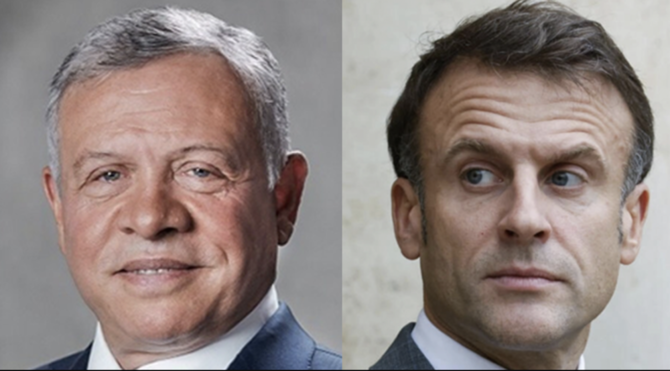
Jordan’s King Abdullah II spoke on the phone to French President Emmanuel Macron on Monday to discuss developments in Gaza, the West Bank, and broader regional issues. (Petra/AFP)
Short Url
Updated 01 September 2025
Follow

King Abdullah, French President Emmanuel Macron discuss Gaza, Syria, Lebanon

  • King emphasizes Jordan’s commitment to supporting Palestinians 

AMMAN: Jordan’s King Abdullah II spoke on the phone to French President Emmanuel Macron on Monday to discuss developments in Gaza, the West Bank, and broader regional issues.

The Royal Court said the king stressed the urgent need for intensified international efforts to halt the war in Gaza and guarantee the uninterrupted delivery of humanitarian aid across the enclave, the Jordan News Agency reported.

He reiterated Jordan’s firm rejection of Israeli plans to consolidate the occupation of Gaza, expand military control there, and its continued settlement expansion in the West Bank.

King Abdullah stressed Jordan’s commitment to supporting the Palestinians in securing their legitimate rights and establishing an independent state based on the two-state solution.

He welcomed France’s declared intention to recognize the Palestinian state later this month and commended its diplomatic and humanitarian efforts to achieve peace in the region.

The two leaders also focused on the importance of supporting Syria and Lebanon in safeguarding their security, stability, and territorial integrity, Petra added.


US Congress moves toward repeal of tough ‘Caesar’ sanctions on Syria

Updated 13 sec ago
Follow

US Congress moves toward repeal of tough ‘Caesar’ sanctions on Syria

  • The Caesar sanctions, the most stringent restrictions, can only be removed permanently by an act of Congress
  • Several Saudi Arabian firms are planning billion-dollar investments in the country as part of Riyadh’s drive to support the country’s recovery

WASHINGTON: A set of tough US sanctions imposed on Syria under its former leader Bashar Assad could be lifted within weeks, after their repeal was included in a sweeping defense policy bill unveiled during the weekend and due for votes in Congress within days. The Senate and House of Representatives included repeal of the so-called Caesar sanctions, a move seen as key to Syria’s economic recovery, in a compromise version of the National Defense Authorization Act, or NDAA, a sweeping annual defense policy bill that was unveiled late on Sunday.
The provision in the 3,000-page defense bill repeals the 2019 Caesar Act and requires regular reports from the White House certifying that Syria’s government is fighting Daesh militants, upholding religious and ethnic minority rights within the country and not taking unilateral, unprovoked military action against its neighbors, including Israel.

HIGHLIGHTS

• Sanctions relief seen as key to Syrian economic revival

• US bill including repeal expected to pass within weeks

• Trump has temporarily lifted sanctions, Congress must approve permanent relief

The NDAA is expected to pass by the end of this year and be signed into law by President Donald Trump, whose fellow Republicans hold majorities in both the House and Senate and lead the committees that wrote the bill. Lifting the sanctions is considered a key to the success of Syria’s new government. Several Saudi Arabian firms are planning billion-dollar investments in the country as part of Riyadh’s drive to support the country’s recovery. The US sanctions have been a significant obstacle to Syria’s economic revival.
Trump announced plans to lift all sanctions on Syria during a meeting with Syrian President Ahmed Al-Sharaa in May, and his administration has suspended them temporarily. However, the Caesar sanctions, the most stringent restrictions, can only be removed permanently by an act of Congress.
The 2019 Caesar Act imposed wide-ranging sanctions on Syria targeting individuals, companies and institutions linked to Assad, who was the president of Syria from 2000 until his ouster in 2024 by rebel forces led by Sharaa. Syrian central bank Governor AbdulKader Husrieh told Reuters last week that the country’s economy was growing faster than had been expected. He described the repeal of many US sanctions as “a miracle.”
The sanctions are named after a Syrian military photographer, code-named “Caesar,” who smuggled out thousands of gruesome photos documenting torture and war crimes by Assad’s government.