

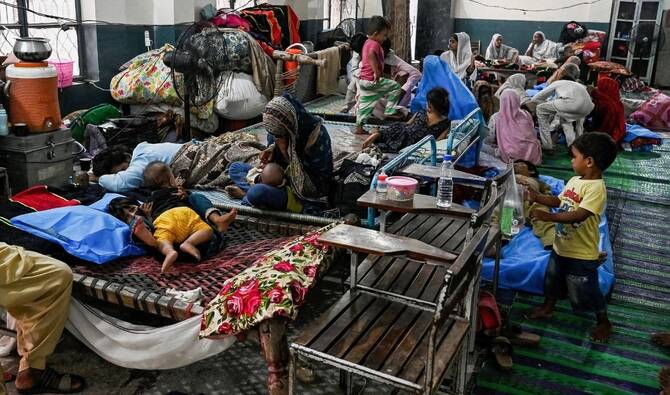

ISLAMABAD: The World Health Organization (WHO) on Monday warned that Pakistan’s flood-hit Punjab province has been witnessing an increase in vector-borne diseases even though provincial authorities have not yet reported any major outbreak.
Punjab, the country’s most populous and breadbasket province, has been facing a flood-emergency, fueled by above-normal rains and India’s release of excess water, which has affected more than 2.4 million people and killed 41 people in the last 10 days, according to the provincial disaster management authority (PDMA).
Authorities have relocated more than 900,000 people to relief camps, where the WHO says unsafe drinking water and mosquitoes pose the main epidemic risks, making displaced people vulnerable to diarrhea, typhoid, malaria, dengue and skin infections.
“Although no major outbreak has been reported so far, an upsurge has been detected for vector-borne diseases such as malaria and dengue, water-borne diseases like acute watery diarrhea, and skin diseases like scabies and eye infections,” Dr. Jose Ignacio Martin Galan, head of communications at the WHO Pakistan Country Office, told Arab News.
To reduce these risks, WHO has urged authorities to prioritize access to essential health services, medicines, diagnostic kits and psychosocial support, along with shelters, food, safe drinking water and sanitation facilities.
“Equally important are water, sanitation and hygiene interventions to reduce outbreak risks and the protection of vulnerable groups in relief camps,” Dr. Galan told Arab News.
Monsoon season brings South Asia 70 to 80 percent of its annual rainfall, but increasingly erratic and extreme weather patterns are turning the annual rains, which are vital for agriculture, food security and the livelihoods of millions of farmers, into a destructive force.
The Punjab government says it has already mobilized resources and more than 100,000 patients have received treatment at field hospitals in flood-hit districts.
“In Lahore alone, 9,000 people have been treated so far,” Punjab Health Minister Imran Nazir told Arab News, adding that over 850 relief camps are providing medicines and treatment for malaria, fever, rabies, snake bites, diarrhea and skin diseases.
“We are prepared for epidemics that may spread in the coming days. All kinds of medicines have been stocked in district, tehsil, and field hospitals.”
Nazir said special facilities have also been arranged for pregnant women who have been displaced by the deluges.
Punjab Chief Minister Maryam Nawaz has also directed local administration officials to ensure anti-mosquito, anti-insect spray in their areas.
“All commissioners and deputy commissioners are hereby directed to ensure timely and effective implementation of anti-mosquito, anti-insect spraying regime in their respective jurisdictions, especially in the rescue camps, in order to safeguard public health and prevent mosquito/insect borne diseases,” she said on X.
Health experts, however, urge more effective measures, saying unsafe drinking water remains the biggest threat to public health in flood-affected areas.
“If safe water supply cannot be ensured, simple filters or chlorine tablets with clear instructions in the local language should be provided,” Rana Asghar, an epidemiologist and former resident adviser at the US Centers for Disease Control and Prevention (CDC), told Arab News.


