- Development comes as Pakistan slowly recovers from a macroeconomic crisis under a $7 billion IMF program
- PM Shehbaz Sharif invites Chinese companies to establish Special Economic Zones, broaden bilateral trade
ISLAMABAD: Pakistan is seeking to broaden its partnership with China by advancing cooperation in finance, port development and the next phase of the China-Pakistan Economic Corridor (CPEC), top Pakistani officials said on Monday, signaling Islamabad’s renewed focus on strengthening economic integration with its longtime strategic ally.
Pakistan sees China as its top economic and diplomatic ally, with Beijing making extensive investments in energy and infrastructure projects in Pakistan as part of CPEC, a major segment of China’s Belt and Road Initiative that aims to build land and maritime trade routes linking Asia with Africa and Europe.
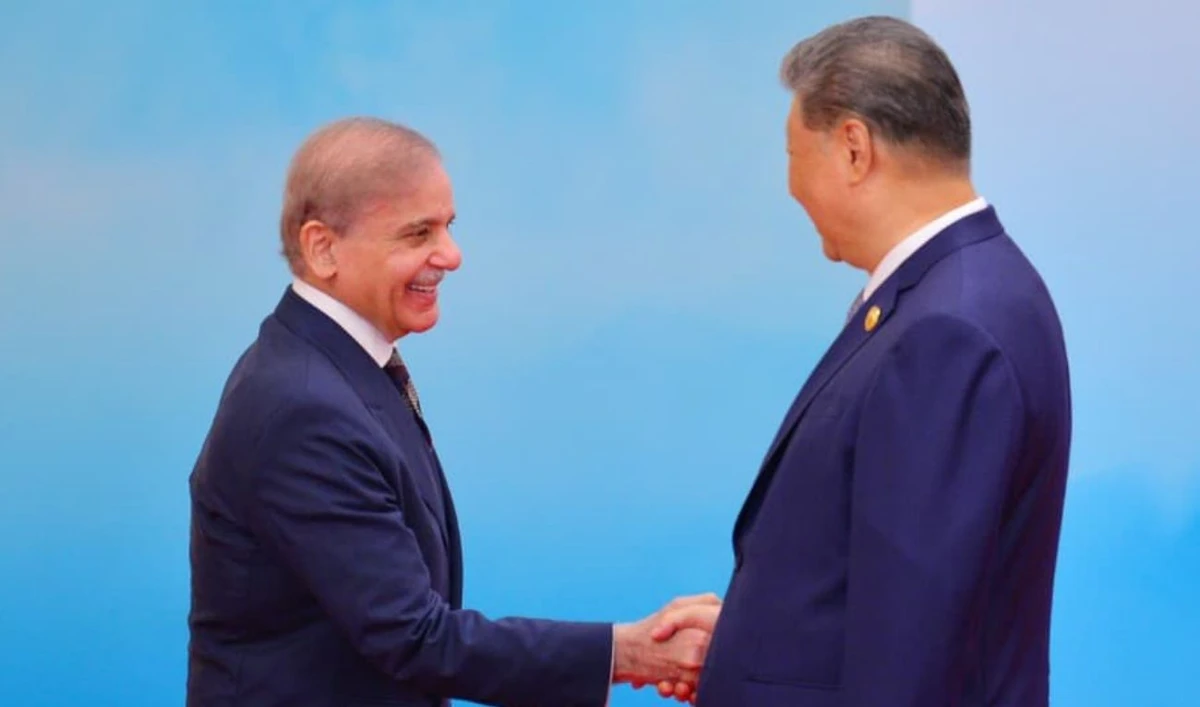
On Monday, Pakistan’s Prime Minister Shehbaz Sharif, who is on a visit to China since Saturday, and Finance Minister Muhammad Aurangzeb held key meetings with senior Chinese officials and discussed with them further strengthening bilateral cooperation in the fields of finance, ports and connectivity.
In a meeting with Communist Party Secretary of Tianjin-Binhai New Area, Lian Maojun, Sharif noted the China-Pakistan Economic Corridor has played a significant role in developing Pakistan’s energy sector and building infrastructure, according to the Pakistan PM’s office.
“The second phase of CPEC would focus on cooperation in smart cities, the agricultural industry, and next-generation technology,” Sharif said, adding that Pakistan seeks to expand economic cooperation and trade with Tianjin-Binhai New Area.
“Pakistan wants to broaden cooperation and trade between its Karachi Port, Port Qasim, and Gwadar Port with China’s Tianjin Port. Pakistan wants to benefit from Tianjin-Binhai New Area’s expertise in port handling and port operations.”
Launched in 2015, the CPEC infrastructure program includes energy projects, highways, railways and the development of the Gwadar Port on the Arabian Sea. Pakistan and China are currently working to advance into “CPEC 2.0,” focused on industrialization, agriculture, energy and connectivity.
Communist Party Secretary Lian briefed PM Sharif on Tianjin-Binhai New Area industries, which focus on intelligent technology, green petrochemicals, automotive, biomedicine, new energy, aerospace, cold chain storage, deep-sea mining, gene therapy and many other sectors.
“Pakistan welcomes Chinese companies to establish Special Economic Zones (SEZs) in the country,” Sharif said. “Pakistan seeks to expand cooperation with Tianjin-Binhai New Area’s industries in pharmaceuticals, biomedicine, and animal vaccines.”
The development comes as the South Asian country slowly recovers from an economic meltdown under a $7 billion International Monetary Fund (IMF) loan program and looks to boost trade, tourism and foreign investment for a sustainable economic growth.
Separately, Finance Minister Aurangzeb met with Dr. Pan Gongsheng, governor of the People’s Bank of China (PBOC), and Liao Lin, chairman of the Industrial and Commercial Bank of China (ICBC), in Beijing on Monday to advance Pakistan–China financial cooperation, the Pakistani finance ministry said.
During his meeting with the People’s Bank of China governor, the finance minister appreciated China’s longstanding economic support to Pakistan and briefed him on Islamabad’s recent economic performance, reform agenda and the positive outlook reflected in improved international credit ratings.
“The Minister acknowledged the crucial role of the PBOC in supporting Pakistan through multilateral engagements and in strengthening financial cooperation between the two countries,” the ministry said. “He underscored the importance of deepening financial integration and expanding cooperation in areas of mutual interest.”
The development comes months after China rolled over $3.4 billion in loans to Islamabad, Reuters reported in June. Beijing rolled over $2.1 billion, which has been in Pakistan’s central bank’s reserves for the last three years, and refinanced another $1.3 billion commercial loan, which Islamabad had paid back two months ago.
The loans are critical to shoring up Pakistan’s low foreign reserves, which the International Monetary Fund (IMF) required to be over $14 billion at the end of the current fiscal year on June 30.
In his meeting with the ICBC chairman, Aurangzeb conveyed Pakistan’s gratitude for the continued support in development financing, commercial facilities, and the refinancing of existing obligations. He emphasized that ICBC’s strong presence in Pakistan reflects the deepening financial and economic partnership, and discussed prospects for enhanced cooperation in investment, trade financing and Pakistan’s forthcoming initiatives in financial diversification, according to the finance ministry.
Aurangzeb underlined that Pakistan’s economic reform program is designed to deliver long-term stability, resilience, and sustainable growth. He emphasized that partnerships with Chinese financial institutions are not only vital for meeting immediate financing needs but are also integral to Pakistan’s broader strategy of diversification, financial innovation, and regional integration, highlighting that new initiatives, such as accessing the Chinese onshore markets, will help open fresh avenues for investment, strengthen market confidence, and align Pakistan’s financial system more closely with regional dynamics.
“Both sides agreed that the Pakistan–China economic partnership has entered a new phase, with opportunities to deepen cooperation across banking, investment, and capital markets,” the Pakistani ministry said.
“Senator Aurangzeb reaffirmed Pakistan’s commitment to a forward-looking partnership with China, where financial cooperation will serve as a cornerstone for broader economic engagement.”