

Nine killed as protesters storm US Consulate in Karachi after Iran confirms Khamenei killed

1 / 3
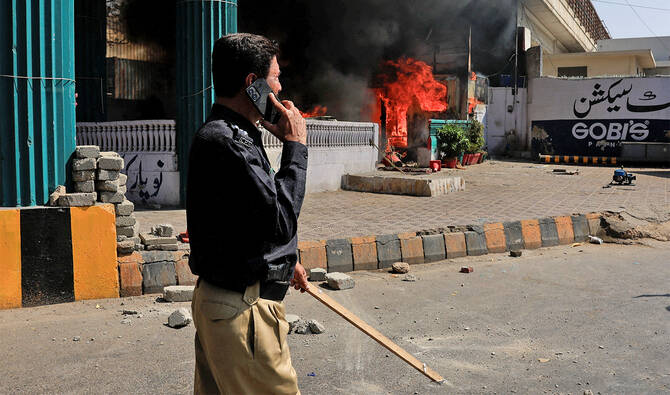
A police officer walks next to a checkpost set ablaze in a protest outside the U.S. Consulate General, following news of U.S. and Israeli strikes on Iran that killed supreme leader Ayatollah Ali Khamenei, in Karachi, Pakistan on March 1, 2026. (REUTERS)
2 / 3
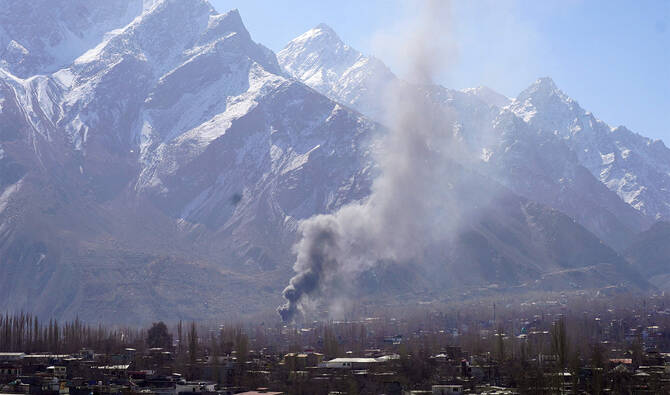
Smoke billows after protesters set fire to a United Nations office during an anti-US and Israel protest in Skardu in Pakistan's Gilgit-Baltistan region on March 1, 2026. (AFP)
3 / 3
Police officer take position outside US Consulate following protesters stormed the U.S. Consulate in Karachi, Pakistan, on March 1, 2026. (AN photo)
Short Url
Updated 01 March 2026
Follow

Nine killed as protesters storm US Consulate in Karachi after Iran confirms Khamenei killed

  • Protesters smashed doors, set fire to property as police used tear gas to disperse crowds
  • Protests spread to Shia-majority areas of Gilgit-Baltistan, UN office torched by demonstrators

ISLAMABAD: At least nine people were killed and 60 injured in clashes near the US Consulate in Karachi on Sunday, a police surgeon said, as protests erupted across parts of Pakistan following Iran’s confirmation that Supreme Leader Ayatollah Ali Khamenei was killed in joint US–Israeli strikes.

Hundreds of protesters gathered outside the consulate on Sunday morning, with some attempting to storm the compound and vandalizing property, according to footage circulating on social media and international news reports.

Videos showed protesters armed with sticks smashing doors and windows. Separate footage appeared to show property inside the consulate premises set on fire, prompting police to fire tear gas at them. Additional Inspector General Karachi Azad Khan told reporters that miscreants managed to enter the consulate from the outer gate before police dispersed them.
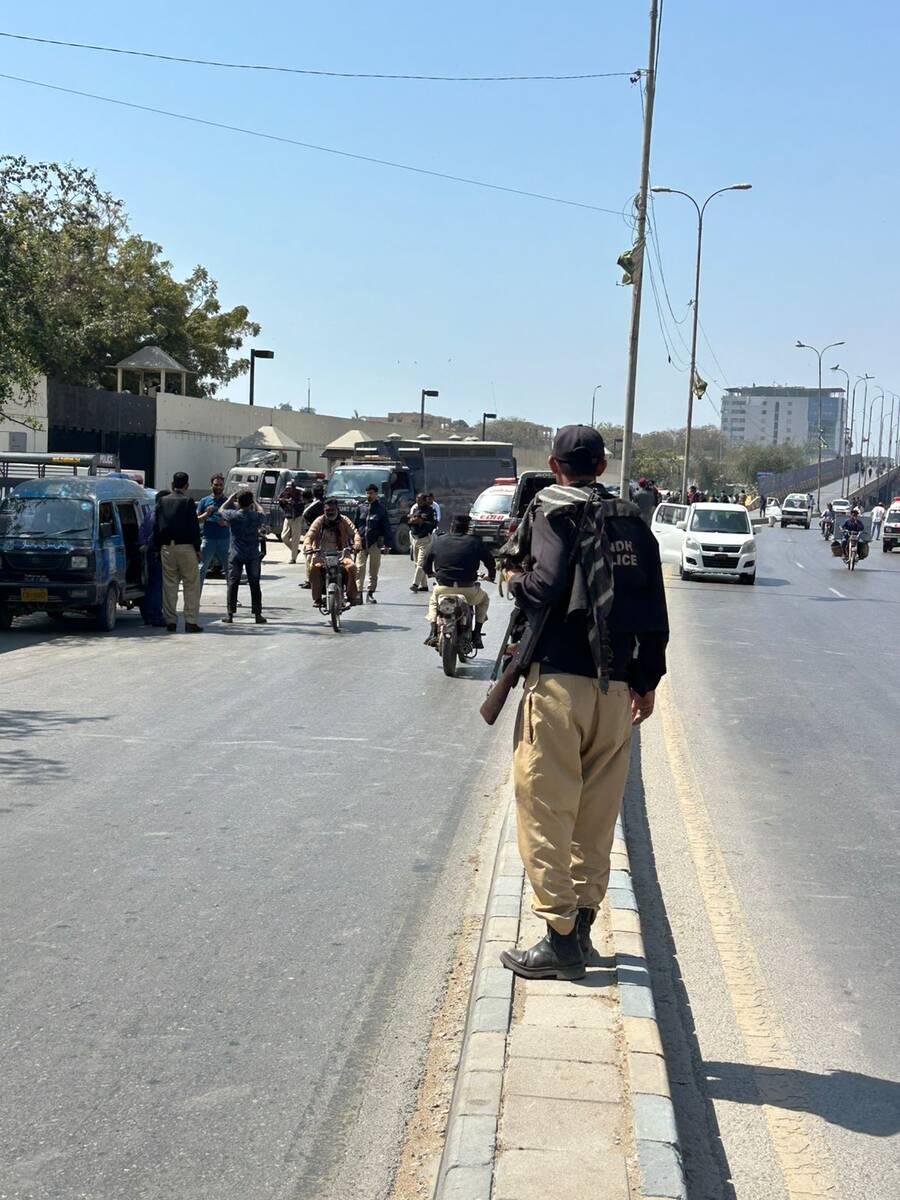


Police officers take position outside US Consulate following protesters stormed the U.S. Consulate in Karachi, Pakistan, on March 1, 2026. (AN photo)

“Nine people are dead while 39 injured are being treated at the Shaheed Mohtarma Benazir Bhutto Institute of Trauma,” Karachi Police surgeon Dr. Summaiya Syed said in a statement.

She said seven others were injured at the Jinnah Postgraduate Medical Center, among them five police personnel, while 14 others were receiving treatment for wounds at private hospitals in the city. 

Separately, the Sindh government expressed grief at the loss of lives in the clashes, saying it had constituted a high-level joint investigation committee (JIT) to carry out an impartial investigation into the incident.

“The JIT will determine the circumstances in which the incident occurred and what its causes were,” a statement by the provincial government said, adding that it respects the constitutional right of citizens to protest. 

A heavy contingent of police personnel was deployed around the Red Zone in Karachi after the protest, with roads leading to the Chief Minister’s House sealed.

The violence came hours after Iranian authorities confirmed Khamenei was killed in coordinated strikes carried out by the United States and Israel, dramatically escalating tensions in the Middle East and triggering protests in several countries.
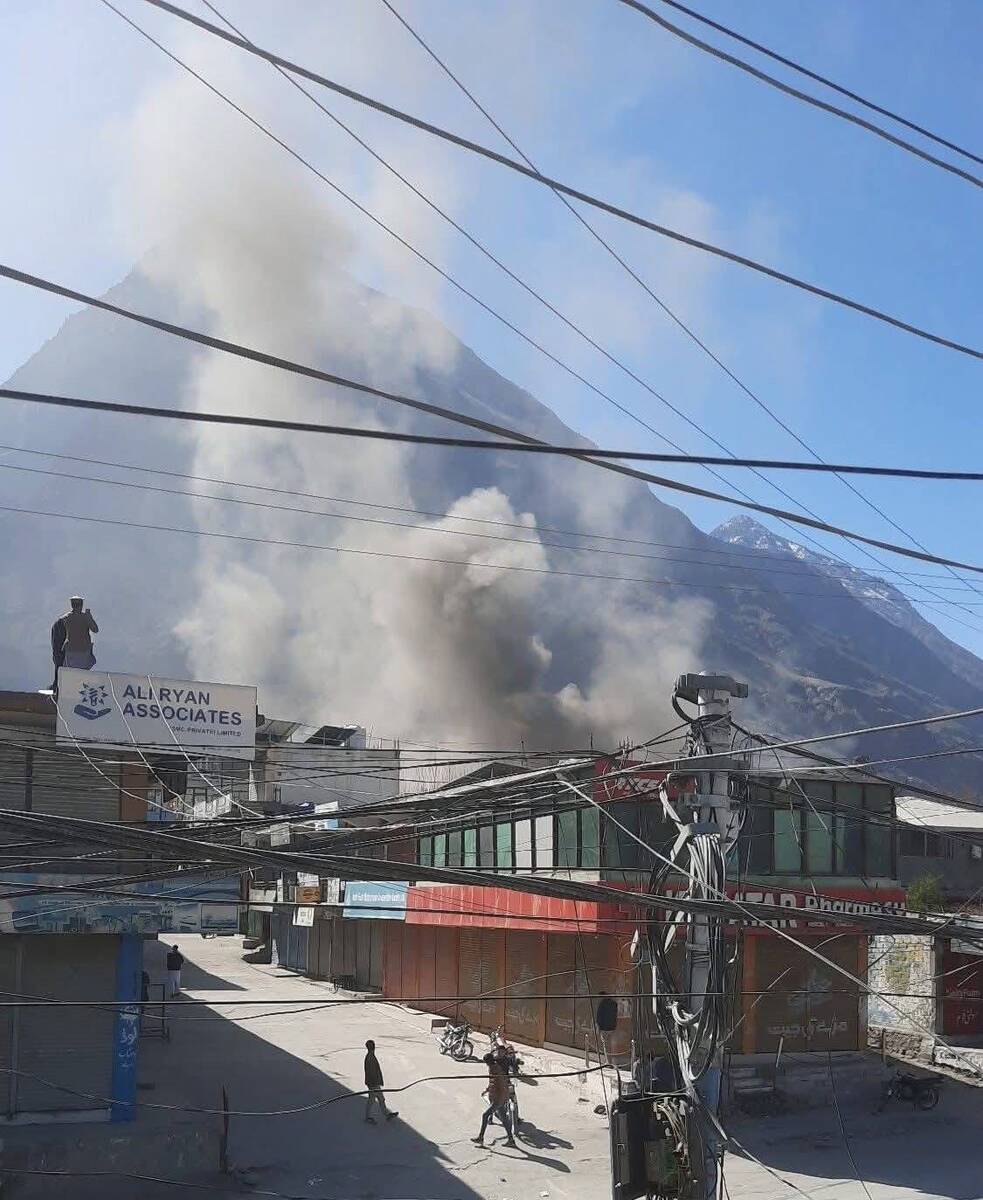


Smoke billows over building in Skardu, Pakistan, on March 1, 2026, as protesters set UN office in district on fire. (Social media)

PROTESTS SPREAD

Demonstrations were also reported in Skardu, in Pakistan’s northern Gilgit-Baltistan region, where hundreds of people staged a sit-in on a main road to protest Khamenei’s killing.

Shabbir Mir, spokesperson for the Gilgit-Baltistan chief minister, told Arab News that a United Nations office in the district had been set on fire.

“The protesters have torched an UN office in Skardu,” Mir confirmed.

Separately, the Islamabad district administration imposed a ban on public gatherings in the city via Section 144.

Section 144 of the Code of Criminal Procedure allows authorities to impose different kinds of restrictions to maintain public order and safety.

“Strict legal action will be taken in the event of any protest, demonstration or gathering,” the administration warned in a statement.

The unrest in Pakistan follows a sharp escalation in the Middle East after the United States and Israel launched coordinated strikes in Iran on Saturday.

According to US officials, the operation targeted Revolutionary Guard command facilities, air defense systems, missile and drone launch sites, and military airfields. The US military said it suffered no casualties and reported minimal damage to its bases despite what it described as “hundreds of Iranian missile and drone attacks.”

Iran retaliated by launching missiles and drones toward Israel and targeting US military installations in Bahrain, Kuwait and Qatar. Israeli ally UAE said its air defense systems intercepted dozens of Iranian missiles and drones, but debris from the interceptions caused material damage in Abu Dhabi and Dubai, and at least one civilian, including a Pakistani national, was killed.

The UAE government condemned the strikes as a “blatant violation of national sovereignty and international law,” and issued rare emergency alerts urging residents to seek shelter, underscoring how the conflict has rippled far beyond Iran’s borders. 

The Israeli military said dozens of Iranian missiles were fired toward Israeli territory, many of which were intercepted. Israel’s Magen David Adom rescue service said a woman in the Tel Aviv area died after being wounded in a missile strike.


Pakistan announces four-day work week among austerity measures to offset impact of Middle East crisis

Updated 54 min 30 sec ago
Follow

Pakistan announces four-day work week among austerity measures to offset impact of Middle East crisis

  • The development comes as ongoing US-Israeli strikes on Iran disrupt oil supplies in Strait of Hormuz, push prices past $119 a barrel
  • Islamabad bans government purchases, cuts fuel allocation for vehicles as well as workforce in public and private offices by 50 percent

ISLAMABAD: Prime Minister Shehbaz Sharif on Monday announced austerity measures, including a four-day work week and cuts in government expenditures, to offset the impact of rising global oil prices due to an ongoing conflict in the Middle East.

Global fuel supply lines have been disrupted in the Strait of Hormuz, which supplies nearly a fourth of world oil consumption, after Tehran blocked it following United States-Israeli strikes on Iran and counterattacks against US interests in the Gulf region.

Oil prices surged more than 25 percent globally on Monday to $119.50 a barrel, the highest levels since mid-2022, as some major producers cut supplies and fears of prolonged shipping disruptions gripped the market due to the expanding US-Israeli war with Iran.

In his televised address on Sunday night, Sharif said global oil prices were expected to rise again in the coming days but vowed not to let the people bear their brunt, announcing austerity measures to lessen the impact of fuel price hikes.

“Fifty percent staff in public and private entities will work from home,” he announced, adding this would not be applicable to essential services. “Offices will remain open for four days a week. One-day additional off is being given to conserve oil, but it would not be applicable to banks.”

Sharif didn’t specify working days of the week and the government was likely to issue a notification in this regard.

He said a decrease of 50 percent was being made in fuel allocation for government vehicles immediately for the next two months, but they would not include ambulances and public buses.

“Cabinet members, advisers and special assistants will not draw salaries for the next two months, 25 percent salaries of parliamentarians are being deducted, two-day salaries of Grade 20 and above officers, or those who are paid Rs300,000 ($1,067) a month, are being deducted for public relief,” he said.

Similarly, there will be 20 percent reduction in public department expenses and a complete ban on the purchase of cars, furniture, air conditioners and other goods, according to the prime minister.

Foreign trips of ministers and other government officials will also be banned along with government dinners and iftar buffets, while teleconferences and online meetings will be given priority.

Sharif’s comments were aired hours after Pakistani authorities said the country had “comfortable levels” of petroleum stocks and the supply chains were functioning smoothly, despite intensifying Middle East conflict.

Petroleum Minister Ali Pervaiz Malik said three oil shipments were due to reach Pakistan this week, state media reported.

Meanwhile, Pakistan Navy (PN) launched ‘Operation Muhafiz-ul-Bahr’ to safeguard national energy shipments, the Pakistani military said on Monday, amid disruptions to critical sea lanes due to the conflict.

The navy is conducting escort operations in close coordination with the Pakistan National Shipping Corporation (PNSC), according to the Inter-Services Public Relations (ISPR), the military’s media wing. It is fully cognizant of the prevailing maritime situation and is actively monitoring and controlling the movement of merchant vessels to ensure their safe and secure transit.

“With approximately 90 percent of Pakistan’s trade conducted via sea, the operation aims to ensure that vital sea routes remain safe, secure, and uninterrupted,” the ISPR said on Monday. “Currently, PN ships are escorting 2 x Merchant Vessels, one of which is scheduled to arrive Karachi today.”