

In the Israeli-occupied West Bank, Palestinian taps run dry

1 / 2
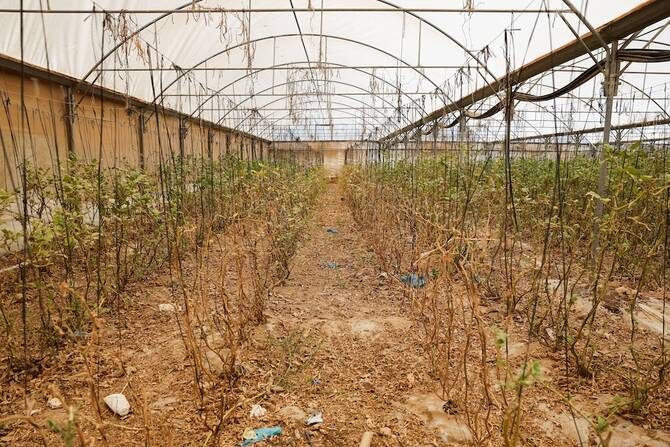
Plants wilt in a greenhouse in Bardala in Jordan Valley, in the Israeli-occupied West Bank, as the area reports severe water shortages. (Reuters)
2 / 2
Palestinians have long faced a campaign of intimidation, harassment and physical violence by extremist settlers, who represent a minority of Jewish settlers living in the West Bank. Above, Palestinian protesters in the West Bank city of Ramallah on Sept. 1, 2025. (AP)
Short Url
Updated 01 September 2025
Follow

In the Israeli-occupied West Bank, Palestinian taps run dry

  • Residents are reporting shortages that have left taps in homes dry and farms without irrigation
  • The UN recorded 62 incidents of Jewish settlers vandalizing water-related infrastructure in the West Bank

KFAR MALIK, West Bank/JERUSALEM: Palestinians in the Israeli-occupied West Bank are facing severe water shortages that they say are being driven by increasing attacks on scarce water sources by extremist Jewish settlers.

Across the West Bank in Palestinian communities, residents are reporting shortages that have left taps in homes dry and farms without irrigation.

In Ramallah, one of the largest Palestinian cities in the West Bank and the administrative capital of the Palestinian Authority, residents facing water shortages are now relying on public taps.

“We only get water at home twice a week, so people are forced to come here,” said Umm Ziad, as she filled empty plastic bottles with water alongside other Ramallah residents.

The United Nations recorded 62 incidents of Jewish settlers vandalizing water wells, pipelines, irrigation networks and other water-related infrastructure in the West Bank in the first six months of the year.

The Israeli military acknowledged it has received multiple reports of Israeli civilians intentionally causing damage to water infrastructure but that no suspects had been identified.

Among the targets have been a freshwater spring and a water distribution station in Ein Samiya, around 16 kilometers northeast of Ramallah, serving around 20 nearby Palestinian villages and some city neighborhoods.

Settlers have taken over the spring that many Palestinians have used for generations to cool off in the hot summer months.

Palestinian public utility Jerusalem Water Undertaking said the Ein Samiya water distribution station had become a frequent target of settler vandalism.

“Settler violence has escalated dramatically,” Abdullah Bairait, 60, a resident of nearby Kfar Malik, standing on a hilltop overlooking the spring.

“They enter the spring stations, break them, remove cameras, and cut off the water for hours,” he said.

The Ein Samiya spring and Kfar Malik village have been increasingly surrounded by Jewish Israeli settlements. The United Nations and most foreign governments consider settlements in the West Bank to be illegal under international law and an obstacle to the establishment of a future Palestinian state.

According to the United Nations’ humanitarian office, settlers carried out multiple attacks targeting water springs and vital water infrastructure in the Ramallah, Salfit and Nablus areas between June 1 and July 14. The Ein Samiya water spring had been repeatedly attacked, it said in a July report.

Israeli security forces view any damage to infrastructure as a serious matter and were carrying out covert and overt actions to prevent further harm, the Israeli military said in response to Reuters questions for this story. It said the Palestinian Water Authority had been given access to carry out repairs.

Kareem Jubran, director of field research at Israeli rights group B’Tselem, told Reuters that settlers had taken control over most natural springs in the West Bank in recent years and prevented Palestinians from accessing them.

Settler violence

Palestinians have long faced a campaign of intimidation, harassment and physical violence by extremist settlers, who represent a minority of Jewish settlers living in the West Bank. Most live in settlements for financial or ideological reasons and do not advocate for violence against Palestinians.

Palestinians say the frequency of settler violence in the West Bank has increased since the October 7, 2023 Hamas attacks on Israel.

They say they fear the rise in settler violence is part of a campaign to drive them from the land. The United Nations has registered 925 such incidents in the first seven months of this year, a 16 percent year-on-year increase.

Since the Hamas militant attacks which sparked the war in Gaza, several Israeli politicians have advocated for Israel to annex the West Bank, which it has occupied since 1967.

Reuters reported on Sunday that Israeli officials said the government is now considering annexing the territory after France and other Western nations said they would recognize a Palestinian state this month. The Palestinian Authority wants a future Palestinian state to encompass West Bank, East Jerusalem and the Gaza Strip.

Palestinians in the West Bank have long struggled to access water. The Western-backed Palestinian Authority exercises limited civic rule in parts of the territory and relies on Israeli approvals to develop and expand water infrastructure. Palestinian officials and rights groups say that’s rarely given.

B’Tselem said in an April 2023 report that Palestinians were facing a chronic water crisis, while settlers have an abundance of water.

“The water shortage in the West Bank is the intentional outcome of Israel’s deliberately discriminatory policy, which views water as another means for controlling the Palestinians,” B’Tselem wrote in the report.

Costly deliveries

Across the West Bank, water tanks are common in Palestinian homes, storing rainwater or water delivered by trucks due to an already unreliable piped water network that has been exacerbated by the settler attacks.

COGAT, the Israeli military agency that oversees policy in the West Bank and Gaza, said in response to Reuters questions the Palestinian Authority was responsible for supplying water to Palestinians in the West Bank. Israel transferred 90 million cubic meters of water to the Palestinian Authority each year, it said, blaming any shortages on water theft by Palestinians.

Along with traveling long distances to collect water, Palestinians have become reliant on costly water deliveries to manage the chronic water crisis that they fear will only grow.

“If the settlers continue their attacks, we will have conflict on water,” said Wafeeq Saleem, who was collecting water from a public tap outside Ramallah.

“Water is the most important thing for us.”


Netanyahu says Israel and Hamas will enter ceasefire’s second phase soon

Updated 08 December 2025
Follow

Netanyahu says Israel and Hamas will enter ceasefire’s second phase soon

  • Says the second phase addresses the disarming of Hamas and withdrawal of Israeli troops from Gaza
  • Second stage also includes the deployment of an international force to secure Gaza and forming a temporary Palestinian government

TEL AVIV, Israel: Israeli Prime Minister Benjamin Netanyahu said Sunday that Israel and Hamas are “very shortly expected to move into the second phase of the ceasefire,” after Hamas returns the remains of the last hostage held in Gaza.
Netanyahu spoke during a news conference with visiting German Chancellor Friedrich Merz and stressed that the second phase, which addresses the disarming of Hamas and the withdrawal of Israeli troops from Gaza, could begin as soon as the end of the month.
Hamas has yet to hand over the remains of Ran Gvili, a 24-year-old police officer who was killed in the Hamas-led Oct. 7, 2023, attack that sparked the war. His body was taken to Gaza.
The ceasefire’s second stage also includes the deployment of an international force to secure Gaza and forming a temporary Palestinian government to run day-to-day affairs under the supervision of an international board led by US President Donald Trump.
A senior Hamas official on Sunday told The Associated Press the group is ready to discuss “freezing or storing or laying down” its weapons as part of the ceasefire in a possible approach to one of the most difficult issues ahead.

Netanyahu says second phase will be challenging
Netanyahu said few people believed the ceasefire’s first stage could be achieved, and the second phase is just as challenging.
“As I mentioned to the chancellor, there’s a third phase, and that is to deradicalize Gaza, something that also people believed was impossible. But it was done in Germany, it was done in Japan, it was done in the Gulf States. It can be done in Gaza, too, but of course Hamas has to be dismantled,” he said.
The return of Gvili’s remains — and Israel’s return of 15 bodies of Palestinians in exchange — would complete the first phase of Trump’s 20-point ceasefire plan.
Hamas says it has not been able to reach all remains because they are buried under rubble left by Israel’s two-year offensive in Gaza. Israel has accused the militants of stalling and threatened to resume military operations or withhold humanitarian aid if all remains are not returned.
A group of families of hostages said in a statement that “we cannot advance to the next phase before Ran Gvili returns home.”
Meanwhile, Israeli military Chief of Staff Lt. Gen. Eyal Zamir on Sunday called the so-called Yellow Line that divides the Israeli-controlled majority of Gaza from the rest of the territory a “new border.”
“We have operational control over extensive parts of the Gaza Strip and we will remain on those defense lines,” Zamir said. “The Yellow Line is a new border line, serving as a forward defensive line for our communities and a line of operational activity.”
Germany says support for Israel is unchanged
Merz said Germany, one of Israel’s closest allies, is assisting with the implementation of the second phase by sending officers and diplomats to a US-led civilian and military coordination center in southern Israel, and by sending humanitarian aid to Gaza.
The chancellor also said Germany still believes that a two-state-solution is the best possible option but that “the German federal government remains of the opinion that recognition of a Palestinian state can only come at the end of such a process, not at the beginning.”
The US-drafted plan for Gaza leaves the door open to Palestinian independence. Netanyahu has long asserted that creating a Palestinian state would reward Hamas and eventually lead to an even larger Hamas-run state on Israel’s borders.
Netanyahu also said that while he would like to visit Germany, he hasn’t planned a diplomatic trip because he is concerned about an arrest warrant issued by the International Criminal Court, the UN’s top war crimes court, last year in connection with the war in Gaza.
Merz said there are currently no plans for a visit but he may invite Netanyahu in the future. He added that he is not aware of future sanctions against Israel from the European Union nor any plans to renew German bans on military exports to Israel.
Germany had a temporary ban on exporting military equipment to Israel, which was lifted after the ceasefire began on Oct. 10.
Israel kills militant in Gaza
The Israeli military said it killed a militant who approached its troops across the Yellow Line.
Gaza’s Health Ministry says Israeli forces have killed more than 370 Palestinians since the start of the ceasefire, and that the bodies of six people killed in attacks had been brought to local hospitals over the past 24 hours.
In the original Hamas-led attack in 2023, the militants killed around 1,200 people and took more than 250 others hostage. Almost all the hostages or their remains have been returned in ceasefires or other deals.
Israel’s offensive in Gaza has killed at least 70,360 Palestinians, according to Gaza’s Health Ministry, which operates under the Hamas-run government. The ministry does not differentiate between civilians and combatants, but says that nearly half the dead have been women and children. The ministry is part of Gaza’s Hamas government and its numbers are considered reliable by the UN and other international bodies.