

Strong quake in eastern Afghanistan near Pakistan border kills at least 250, injures 500

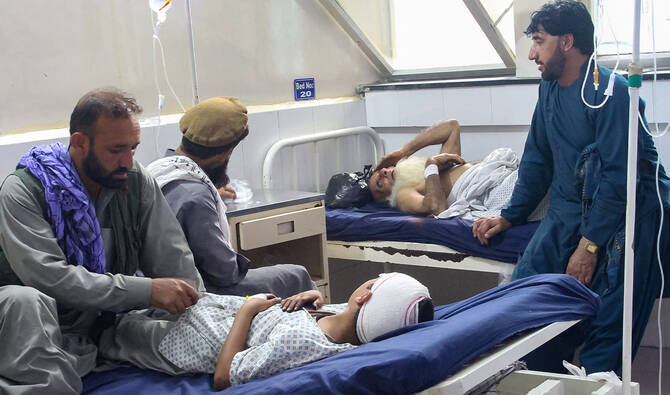
Injured Afghan people receive treatment at a hospital after an earthquake in Afghanistan's Jalalabad on September 1, 2025. (AFP)
Short Url
Updated 01 September 2025
Follow

Strong quake in eastern Afghanistan near Pakistan border kills at least 250, injures 500

  • Magnitude 6 quake hit a series of towns in Kunar province late Sunday, near the city of Jalalabad
  • Tremors were felt in northwestern Pakistan on Sunday, which reported no casualties from the quake

KABUL, Afghanistan: A strong earthquake in eastern Afghanistan near the Pakistan border has killed at least 250 people and injured at least 500 others, officials said.

The quake late Sunday hit a series of towns in the province of Kunar, near the city of Jalalabad in neighboring Nangahar province. The 6.0 magnitude at 11:47 p.m. was centered 27 kilometers (17 miles) east-northeast of the city of Jalalabad in Nangarhar province, the US Geological Survey said. It was just 8 kilometers (5 miles) deep. Shallower quakes tend to cause more damage.

The Kunar Disaster Management Authority said in a statement that at least 250 people were killed and 500 others injured in the districts of Nur Gul, Soki, Watpur, Manogi and Chapadare.

Jalalabad is a bustling trade city due to its proximity with neighboring Pakistan and a key border crossing between the countries. Although it has a population of about 300,000 according to the municipality, it’s metropolitan area is thought to be far larger. Most of its buildings are low-rise constructions, mostly of concrete and brick, and its outlying areas include homes built of mud bricks and wood. Many are of poor construction.

Jalalabad also has considerable agriculture and farming, including citrus fruit and rice, with the Kabul River flowing through the city.

A magnitude 6.3 earthquake struck Afghanistan on Oct. 7, 2023, followed by strong aftershocks. The Taliban government estimated at least 4,000 people perished.

The UN gave a far lower death toll of about 1,500. It was the deadliest natural disaster to strike Afghanistan in recent memory.


Pakistan’s PPL says Türkiye partnership opens ‘new chapter’ in offshore oil and gas exploration

Updated 10 sec ago
Follow

Pakistan’s PPL says Türkiye partnership opens ‘new chapter’ in offshore oil and gas exploration

  • Indus Block C work program valued at $3.45 million, seen as Pakistan’s most ambitious offshore drilling test in collaboration with Türkish state company
  • Pakistan has drilled offshore since the 1960s, including wells like Pak Can-1, Pasni-X2, Kekra-1 but none produced commercially viable volumes 

ISLAMABAD: The chief executive of Pakistan Petroleum Limited (PPL) said on Thursday a new exploration partnership with Turkish Petroleum Overseas Company (TPOC) could accelerate Pakistan’s search for offshore oil and gas, describing the venture as a potential turning point for long-stalled development of the sector.

The agreement, signed in Islamabad this week, includes three offshore and two onshore concessions, the most prominent being Eastern Offshore Indus Block C, where TPOC, the overseas arm of Türkiye’s state-owned Turkish Petroleum Corporation (TPAO), will operate with a 25 percent stake. PPL holds 35 percent, while state-owned Oil & Gas Development Company Limited (OGDCL) and Mari Energies each retain 20 percent.

The block carries a minimum work commitment of $3.45 million, and is being positioned as Pakistan’s first serious offshore drilling attempt under the Pakistan–Türkiye energy collaboration.

Speaking to Arab News, PPL Managing Director Sikandar Ali Memon said TPAO brings scale, deep-sea rigs and technical capacity that local firms lack.

“Their coming down here, working with us, will not only develop the offshore prospects, but also the service industry and other related businesses,” Memon said. “I would say this is the beginning of a wonderful chapter that we are looking forward to.”

TPOC will also join Pakistan’s offshore Deep F block as a non-operating partner, where Mari Energies leads the venture with Fatima Petroleum as co-partner.

Pakistan has drilled offshore intermittently since the 1960s, including high-profile wells such as Pak Can-1 (1985), Pasni-X2 (2005), and Kekra-1 in 2019, once touted as the country’s deepest attempt, but none yielded commercial-scale results. Discoveries that did materialize produced volumes too small to economically develop.

Officials say failures were driven by cost, limited technology and uncertain policy environments, though each attempt improved basin modelling and seismic understanding.

Memon said the new Indus Block C prospect benefits from advanced 3D seismic mapping, independent technical validation and an upgraded global technology landscape.

Drilling of the first well is unlikely before early 2027, he added, though the joint venture hopes to accelerate timelines.

Pakistan is seeking foreign capital to reduce reliance on imported fuels, expand domestic reserves and support a strained energy system facing rising demand and falling onshore outputs. Offshore blocks are being offered through new bidding rounds in a push to attract experienced operators.

“This is one of the best prospects,” Memon said, adding that previous technology limitations had held back Pakistan’s offshore potential. “They [TPAO] found that this is the prospect they want to come and join in.”

The officer said PPL intends to pursue further deepwater exploration while improving production from existing onshore fields.

“In the last one-and-a-half years, we have added about 40-plus million units of hydrocarbons to the economy,” Memon said. “We’ll continue optimizing today’s wells while exploring tomorrow’s reserves.”