


ISLAMABAD: Pakistan’s top disaster management body has warned that the country is facing a climate emergency as major natural hazards have been hitting every two months and now pose a grave “national security threat,” underscoring the urgent need for resilience and preparedness measures.
Pakistan, which ranks among the world’s most climate-vulnerable nations, has experienced increasingly erratic, frequent weather events, including heat waves, untimely rains, storms, cyclones and droughts, in recent years, which scientists have blamed on human-driven climate change.
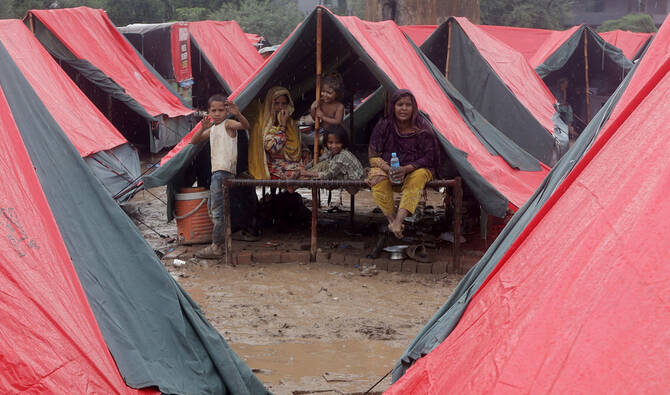
The South Asian country is currently reeling from one of the deadliest floods in its history that have claimed more than 850 lives, according to the National Disaster Management Authority (NDMA). The deluges swept away livestock and swathes of prime farmland in the most populous Punjab province.
Speaking at a press briefing on Sunday, NDMA chief Lt. Gen. Inam Haider Malik said they were planning short-, medium- and long-term measures to deal with these frequently occurring climate disasters, including the monsoon season that bring South Asia up to 80 percent of its annual rainfall.
“After every two months, Pakistan is facing a big disaster, in which the winter hazards are yet to come, after that, the early heatwave will come, and whatever will be triggered by the early heatwave, in which there are forest fires, and the next heatwave, and after that, another monsoon,” Malik said.

Residents inspect the remains of damaged property after water levels receded along the right bank of the Ravi River, following recent floods caused by monsoon rains, in Lahore, Pakistan on August 31, 2025. (REUTERS)
“Unfortunately, this is a part of reality, as we just talked about, in climate change, this is intensifying in the coming years... now climate change is being taken as a national security threat.”
Global warming has worsened monsoon rains this year in Pakistan. While downpours and cloudbursts have triggered flash floods and landslides across the mountainous northern regions, residents in eastern Punjab have experienced abnormal amounts of rain as well as cross-border flooding after India released excess water from its overflowing dams into Pakistan.
In May, severe storms killed at least 32 people in northern parts of the country, while other regions experienced sweltering heatwaves.
Climate Change Minister Musadiq Malik said “the whole country is in chaos” right now, adding that they have been sharing their assessments reports with the prime minister as well as the military leadership.
He said their top priority is to provide relief to the poorest 800,000 of a total of 2 million people displaced by the deluges.
“We are trying very hard, 800,000 of them are those poor people who have no rich relatives, who have been displaced, who need water, who have water-borne diseases, that is, water which is not available, water which is not drinkable, the diseases that spread because of that, so that this epidemic does not spread,” he said.

Residents who fled from a flooded area are seen with their belongings as they take refuge along a road, following monsoon rains and rising water levels of the Chenab River, in Harsa Bhula village, Chiniot district, Punjab province, Pakistan on August 30, 2025. (REUTERS)
“We have to deliver mosquito nets, we have to deliver tents, we have to deliver food, we have to deliver electricity, for all these things, our primary focus is on those displaced poor people on whom work is being done.”
The deluges have revived memories of the 2022 cataclysmic floods when a third of Pakistan was submerged, with more than 1,700 people killed, over 30 million affected and damages totaling $35 billion.
In the southern Sindh province, from where the dangerously high floodwaters are likely to pass in the coming days, local authorities have already started evacuating people to safety with support from army, navy and NDMA.
“It is our duty to protect every citizen,” the climate change minister said. “All the civil institutions are standing with the provinces, our 1122 is standing with the provinces, so God willing, we will minimize the damage.”


