

Trump says oil price spike on Iran war a ‘small price to pay’

1 / 2
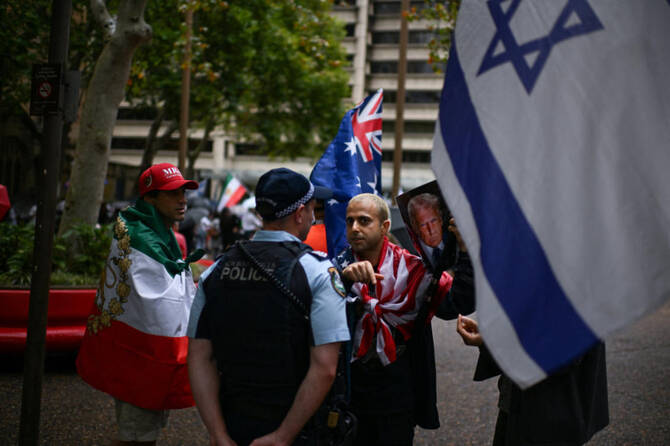
A man holding an image of US President Donald Trump speaks with a police officer during a rally in support of political change in Iran at Town Hall Square in Sydney, Australia, on March 8, 2026. (REUTERS)
2 / 2
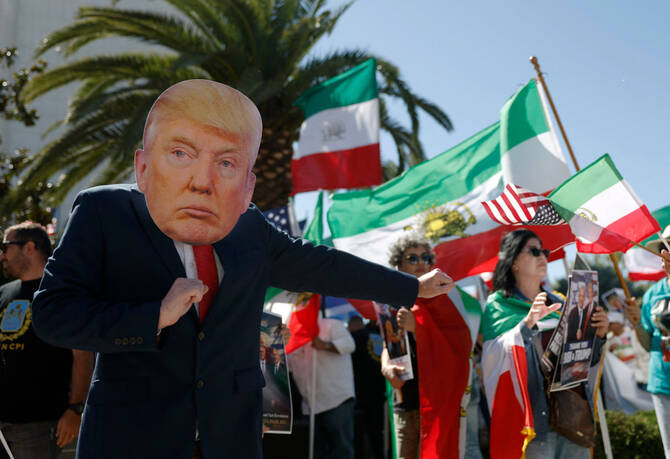
A demonstrator dressed as US President Donald Trump dances during a rally in support of the war outside of the Wilshire Federal Building on March 07, 2026 in Los Angeles, California. (Getty Images/AFP)
Short Url
Updated 09 March 2026
Follow

Trump says oil price spike on Iran war a ‘small price to pay’

  • Says prices will drop rapidly when the destruction of the Iran nuclear threat is over
  • "ONLY FOOLS WOULD THINK DIFFERENTLY!” he wrote on his Truth Social platform

WASHINGTON: US President Donald Trump on Sunday dismissed the war-related spike in oil prices as a “small price to pay” for removing the threat of Iran’s nuclear program.
“Short term oil prices, which will drop rapidly when the destruction of the Iran nuclear threat is over, is a very small price to pay for USA, and World, Safety and Peace. ONLY FOOLS WOULD THINK DIFFERENTLY!” he wrote on his Truth Social platform.


Oil prices have eclipsed $100 per barrel for the first time in more than three and a half years as the Iran war hinders production and shipping in the Middle East. The war, now in its second week, ensnared countries and places that are critical to the production and movement of oil and gas from the Arabian Gulf.

Roughly 15 million barrels of crude oil — about 20 percent of the world’s oil — typically are shipped every day through the Strait of Hormuz, according to independent research firm Rystad Energy. The threat of Iranian missile and drone attacks has all but stopped tankers from traveling through the strait, which is bordered in the north by Iran, carry oil and gas from Saudi Arabia, Kuwait, Iraq, Qatar, Bahrain, the United Arab Emirates and Iran.

Iraq, Kuwait and the UAE have cut their oil production as storage tanks fill due to the reduced ability to export crude. Iran, Israel and the United States also have attacked oil and gas facilities since the war started, exacerbating supply concerns.

The last time US crude futures traded above $100 per barrel was June 30, 2022, when the price reached $105.76. For Brent, it was July 29, 2022, when the price hit $104 per barrel.

The global surge in oil prices since Israel and the US attacked Iran on March 1 has rattled financial markets, sparking worries that higher energy costs will fuel inflation and lead to less spending by US consumers, the main engine of the economy.

In the US, a gallon of regular gasoline rose to $3.45 on Sunday, about 47 cents more than a week earlier, according to AAA motor club. Diesel was selling for about $4.60 a gallon, a weekly increase of about 83 cents.


Russian envoy reports ‘productive meeting’ with US negotiators

Updated 6 sec ago
Follow

Russian envoy reports ‘productive meeting’ with US negotiators

WASHINGTON: Russian President Vladimir Putin’s envoy said Wednesday that he had joined a “productive meeting” with US negotiators, the first talks between Moscow and Washington since the start of the Iran war.
The discussions in Florida come after the United States lifted some sanctions on Russian oil earlier this week — imposed because of Moscow’s 2022 invasion of Ukraine — to ease prices as war engulfed the Middle East.
“Thank you, Steve, Jared, and Josh, for a productive meeting,” Russian negotiator Kirill Dmitriev posted on X, referring to US President Donald Trump’s roving global envoy Steve Witkoff, Trump’s son-in-law Jared Kushner, and White House Senior Adviser Josh Gruenbaum.
“The teams discussed a variety of topics and agreed to stay in touch,” Witkoff posted earlier.
Trump said this week that Putin, to whom he spoke on Monday, wanted to be “helpful” in relation to the Middle East war.
Dmitriev said after the Florida meeting that Washington was “beginning to better understand” the importance of Russian oil.
“We discussed promising projects that could contribute to the restoration of Russian-American relations and the current crisis on global energy markets,” he wrote in a Telegram post.
“Today, many countries, primarily the United States, are beginning to better understand the key, systemic role of Russian oil and gas in ensuring the stability of the global economy, as well as the ineffectiveness and destructive nature of sanctions against Russia.”