Closing Bell: Saudi main index slips to 10,696

The total trading turnover of the benchmark index reached SR3.16 billion ($842 million), with 38 stocks advancing and 217 declining. Tadawul
Short Url
Updated 31 August 2025
Follow

Closing Bell: Saudi main index slips to 10,696

  • Parallel market Nomu dropped 1.37% to end at 25,943.03
  • MSCI Tadawul Index shed 0.19% to close at 1,382.06

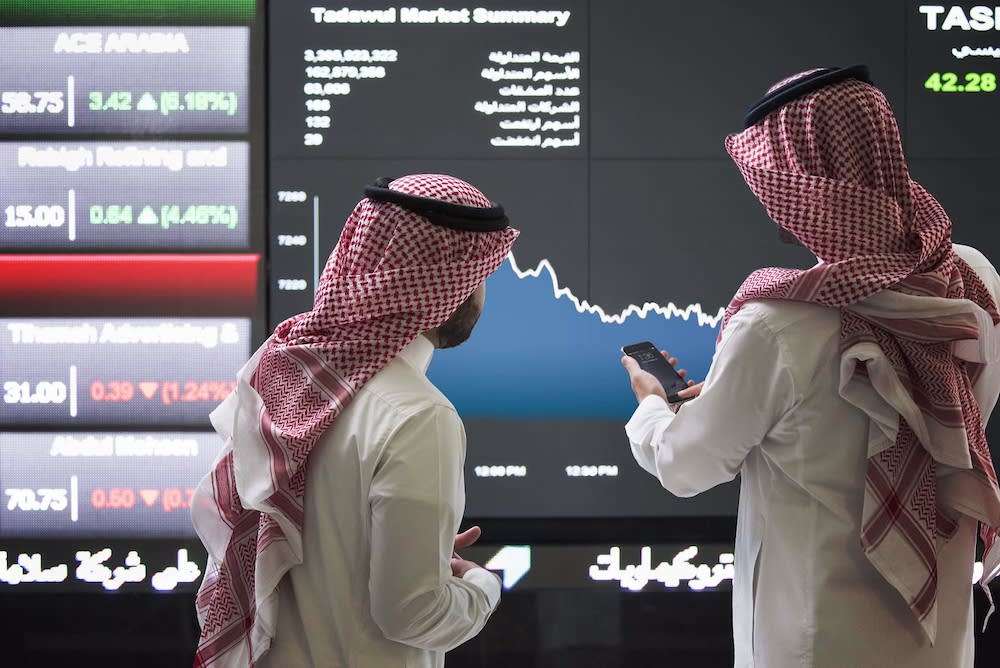
RIYADH: Saudi Arabia’s Tadawul All Share Index slipped on Sunday, losing 35.42 points, or 0.33 percent, to close at 10,696.89.

The total trading turnover of the benchmark index reached SR3.16 billion ($842 million), with 38 stocks advancing and 217 declining.

The Kingdom’s parallel market Nomu also dropped, falling 360.62 points, or 1.37 percent, to 25,943.03, as 30 stocks advanced while 65 retreated.

The MSCI Tadawul Index shed 2.59 points, or 0.19 percent, to close at 1,382.06.

Development Works Food Co. was the day’s top performer, rising 6.53 percent to SR124. Arab National Bank gained 3.02 percent to SR24.21, while Banque Saudi Fransi advanced 2.96 percent to SR16.70.

On the downside, SABIC Agri-Nutrients Co. fell 5.44 percent to SR114.80. 

Rabigh Refining and Petrochemical Co. (Petro Rabigh) declined 5.14 percent to SR7.01. The company announced a board recommendation to raise its capital from SR16.7 billion to SR21.9 billion through issuing and privately offering new ordinary shares to founding shareholders, alongside a subscription agreement.

In corporate updates, Saudi Networkers Services Co. reported a net profit of SR20.6 million for the first half of 2025, up 4.4 percent from a year earlier, supported by higher revenues and improved margins. Its shares closed at SR73, up 6.84 percent.

Advance International Co. for Communication and Information Technology posted a net loss of SR2.9 million for the same period, compared with a profit of SR5.15 million last year. The company cited higher operating costs and lower selling prices in its wholesale and supplies division. Its shares ended at SR2.30, down 8.33 percent.

Arabian International Healthcare Holding Co. narrowed its losses to SR24.2 million, down 23.6 percent year on year, aided by stronger gross profit and lower impairment charges. Its shares closed at SR33.30, down 15.87 percent.

Saudi Parts Center Co. swung to a net loss of SR6.2 million in the first half of the year, versus a profit of SR689,000 last year, due to a 17 percent sales drop and weaker revenue from its Engine and Generator Repair Center. Its shares ended at SR42, down 13.04 percent.

Rawasi Albina Investment Co. turned to a net profit of SR1.19 million from a loss of SR9.7 million a year earlier, driven by higher revenues from completed projects and contract expansions in construction, telecoms, and energy. Its stock fell 7.69 percent to SR3.98.


European gas prices soar almost 50% as Iran conflict halts Qatar LNG output

Updated 02 March 2026
Follow

European gas prices soar almost 50% as Iran conflict halts Qatar LNG output

  • Analysts warn prolonged disruption could push prices higher
  • Some shipments of oil, LNG through Strait of Hormuz suspended
  • Benchmark Asian LNG price up almost 39 percent

LONDON: ​Benchmark Dutch and British wholesale gas prices soared by almost 50 percent on Monday, after major liquefied natural gas exporter Qatar Energy said it had halted production due to attacks in the Middle East.

Qatar, soon to cement its role as the world’s second largest LNG exporter after the US, plays a major role in balancing both Asian and European markets’ demand of LNG.

Most tanker owners, oil majors and ‌trading houses ‌have suspended crude oil, fuel and liquefied natural ​gas shipments ‌via ⁠the ​Strait of ⁠Hormuz, trade sources said, after Tehran warned ships against moving through the waterway.

Europe has increased imports of LNG over the past few years as it seeks to phase out Russian gas following Russia’s invasion of Ukraine.

Around 20 percent of the world’s LNG transits through the Strait of Hormuz and a prolonged suspension or full closure would increase global competition for other ⁠sources of the gas, driving up prices internationally.

“Disruptions to ‌LNG flows would reignite competition between ‌Asia and Europe for available cargoes,” said ​Massimo Di Odoardo, vice president, gas ‌and LNG research at Wood Mackenzie.

The Dutch front-month contract at the ‌TTF hub, seen as a benchmark price for Europe, was up €14.56 at €46.52 per megawatt hour, or around $15.92/mmBtu, by 12:55 p.m. GMT, ICE data showed.

Prices were already some 25 percent higher earlier in the day but extended gains ‌after QatarEnergy’s production halt.

Benchmark Asian LNG prices jumped almost 39 percent on Monday morning with the S&P Global ⁠Energy Japan-Korea-Marker, widely used ⁠as an Asian LNG benchmark, at $15.068 per million British thermal units, Platts data showed.

“If LNG/gas markets start to price in an extended period of losses to Qatari LNG supply, TTF could potentially spike to 80-100 euros/MWh ($28-35/mmBtu),” Warren Patterson, head of commodities strategy at ING, said. The British April contract was up 40.83 pence at 119.40 pence per therm, ICE data showed.

Europe is also relying on LNG imports to help fill its gas storage sites which have been depleted over the winter and are currently around 30 percent full, the latest data from Gas Infrastructure ​Europe showed. In the European carbon ​market, the benchmark contract was down €1.10 at €69.17 a tonne