



ISLAMABAD/KARACHI: Pakistan’s southern Sindh province is on high alert for a possible “super flood” as authorities prepare mass evacuations, after relentless monsoon deluges in neighboring Punjab killed at least 33 people and displaced 750,000 this week.
Punjab, home to nearly 128 million people — almost half of Pakistan’s total population of 240 million — has been battered this week by floods triggered by heavy monsoon showers and excess water released by India. The deluges are now surging downstream toward Sindh, the country’s second-most populous province with about 56 million residents, raising fears of large-scale devastation.
Floodwaters in the Chenab, Ravi and Sutlej rivers are expected to reach Sindh in the coming days, with officials warning that flows at Guddu and Sukkur barrages could swell to as high as 900,000 cusecs. A super flood refers to an exceptionally large and destructive event, rare in occurrence, that can cause widespread devastation across vast areas.
Nationwide, at least 854 people have been killed and more than 1,100 injured since the monsoon season began in late June.
“The government’s top priority is the safety of human lives, livestock and barrages,” Sindh Information Minister Sharjeel Memon said in a statement on Sunday. “The district administration, PDMA [provincial disaster management authority], Pakistan Navy, and Pakistan Army are actively engaged in evacuation and relief operations.”
Sindh Chief Minister Murad Ali Shah has directed authorities to intensify flood-fighting efforts at vulnerable locations, the minister said.
“Machinery, stones, and staff have been deployed at KK embankments, Shaheen embankment, Qadirpur, Rawanti, and other vulnerable sites, with officers maintaining round-the-clock surveillance,” Memon added.
A survey of riverine, or kachha, areas has already been completed, and families have been prepared to move into government schools, public buildings and tent villages. Some 948 relief camps have been set up across the province, equipped with food, clean water and health care services.
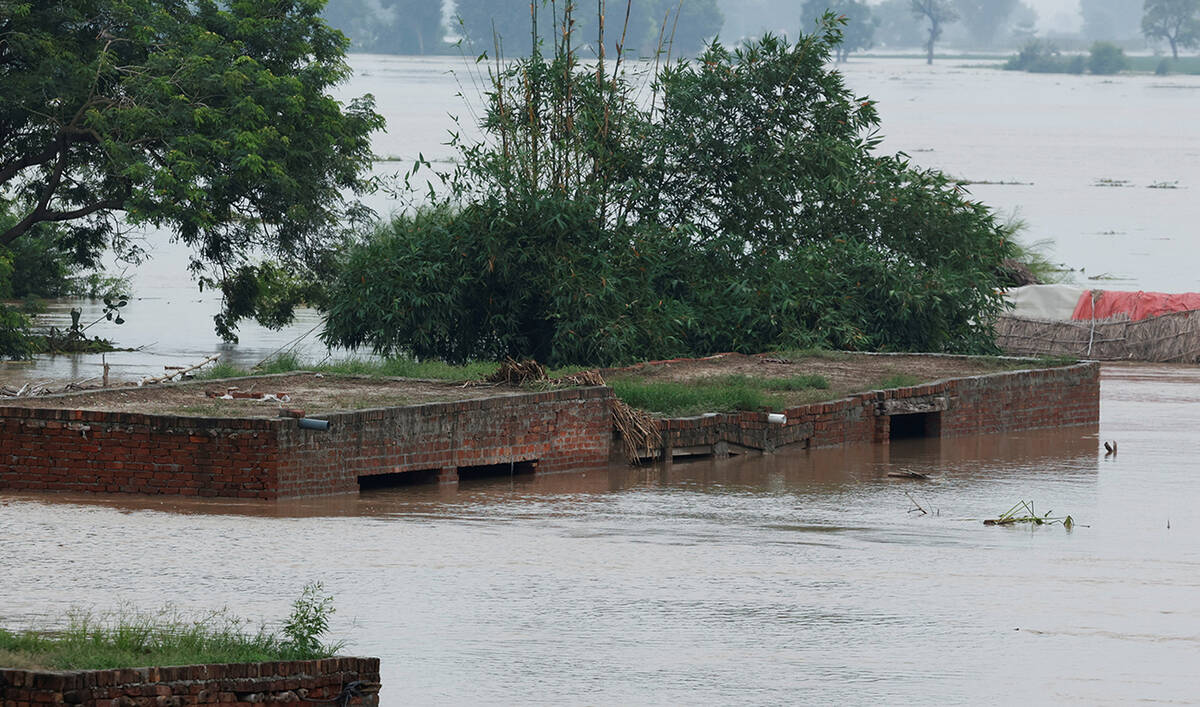
Houses are partially submerged following monsoon rains and rising water levels of the Sutlej River, in Chanda Singh Wala village near the Pakistan-India border in Kasur district of the Punjab province, Pakistan on August 29, 2025. (REUTERS)
“The public should keep information about nearby relief camps and evacuation routes with them,” CM Shah’s office quoted him as saying. “Farmers and locals should move their valuables and livestock to safer places in advance.”
Meanwhile, the Pakistan Meteorological Department (PMD) has warned that the ninth spell of monsoon rains will continue until Sept. 2. A monsoon low over Rajasthan in India and a strong westerly trough over northern Pakistan are expected to bring widespread heavy to very heavy rainfall in upper Punjab catchments.
“Forecasted rains have the potential to generate very high to extremely high flows in Rivers Sutlej, Ravi and Chenab… and produce urban flooding in Lahore, Gujranwala and Gujrat divisions,” the PMD said.
PUNJAB’S CRITICAL SITUATION
On Sunday morning, Punjab Provincial Disaster Management Authority chief Irfan Ali Kathia told reporters that a flow of around 900,000 cusecs was passing through the Chenab River in Punjab’s Jhang district, creating a “critical situation.”
Nearly 750,000 people have been evacuated from high-risk areas across the province, he said, as floods have submerged more than 2,200 villages and affected over two million residents in a week. Authorities in Sialkot have also suspended flight operations after floodwaters swamped the airport.

Residents look on after water levels receded along the right bank of the Ravi River, following recent floods caused by monsoon rains, in Lahore, Pakistan on August 31, 2025. (REUTERS)
“Flood water is being drained from the airport,” Muhammad Umair Khan, a spokesman for Sialkot Airport, said. “Air operations will remain temporarily suspended until 10 p.m. tomorrow.”
The NDMA said it had begun dispatching emergency rations to Punjab’s flood-hit districts in coordination with provincial authorities and the private sector. Convoys carrying 46-kilogram food packages, each containing 22 essential items, were sent to Wazirabad and Hafizabad, with deliveries to Narowal, Sialkot, Chiniot and Jhang also underway.
Prime Minister Shehbaz Sharif has directed the NDMA to scale up assistance and relief coordination with provinces.
Since June 26, Punjab has reported 209 deaths, second only to northwestern Khyber Pakhtunkhwa, where 484 people have died. Sindh has reported 58 fatalities, Gilgit-Baltistan 41, Azad Kashmir 29, Balochistan 25 and Islamabad eight, according to NDMA figures.


