

Palestinian president’s office urges US to reinstate his visa ahead of key UN meetings

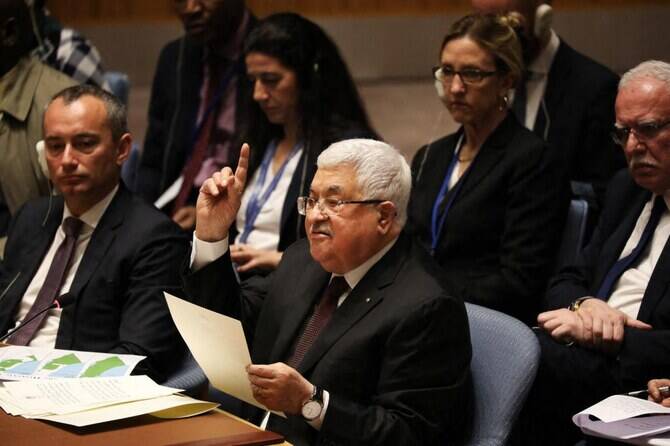
Palestinian President Mahmoud Abbas’ office on Saturday urged the US government to reverse its unusual decision to revoke his visa, weeks before he was meant to appear at the UN’s main annual meeting and an international conference about creating a Palestinian state. (AFP/File)
Short Url
Updated 30 August 2025
Follow

Palestinian president’s office urges US to reinstate his visa ahead of key UN meetings

  • “This decision will only increase tension and escalation," Palestinian presidential spokesperson Nabil Abu Rudeineh said
  • “We have been in contact since yesterday with Arab and foreign countries, especially those directly concerned with this issue”

RAMALLAH: Palestinian President Mahmoud Abbas’ office on Saturday urged the U.S. government to reverse its unusual decision to revoke his visa, weeks before he was meant to appear at the U.N.’s main annual meeting and an international conference about creating a Palestinian state.

U.S. Secretary of State Marco Rubio rescinded the visas of Abbas and 80 other officials ahead of next month’s annual high-level meeting of the U.N. General Assembly, the State Department disclosed Friday. Abbas has addressed the General Assembly for many years, and generally leads the Palestinian delegation.

“We call upon the American administration to reverse its decision. This decision will only increase tension and escalation," Palestinian presidential spokesperson Nabil Abu Rudeineh told The Associated Press in Ramallah on Saturday.

“We have been in contact since yesterday with Arab and foreign countries, especially those directly concerned with this issue. This effort will continue around the clock," he said.

He urged other countries to put pressure on the Trump administration to reverse the decision, notably the countries that have organized a high-level conference on Sept. 22 about reviving efforts for a two-state solution for the Middle East. It is co-hosted by France and Saudi Arabia.

French Foreign Minister Jean-Noël Barrot protested restrictions on access to the U.N. General Assembly, and said he would discuss the issue with EU counterparts.

“The United Nations headquarters is a place of neutrality, a sanctuary dedicated to peace, where conflicts are resolved," he said Saturday. “The UN General Assembly … cannot suffer any restrictions on access.”

Abu Rudeineh also urged an end to Israel’s offensive in Gaza and "escalation in the West Bank, because none of this will lead to any solution.”

The move came as the Israeli military declared Gaza’s largest city a combat zone. Israel says Gaza City remains a stronghold of Hamas.

The Trump administration has taken several steps to target Palestinians with visa restrictions.

“It is in our national security interests to hold the PLO (Palestinian Liberation Organization) and PA (Palestinian Authority) accountable for not complying with their commitments, and for undermining the prospects for peace,” the State Department said in a statement.

The Palestinian Authority denounced the visa withdrawals as a violation of U.S. commitments as the host country of the United Nations. U.N. spokesman Stephane Dujarric said the world body would be seeking clarification from the State Department.


Lebanon warns Israeli violations threaten stability as UN peacekeepers enter final phase of mission

Updated 11 November 2025
Follow

Lebanon warns Israeli violations threaten stability as UN peacekeepers enter final phase of mission

  • UN envoy accuses Israel of jeopardizing ‘hard-won progress’ by undermining Lebanese sovereignty and territorial integrity through airstrikes and border violations
  • He says Lebanon’s army commander has presented to ministers his second progress report on a plan to extend state authority country-wide and limit weapons to state control

NEW YORK CITY: Lebanon has warned that Israeli airstrikes and border violations risk undermining progress toward achieving stability in southern Lebanon, as the UN peacekeeping mission in the country begins preparations for its withdrawal.

Speaking before the UN General Assembly’s Fourth Committee, Lebanon’s permanent representative to the organization, Ahmad Arafa, welcomed the recent renewal of the UN Interim Force in Lebanon’s mandate under Security Council Resolution 2790. This authorized the extension of the force’s operations until Dec. 31, 2026, followed by an “orderly, safe and coordinated” drawdown within a year.

“The Lebanese Armed Forces have been working tirelessly to ensure full implementation of Resolution 1701,” Arafa said, referring to the 2006 resolution that ended the war that year between Israel and Hezbollah.

It calls for the disarmament of all militias in Lebanon, including Hezbollah. The US has consistently pressured Lebanese authorities to disarm the group, designating it a terrorist organization.

The November 2024 ceasefire deal with Israel also requires Lebanon to disarm Hezbollah and establish a state monopoly on arms. The agreement states that only state security forces should bear arms, which is interpreted by Israel and others as requiring the full disarmament of Hezbollah. The group insists it applies only to southern Lebanon.

Arafa said the commander of the Lebanese army has presented to the Council of Ministers his second progress report on a plan to extend state authority throughout the country and confine possession of weapons to legitimate state institutions.

However, he accused Israel of jeopardizing the “hard-won progress” that has been made, through what he described as ongoing violations of Lebanon’s sovereignty and territorial integrity, including airstrikes, the continued occupation of Lebanese territory, and the creation of “so-called buffer zones.”

UNIFIL spokesperson Dany Ghafri said last week that Israel had carried out more than 7,000 airspace violations since the cessation of hostilities in November last year, Arafa noted. UNIFIL has warned that the airstrikes breach Resolution 1701, “threaten the safety of civilians, and undermine progress toward a political and diplomatic solution,” he added

Lebanon also condemned Israeli attacks on UNIFIL personnel and positions, describing them as “a blatant violation of international law.”

Arafa expressed gratitude to the leadership of the UN force, and the countries that contribute troops, for their “dedication and sacrifice” since the mission was established in 1978. He called for the avoidance of any “security vacuum” during the upcoming transitional period, while maintaining stability and respect for Lebanon’s sovereignty.