

Palestinian president’s office urges US to reinstate his visa ahead of key UN meetings

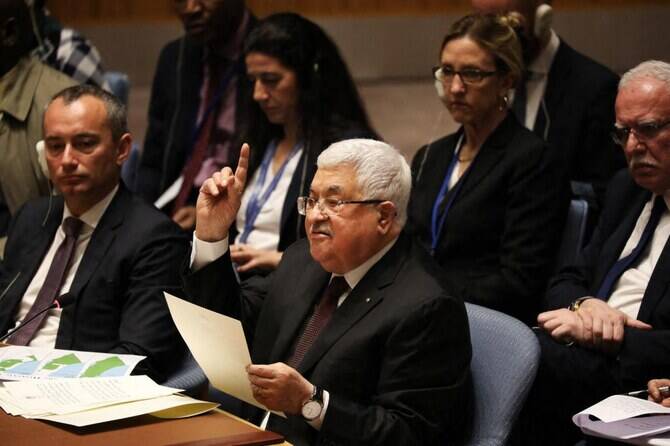
Palestinian President Mahmoud Abbas’ office on Saturday urged the US government to reverse its unusual decision to revoke his visa, weeks before he was meant to appear at the UN’s main annual meeting and an international conference about creating a Palestinian state. (AFP/File)
Short Url
Updated 30 August 2025
Follow

Palestinian president’s office urges US to reinstate his visa ahead of key UN meetings

  • “This decision will only increase tension and escalation," Palestinian presidential spokesperson Nabil Abu Rudeineh said
  • “We have been in contact since yesterday with Arab and foreign countries, especially those directly concerned with this issue”

RAMALLAH: Palestinian President Mahmoud Abbas’ office on Saturday urged the U.S. government to reverse its unusual decision to revoke his visa, weeks before he was meant to appear at the U.N.’s main annual meeting and an international conference about creating a Palestinian state.

U.S. Secretary of State Marco Rubio rescinded the visas of Abbas and 80 other officials ahead of next month’s annual high-level meeting of the U.N. General Assembly, the State Department disclosed Friday. Abbas has addressed the General Assembly for many years, and generally leads the Palestinian delegation.

“We call upon the American administration to reverse its decision. This decision will only increase tension and escalation," Palestinian presidential spokesperson Nabil Abu Rudeineh told The Associated Press in Ramallah on Saturday.

“We have been in contact since yesterday with Arab and foreign countries, especially those directly concerned with this issue. This effort will continue around the clock," he said.

He urged other countries to put pressure on the Trump administration to reverse the decision, notably the countries that have organized a high-level conference on Sept. 22 about reviving efforts for a two-state solution for the Middle East. It is co-hosted by France and Saudi Arabia.

French Foreign Minister Jean-Noël Barrot protested restrictions on access to the U.N. General Assembly, and said he would discuss the issue with EU counterparts.

“The United Nations headquarters is a place of neutrality, a sanctuary dedicated to peace, where conflicts are resolved," he said Saturday. “The UN General Assembly … cannot suffer any restrictions on access.”

Abu Rudeineh also urged an end to Israel’s offensive in Gaza and "escalation in the West Bank, because none of this will lead to any solution.”

The move came as the Israeli military declared Gaza’s largest city a combat zone. Israel says Gaza City remains a stronghold of Hamas.

The Trump administration has taken several steps to target Palestinians with visa restrictions.

“It is in our national security interests to hold the PLO (Palestinian Liberation Organization) and PA (Palestinian Authority) accountable for not complying with their commitments, and for undermining the prospects for peace,” the State Department said in a statement.

The Palestinian Authority denounced the visa withdrawals as a violation of U.S. commitments as the host country of the United Nations. U.N. spokesman Stephane Dujarric said the world body would be seeking clarification from the State Department.


Israel aims to bring ‘permanent demographic change’ to West Bank, Gaza: UN

Updated 42 min 5 sec ago
Follow

Israel aims to bring ‘permanent demographic change’ to West Bank, Gaza: UN

  • UN rights chief Volker Turk says Israeli military operation in West Bank’s north has displaced 32,000 Palestinians

GENEVA: Israel’s actions in the occupied West Bank and the Gaza Strip seem aimed at creating “permanent demographic change,” UN rights chief Volker Turk said on Thursday.
“Taken together, Israel’s actions appear aimed at making a permanent demographic change in Gaza and the West Bank, raising concerns about ethnic cleansing,” Turk said in a speech before the UN’s Human Rights Council in Geneva.
Turk pointed in particular to an ongoing, year-long Israeli military operation in the West Bank’s north that has caused the displacement of 32,000 Palestinians.
Elsewhere in the West Bank, entire Bedouin herder communities have been displaced by increasing harassment and violence from Israeli settlers, including near Mikhmas to the east of Ramallah, and Ras Ein Al-Auja, in the Jordan Valley, since the start of the year.
In addition to roughly three million Palestinians, more than 500,000 Israelis live in settlements and outposts in the West Bank, which are considered illegal under international law.
Israel has approved a series of initiatives this month backed by far-right ministers, including launching a process to register land in the West Bank as “state property” and allowing Israelis to purchase land there directly, in a move condemned by several countries as well as Hamas.
Israel’s current government has accelerated settlement expansion, approving a record 54 settlements in 2025, according to Israeli settlement watchdog NGO Peace Now.
Israel has occupied the West Bank since 1967.

‘Maximum land, minimum Arabs’ 

In the Gaza Strip, most of the territory’s 2.2 million inhabitants have been displaced at least once since the start of the war sparked by Hamas’s unprecedented attack against Israel on October 7, 2023.
“Intensified attacks, the methodical destruction of entire neighborhoods and the denial of humanitarian assistance appeared to aim at a permanent demographic shift in Gaza,” the UN human rights office said in a report last week.
Israeli far-right Finance Minister Bezalel Smotrich also vowed to encourage “emigration” from the Palestinian territories in February.
“We will finally, formally and in practical terms nullify the cursed Oslo Accords and embark on a path toward sovereignty, while encouraging emigration from both Gaza and Judea and Samaria,” he said, using the Biblical term for the West Bank.
“There is no other long-term solution,” added Smotrich, who himself lives in a settlement in the West Bank.
“They want maximum land and minimum Arabs,” Fathi Nimer, a researcher with Palestinian think tank Al-Shabaka, told AFP, referring to a commonly used phrase used to describe Israeli settlement tactics.