

New $250 visa fee risks deepening US travel slump

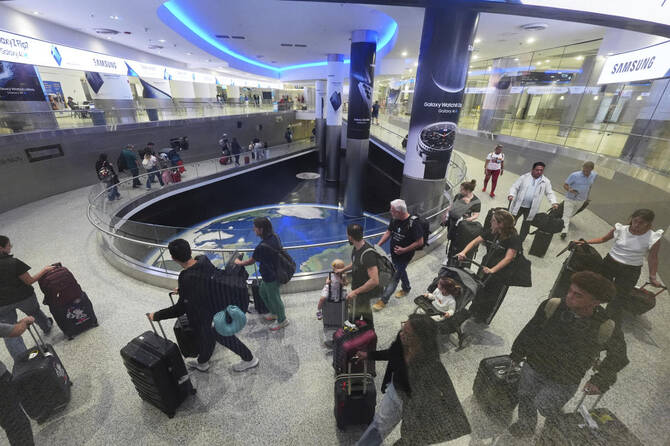
International travelers are seen through a window as they arrive at Miami International Airport at the start of the Labor Day weekend, Friday, Aug. 29, 2025, in Miami. (AP Photo/Rebecca Blackwell)
Short Url
Updated 30 August 2025
Follow

New $250 visa fee risks deepening US travel slump

  • Fee impacts travelers from non-visa waiver countries like Mexico, India, China
  • Visa fee raises total cost to $442, among highest globally

NEW YORK: A new $250 “visa integrity fee” imposed on travelers to the United States risks piling more pressure on the struggling travel industry, as overseas arrivals continue to fall due to President Donald Trump’s crackdown on immigration and hostility to many foreign countries. Overseas travel to the US fell 3.1 percent year-on-year in July to 19.2 million visitors, according to US government data. It was the fifth month of decline this year, defying expectations that 2025 would see annual inbound visitors finally surpass the pre-pandemic level of 79.4 million. The new visa fee, set to go into effect on October 1, adds an additional hurdle for travelers from non-visa waiver countries like Mexico, Argentina, India, Brazil and China. The extra charge raises the total visa cost to $442, one of the highest visitor fees in the world, according to the US Travel Association, a membership organization.
“Any friction we add to the traveler experience is going to cut travel volumes by some amount,” said Gabe Rizzi, President of Altour, a global travel management company. “As the summer ends this will become a more pressing issue, and we’ll have to factor the fees into travel budgets and documentation.” International visitor spending in the US is projected to fall below $169 billion this year, down from $181 billion in 2024, according to the World Travel & Tourism Council. The visa fee reinforces a bleak perception of the US under Trump, whose immigration policies, cuts to foreign aid and sweeping tariffs have eroded America’s appeal as a destination — even with major events like the 2026 FIFA World Cup and Los Angeles 2028 Olympics on the horizon. The Trump administration on Wednesday proposed government regulation that aims to tighten the duration of visas for students, cultural exchange visitors and members of the media. In early August, the administration said the US could require bonds of up to $15,000 for some tourist and business visas under a pilot program effective August 20 that will last for approximately a year, in an effort to crack down on visitors overstaying their visas. Tourism Economics, an Oxford Economics consultancy, forecast in December 2024 that overseas travel to the US in 2025 would increase more than 10 percent year-over-year. Instead, it is on track to fall 3 percent, said Aran Ryan, director of industry studies at Tourism Economics.
“We see it as a sustained setback, and we anticipate much of it is in place throughout the administration,” Ryan said.

HARDEST HIT
The newest visa fee is likely to hit hardest in Central and South American countries that have been a rare bright spot for US travel this year.
As of May, travel from Mexico to the US was up nearly 14 percent in 2025, according to the National Travel and Tourism Office.
Arrivals from Argentina rose 20 percent and from Brazil 4.6 percent year-to-date. Overall, travel from Central America grew 3 percent and from South America 0.7 percent, compared with a decline of 2.3 percent from Western Europe.
In China, arrivals have remained muted since the pandemic, with July numbers still 53 percent below 2019 levels. The visa fee also threatens travel from India, where visits are down 2.4 percent so far this year, driven by a near 18 percent drop in students.
For some, the rise in fees will be absorbed as just another cost in an already expensive trip to the US
“The US has always been selective about its visitors. If your financial standing isn’t up to par, getting a visa is tough anyway,” said Su Shu, founder of Chinese firm Moment Travel in Chengdu.
As foreign visitors face higher entry fees, US travelers worry about stricter requirements being imposed abroad, said James Kitchen, travel agent and owner of Seas 2 Day & Travel.
“Travelers have expressed concern around reciprocal fees that may be imposed in the coming months,” Kitchen said.


How a Syrian refugee chef met Britain’s King Charles

Imad Alarnab, a chef and restaurant owner who fled Syria in 2015, works at one of his restaurants in central London. (AFP)
Updated 02 March 2026
Follow

How a Syrian refugee chef met Britain’s King Charles

  • Alarnab, 48, said he had asked the king to come to the popular eatery when he met him at Buckingham Palace

LONDON: Pots clanged and oil sizzled inside the London kitchen of Syrian chef Imad Alarnab, as the former refugee who fled his country’s civil war recalled hosting King Charles III.
When the chef left his war-torn homeland in 2015, he never imagined that one day he would watch as cameras flashed and wide-eyed crowds greeted the monarch arriving at his Soho restaurant last year.
Alarnab, 48, said he had asked the king to come to the popular eatery when he met him at Buckingham Palace before an event honoring humanitarian work in 2023.
“I told him ‘I would love for you to visit our restaurant one day’ and he said: ‘I would love to’... I was over the Moon to be honest.”
The chef has come a long way since he arrived in London after an arduous journey from Damascus with virtually no money in his pocket.
Fearing for his life, he had escaped Syria after his family was uprooted again and again by fighting.
His culinary empire — restaurants, cafes, and juice bars peppered across the Syrian capital — had been destroyed by bombing in just six days in 2013.
Alarnab spent three months crisscrossing Europe in the back of lorries, aboard trains, on foot and even on a bicycle before he reached the UK.
“When I left, I left with nothing,” he told AFP, as waiters whirled past carrying steaming plates of traditional Syrian fare.
Starving and exhausted, he spent the last of his money on a train ticket to Doncaster where his sister lived.
“Love letter from Syria”
To make a living, Alarnab initially picked up any odd jobs, such as washing and selling cars, saving enough to bring his wife and three daughters over after seven months.
His love of cooking never left him though. In France, while he was sleeping on the steps of a church, Alarnab had often cooked for hundreds of other refugees.
“I always dreamed of going back to cooking,” he said.
So it wasn’t long before he found himself back in the kitchen, cooking up a storm across London with his sold-out supper clubs, bustling pop-up cafes, and crowded lunchtime falafel bars.
Alarnab’s friends gave him the initial boost for his first pop-up in 2017, and profits from his new catering business then covered the costs of later events.
He now runs two restaurants in the city — one in Soho’s buzzing Kingly Court and another nestled in a corner of the vibrant Somerset House arts center.
“I was looking for a city to love when I found London,” Alarnab said, adding it had offered him “space to innovate” and add his own modern twist to classic Syrian dishes.
Far from home, Alarnab said his word-of-mouth success had grown into a “love letter from Syria to the world” that needs no translation.
“You don’t really need to speak Arabic or Syrian to know that this is the best falafel ever,” he said, pointing to a row of colorful plates.
“There is hope”
For Alarnab, spices frying, dough rising and cheese melting inside a kitchen offered an unlikely escape from the real world.
“All my problems, I leave them outside the kitchen and walk in fresh.”
When he fled Syria, Alarnab thought going back to Damascus was forever off the table.
Yet he returned for the first time in October, almost a year to the day after longtime leader Bashar Assad was toppled in a lightning rebel offensive — ending almost 14 years of brutal civil war.
He walked the familiar streets of his old home, where his late mother taught him to cook many years ago.
“To return to Damascus and for her not to be there, that was extremely difficult.”
Torn between the two cities, Alarnab said he longed to one day rebuild his home in Damascus.
“I wish I could go back and live there. But at the same time, I feel like London is now a part of me. I don’t know if I could ever go back and just be in Syria,” he said.
Although Syrians still bear the scars of war, Alarnab said he had seen “hope in people’s eyes which was missing when I left in 2015.”
“The road ahead is still very long, and yes this is only the beginning — but there is hope.”